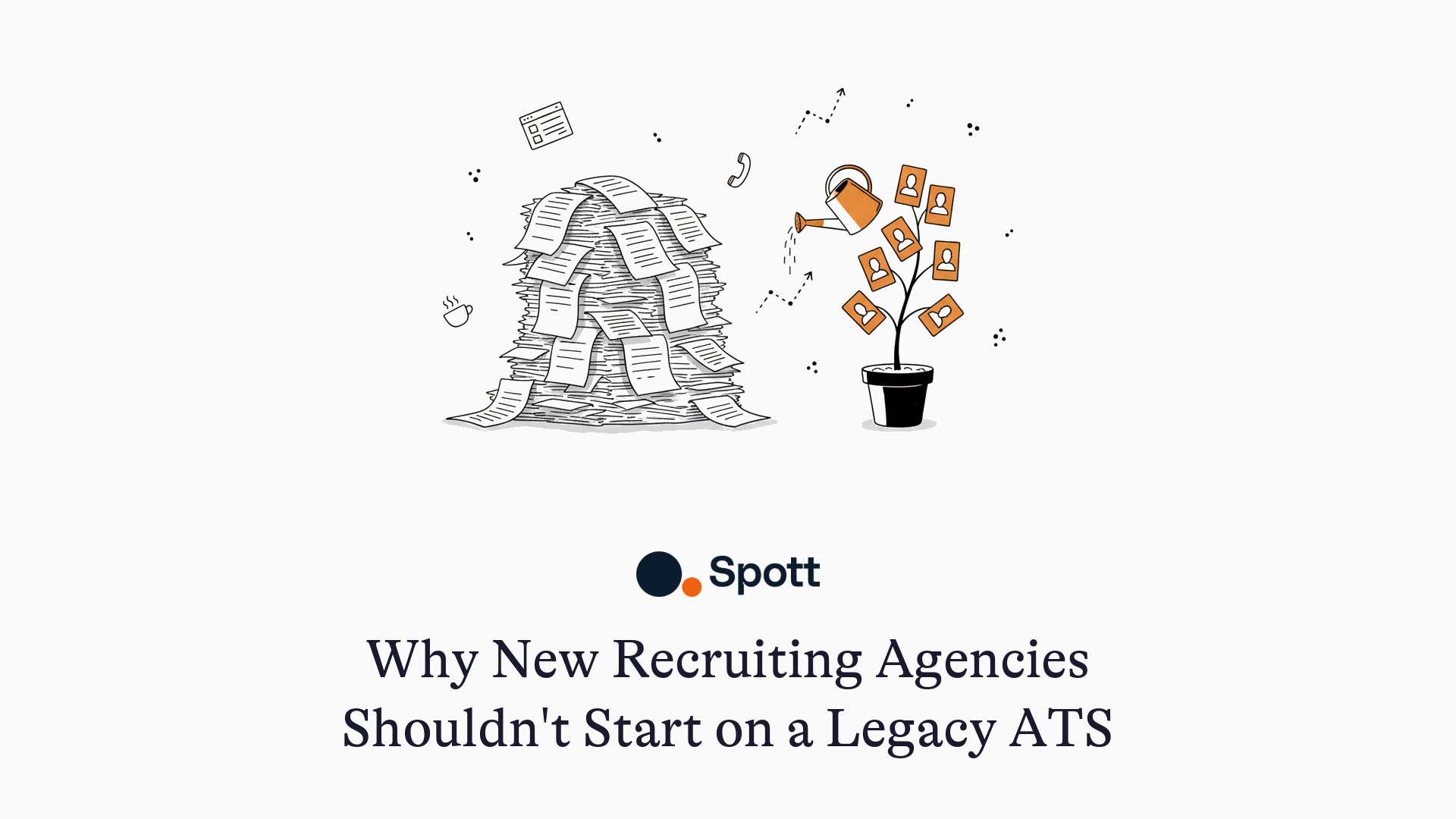
Why New Recruiting Agencies Shouldn't Start on a Legacy ATS
TL;DR
The best ATS for a new recruiting agency is not the one that ships with the biggest pre-loaded candidate database, and it is not the enterprise system your old firm ran. A pre-populated database is everyone's database: the same records, worked by every other agency on the same platform, with no context attached. What actually compounds is a proprietary database enriched by your own interactions: notes, call recordings, submissions, outcomes. Our case below: six months in, 5,000 candidates you have actually talked to beat a generic pool of 500,000 strangers on the searches that lead to placements. Start on a system built to capture context from day one, then build to 1,000 qualified candidates in your first 30 days using the playbook below.
I talk to a lot of founders starting a recruiting agency in the US, and one conversation stuck with me. A founder trialing platforms told me a competitor's trial won him over at first because it came pre-populated with a contact database. Instant running start. Our trial opened on an empty screen, and empty felt like a disadvantage.
That objection is real, and it deserves a straight answer instead of a shrug. So here it is: the answer, why the running start is weaker than it looks, and what a new agency should do in its first 30 days instead.
Why does an empty ATS feel like a disadvantage?
Because on day one, it is one. You have roles to fill and nobody to call. A platform that hands you millions of searchable profiles on signup solves today's problem before lunch.
Credit where due: this is a genuine strength of sourcing-led platforms. Loxo, for example, markets an 800-million-person talent graph on its homepage, built into the platform. If your model is high-volume cold sourcing, that built-in pool is real value, which is exactly why it shows up in trials as a selling point. We say the same in our breakdown of the top Loxo alternatives for 2026: the sourcing database is where Loxo legitimately wins.
But "useful on day one" and "an advantage" are different things. An advantage is something your competitors do not have.
What is actually inside a pre-populated candidate database?
Three things worth being clear-eyed about:
- It is everyone's database. Every agency on that platform gets the same records. The candidate you found in thirty seconds was found in thirty seconds by every competitor running a similar search. You are not sourcing; you are queueing.
- It is data, not context. A scraped profile tells you where someone works. It does not tell you what they said on a call, what salary they walked away from, or why they turned down a counteroffer. None of it is knowledge you own.
- Freshness varies. Aggregated public-web profiles can lag reality. People change jobs, and third-party reviews of these databases consistently note that usable, current records are a fraction of the headline number. Verify against the roles you actually work before you weight this in a buying decision.
There is no competitive advantage in data everyone has. Your differentiation as a new agency will never be "we can see the same 800 million profiles as everyone else."
What compounds instead: a database only you have
The asset that actually builds a recruiting agency is a proprietary database enriched with your own interactions. Every screening call, every submission, every rejection reason, every "call me again in Q3" is context that exists nowhere else.
Run the math forward six months. Two agencies, same market:
| Agency A: generic pool | Agency B: proprietary database | |
|---|---|---|
| Records | 500,000 scraped profiles | 5,000 candidates actually spoken to |
| Context per record | Job title, employer, maybe an email | Calls, notes, salary expectations, outcomes |
| Who else has it | Every agency on the platform | Nobody |
| Search quality | Keyword filters over shared public data | Meaning-based search over real conversations |
| Value over time | Flat (refreshed for everyone equally) | Compounds with every interaction |
Agency B can answer questions Agency A structurally cannot: who mentioned an expiring non-compete, who was open to relocating for the right title, which candidate a client already saw and passed on. That is the difference between a list and an asset, and it is the entire argument for choosing an AI-native ATS that captures context automatically instead of a system that stores whatever you remember to type in.
The failure mode is just as real. Most agencies end up with years of records nobody can surface, which is the story of the ATS database graveyard: a database that never compounded because context was never captured.
Why shouldn't a new agency start on a legacy enterprise ATS?
The other trap for founders is over-buying. Legacy enterprise systems were built for 50-seat incumbents: long contracts, implementation projects, per-module pricing, admin workflows that assume an ops team. For a two-person startup, that is weight, not capability. If you're unsure what you even need at this stage, start with what a recruiting agency actually needs from an ATS vs a CRM.
A new agency needs three things from its first system:
- Speed. Live the week you sign up, not after an implementation project.
- Low admin. Two founders cannot afford a system that demands data entry to stay useful.
- Compounding. Every call and submission should make the database more valuable automatically.
And if you do start somewhere else and switch later, moving is not the ordeal it used to be: with AI-assisted migration it takes from a day to a few weeks, depending on database size and feedback speed. But the cheapest migration is the one you never do.
How do you build your database from 0 to 1,000 qualified candidates in 30 days?
Here is the playbook we see work for new US agencies. The goal is not raw volume; it is qualified candidates with context attached.
Week 1: Import the network you already own (target: 200 to 300)
- Export and import the contacts you legally own: your email history, past placements, personal spreadsheets, phone contacts.
- Do not import your old employer's database. Beyond the legal risk, it recreates the exact problem: records without your context.
- Let enrichment fill the gaps (current role, company, contact details) so every imported record starts complete.
Week 2: Capture while you sell (target: 400 to 500 total)
- Work your live roles on LinkedIn as you already do, and capture every relevant profile with a Chrome extension as you go. Sourcing and database-building become the same motion instead of two jobs.
- Every candidate you contact for a live role enters the database with a role, a status, and an outcome attached. That is context from interaction number one.
Week 3: Add net-new discovery (target: 700 to 800 total)
- Layer in a dedicated sourcing tool for candidates outside your network. Juicebox (PeopleGPT) searches 800M+ profiles in natural language; Pin searches 850M+ and automates outreach. Both plug into your ATS.
- This is where a generic pool belongs in your stack: as a discovery layer that feeds your proprietary database, not as the database itself.
- Run personalized outreach campaigns against the week's additions while they are fresh.
Week 4: Let every call build the asset (target: 1,000 total)
- Put an AI note-taker on every screening call from day one. Transcripts, salary expectations, motivations, and objections land on the record without you typing a word.
- Review what you can now do that a pre-loaded trial never could: search your database by meaning ("who was open to relocation and mentioned fintech?") and get answers from conversations you actually had.
- From here it is a flywheel. Every conversation makes the asset more valuable, and it is yours alone.
One honest caveat to close the loop: if your model is pure high-volume cold sourcing, a pre-populated database genuinely accelerates you, and a sourcing-led platform may fit. The argument here is about what wins long-term for a search or placement agency, where relationships and context are the product. For a wider view of the market, see our guide to the best recruitment CRM software in 2026.
The bottom line
An empty ATS on day one is a temporary problem. A pre-loaded database that every competitor is also working is a permanent one. Choose a system that turns every call and every submission into context you own, follow the 30-day playbook, and by month six you will have the one asset in recruiting nobody can copy.
That is what we built Spott to do. See what it costs, or book a demo and we will show you what your first 30 days look like.

Frequently Asked
A new recruiting agency should use an ATS that is live within days, needs minimal admin, and captures context automatically from calls, emails, and sourcing. Skip enterprise systems built for 50-seat firms (long contracts, implementation projects) and platforms whose main pitch is a pre-loaded database everyone else also has.
No. A pre-populated database is shared by every agency on the platform and carries no relationship context. It helps with day-one cold sourcing volume, but a proprietary database of candidates you have actually spoken to becomes more valuable within months and is the asset that differentiates your agency. Use sourcing tools like Juicebox or Pin as a discovery layer instead.
Aim for roughly 1,000 qualified candidates with context in your first 30 days: your existing network first, then capture from live-role sourcing, then net-new discovery. A smaller database of candidates you know beats a large pool of strangers on the searches that lead to placements.
Less than it used to be. AI-assisted migration takes from a day to a few weeks, depending on database size and feedback speed. The bigger cost of a wrong first choice is the context you never captured, which no migration can recover.

Outp(l)ace everyone.
You can’t win tomorrow’s placements
with yesterday’s tools.