Spott vs Invenias
In depth review
Discover the ideal ATS/CRM solution for your business as we
compare the top contenders for you in our head-to-head series
Invenias has been the default platform for executive search for close to two decades. Bullhorn bought it in 2018, and Bullhorn's own product page puts it at "18 years in market and 700+ global customers with 10,000 users". If your firm runs retained search out of Outlook, you have almost certainly worked in it or been pitched it.
The question in 2026 is not whether Invenias has AI. It does. In June, Bullhorn confirmed that stage one of its Invenias AI roadmap is live: natural language search, AI-powered candidate matching, document search and relationship intelligence. That dates most of the "legacy tool with no AI" commentary about Invenias, including an earlier version of this page.
The real question is what it takes to switch that AI on. Invenias AI is bring-your-own-model: you choose OpenAI or Azure, buy your own API model, sign a legal addendum, and ask Support to enable it. Richer reporting needs a Power BI connector that sits in the Executive package rather than the base plan, with Power BI licensed separately from Microsoft. Automation comes from Bullhorn Automation, a separate product.
None of it is hidden. Bullhorn documents all of it. But it adds up to a particular shape of buying decision, and that shape is the real difference between Invenias and a platform like Spott, where search, matching and automatic note-taking are part of the core product rather than things you assemble.
Last reviewed July 2026.
At-a-glance comparison
| Category | Spott | Invenias by Bullhorn |
| ATS/CRM core | Executive search, perm, contract and interim on one platform, fully in the browser | Exec search only; 18 years, 700+ firms, 10,000 users; Windows desktop, web + mobile |
| Search & matching | Semantic matching over notes, call transcripts, CVs and attachments; in the subscription, no model to buy | AI matching, natural language search since June 2026; firm-bought, self-maintained model |
| AI & talent intelligence | Search, matching and auto note-taking are the core, not add-ons; enrichment on credits | Bring-your-own-model: buy OpenAI/Azure, sign addendum; fixed prompts, three data sources |
| Data management & compliance | Duplicates blocked on email and phone; GDPR tooling, EU hosting, ISO 27001 | GDPR tooling: consent requests, legal-basis capture; Sovren CV parsing |
| Workflow & process optimisation | Saved views and custom attributes, filled and backfilled by AI the moment they're created | Assignment dashboards, candidate scoring, bulk update, off-limits; automation separate |
| Team collaboration | One shared record for the whole team: full comms history, owner-attributed notes | Feedback and likes, company relationships, forecasting/weighting in web app |
| Analytics & reporting | Reporting built into the platform; no BI licence to buy | Invenias Analytics included; Power BI connector Executive-package only, per-viewer Microsoft licence |
| Migration & adoption | Spott's in-house team migrates you in about a month; schema mirrored before import | Bullhorn Launch, dedicated account management, 250+ support advisors |
| Pricing | $199/user · All-in-one platform | Quote-based, plus Executive package, Microsoft licences, your own AI model |
Comparison compiled July 2026 from Bullhorn's product pages, release notes and knowledge base. Confirm current pricing and packaging with the vendor.
What Invenias AI gives you, and what it asks for
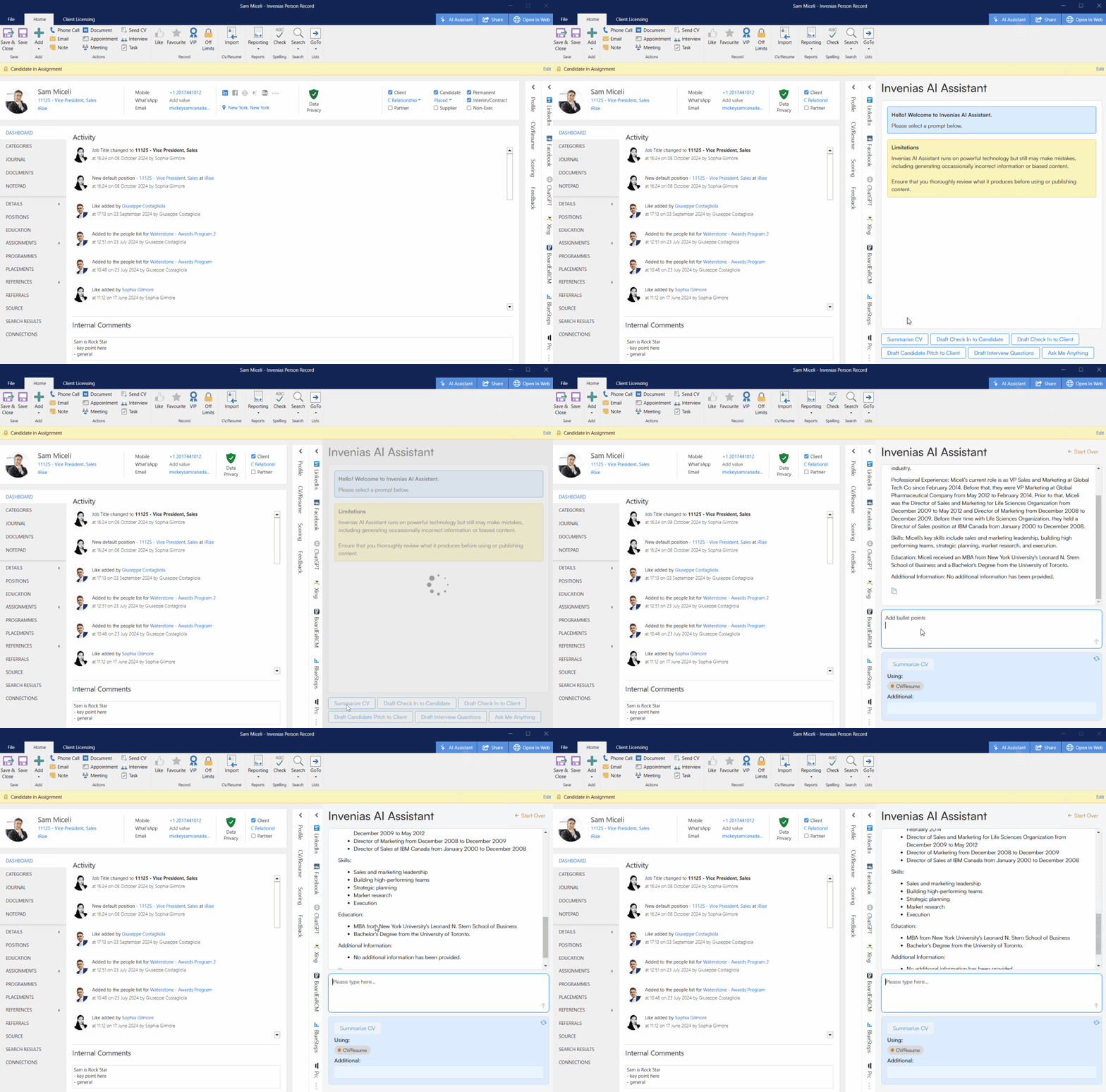
Invenias. Stage one is real and available today. Natural language search lets a consultant describe what they want instead of assembling Boolean strings. AI matching returns ranked, contextualised profiles. Document search finds keywords inside CVs, proposals and assessments. Relationship intelligence maps who in the firm already knows whom. Bullhorn puts AI note-taking in stage two, "coming next", and autonomous agents in stage three. Kevin Capel, VP of Product at Bullhorn, described the task ahead as needing to "completely rewrite the rules of executive search workflows", which is a fair reading of how much is still to come.
The conditions are in Bullhorn's knowledge base. AI Assistant "utilizes a 'Bring Your Own Model' implementation, so Bullhorn doesn't host, train or control the AI model." In practice: pick Azure or OpenAI, buy an API model, sign a legal addendum, then have Support switch it on. When a better model arrives, that is your job too: "You would need to purchase the newer model through your AI provider."
Three limits worth knowing before you budget. The assistant reads the CV pane, your user details and three assignment fields. Default prompts cannot be customised. Conversation history disappears when you leave a record.
Spott. Search and matching read the whole record: notes, call and intake transcripts, attachments and work history, not just the CV. The note taker is on by default once a calendar is connected, joins online meetings, and files a summary against the attendees it recognises. Calls through a connected telephony provider come back the same way. No model to procure, no addendum, no version to keep current.
Enrichment in Spott is a credit-based action you trigger, not a background process: you decide when a profile is worth the spend.
Bottom line: both platforms can now answer "who in my database fits this role". With Invenias you buy and maintain the engine that answers it. With Spott it is already running.
Search, scoring and the day-to-day workflow
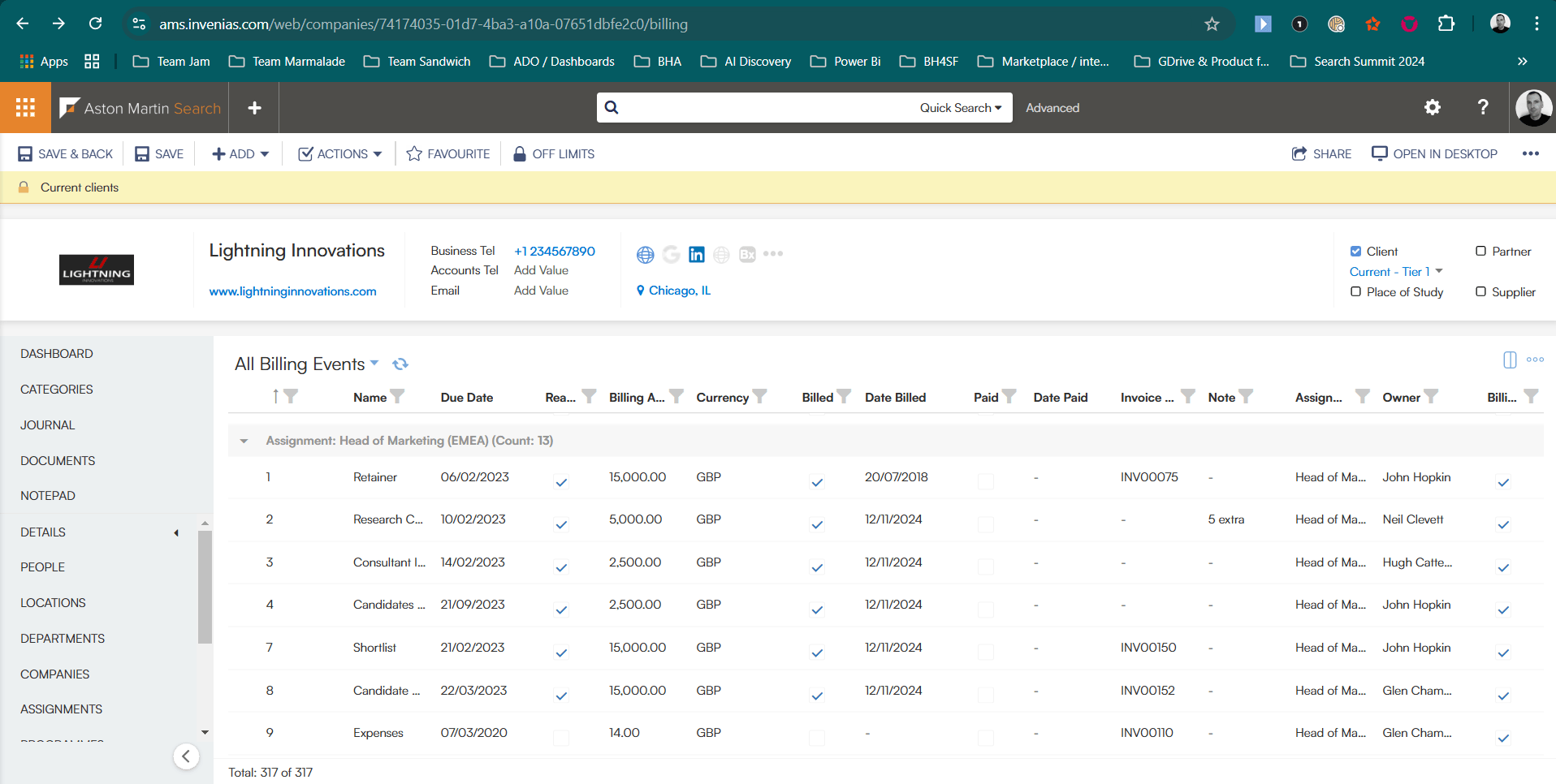
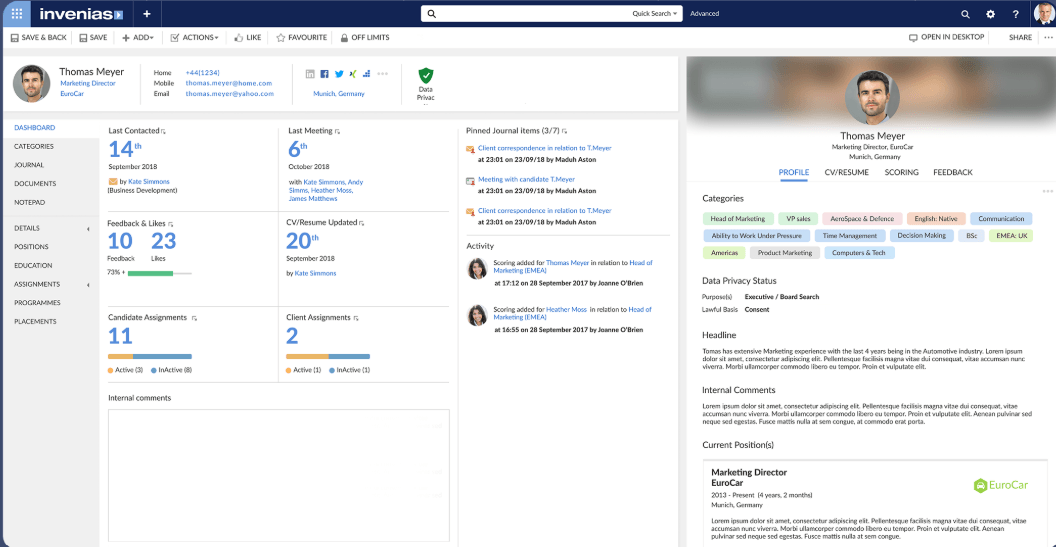
Invenias. Alongside the new AI search, the classic tooling is still there: Boolean operators, field filtering, assignment research views, candidate scoring, bulk update and automatic off-limits enforcement. The web application is no longer the on-the-go companion it started as, and now documents advanced search, assignment dashboards, company relationships, email and meeting templates, forecasting and CV parsing through Sovren.
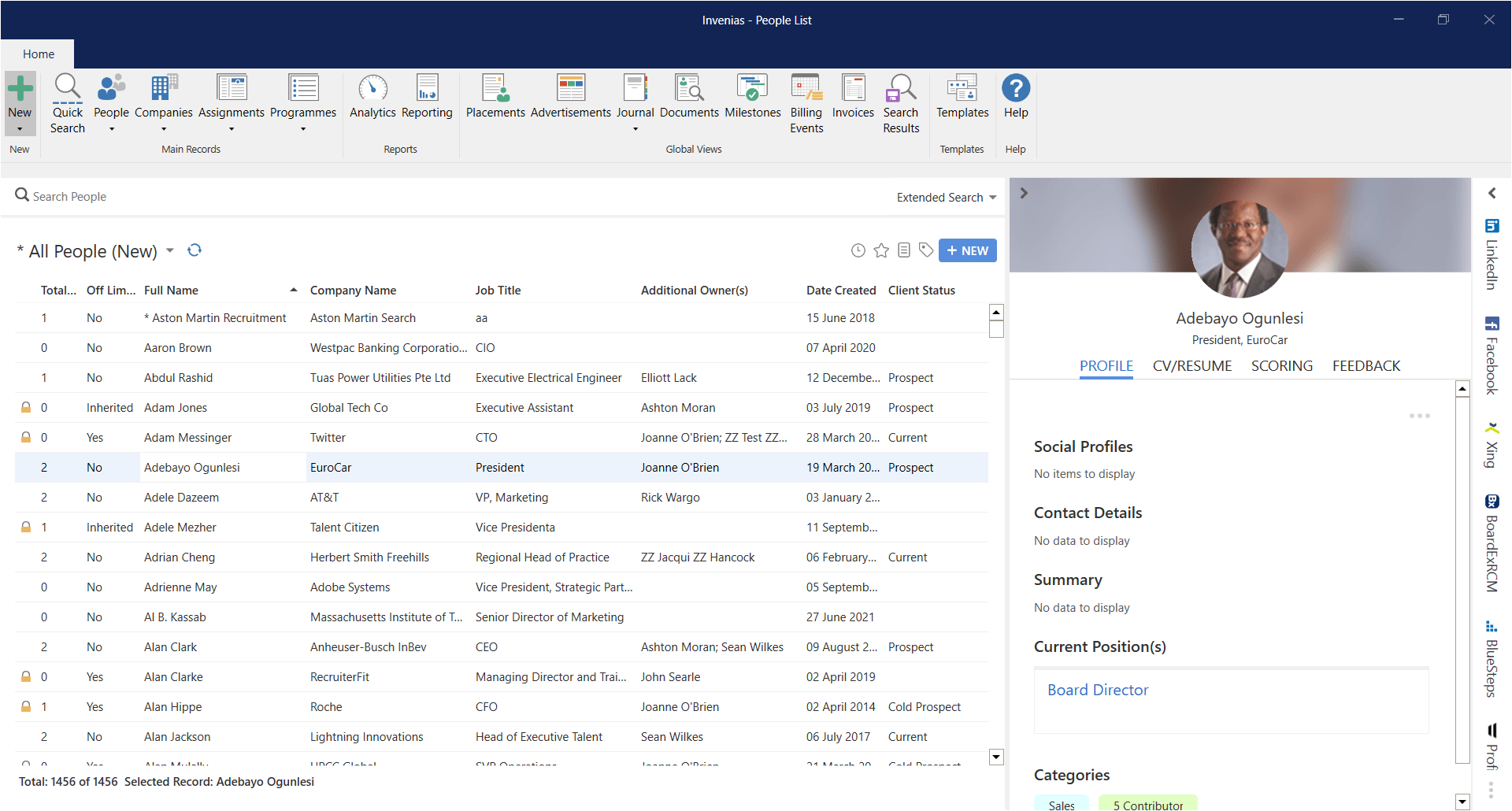
Parity with the desktop client is close but not complete, and Bullhorn's own roadmap lists what is missing. Offers and Placements went live on the web in 2026, Fee Allocations are "coming next", References and Referrals "coming later". The desktop client is Windows-only, with no Mac build, so a team split across operating systems ends up split across two versions of the product.
Spott. Views are configurable per user across candidates, jobs, contacts and companies: pick columns, add filters and sorts, save them, switch between named views. Custom attributes use a flexible model rather than a fixed tag list, and any attribute can fill itself from an AI prompt, backfilling every existing record of that type when you create it. No desktop install, no operating system requirement.
Bottom line: Invenias gives search specialists a structured toolkit with a Windows dependency at the centre of it. Spott gives every consultant the same platform in a browser.
Data quality, deduplication and compliance
Invenias. The GDPR tooling is the part Bullhorn markets hardest: mass consent requests, auto-generated emails carrying your purpose and legal basis, off-limits enforced through Bullhorn Automation. Firms holding senior candidate data across jurisdictions for years at a time will use it.
What the tooling does not do is maintain itself. Tagging is manual against a predefined category set, there is no automatic enrichment, and deduplication is a job someone has to own. On a database of senior candidates whose roles change constantly, that is recurring work rather than a one-off setup cost.
Spott. Spott enforces uniqueness on email and phone across the database, so the same person cannot exist twice, and normalises phone numbers during migration. When an updated CV arrives, Spott diffs it against what it holds rather than creating a parallel record. AI-filled attributes keep categorisation consistent without asking consultants to remember a tagging convention.
Our own compliance position: hosting in the EU, ISO 27001 certification, and a standing rule that customer data never reaches model training. Bullhorn holds SOC 2, which Spott does not; Spott's answer to the same questionnaire is ISO 27001, held platform-wide.
Bottom line: Invenias covers compliance and leaves the record-keeping to consultants. Spott automates more of the hygiene and certifies the whole platform under ISO 27001; SOC 2 is the one badge it doesn't carry.
What it costs to run properly
Invenias. Bullhorn does not publish Invenias pricing; licences are quoted and the product sits at the premium end of the market. A realistic budget adds three things to the licence.
The Power BI connector is the clearest example. Bullhorn's licensing documentation states it "is available exclusively within the Invenias Executive package and is not included in the base Invenias plan", so richer reporting means moving up a package. Power BI then comes from Microsoft: nothing is needed to build and view reports locally on Power BI Desktop, but sharing a dashboard through the Power BI Service requires a Pro licence for every viewer. Bullhorn's product page footnote is blunt, you must be a paying customer of both, and it names no figure, directing firms to "consult Microsoft based on your organisation's specific setup and requirements". Any annual number quoted for this elsewhere is guesswork.
Then the AI model, bought from OpenAI or Azure and managed by you. Then automation, a separate Bullhorn product.
Spott. The question here is not which number is lower. It is how many numbers there are.
There are two, both on the pricing page. Core is $139. Pro is $199. Per user, per month, on an annual agreement. Nothing about the AI changes between them: search, matching and automatic note-taking are core behaviour on the entry tier, so there is no model to procure, no addendum to sign and no provider relationship to maintain. Pro is the tier for teams that also want automation, outbound sequences and enrichment. Enrichment consumes credits, which we would rather state plainly than bury.
Bottom line: Invenias quotes you a licence and the total arrives in pieces: package tier, Microsoft licences, an AI provider, an automation product. Spott publishes two numbers and the AI is inside them.
Switching from Invenias to Spott: what a migration looks like
Migrations off Invenias are usually less painful than firms expect, because the data is structured and Invenias holds it cleanly.
Reckon on four weeks, with Spott's own team doing the work rather than an implementation partner. Before any records move we mirror the source system's custom attribute schema exactly, so the categorisation your researchers built over years survives rather than flattening into a notes field. Phone numbers are normalised on the way in. Assignment history, candidate records and attachments carry across.
Four weeks is the working figure, not a floor. The variable is rarely the data. It is how quickly your team reviews the test import and signs off the field mapping.
Bottom line: budget four weeks and a named person to check the mapping. You will not need a consultancy.
Where Invenias is still a good choice
- You run retained search out of Outlook and it works. If email, calendar and candidate data already sit together in a way your consultants trust, changing that has a cost.
- Compliance is a procurement gate. Bullhorn holds SOC 2 with enterprise audit trails, and the GDPR tooling covers consent and legal basis for long retention horizons.
- You want a large vendor behind you. Dedicated account management, the Bullhorn Launch education programme, and 250+ support advisors globally.
- Your research process is Boolean-first. Assignment research, candidate scoring, off-limits enforcement and forecasting are built for search specialists, not generalist recruiters.
- You want the Bullhorn ecosystem. The Bullhorn marketplace and a route into the wider product set, if you expect to grow into it.
Where Spott wins
- The AI comes with the platform. No model to procure, no addendum, no version upgrades, no fixed prompt set. Search and matching work on day one.
- Matching reads everything, not a CV field. Notes, transcripts, attachments and work history feed the same result, so context from a call six months ago still counts.
- Notes write themselves. The note taker joins online meetings and files the summary against the right records. That is the stage-two capability Invenias has scheduled but not shipped.
- Reporting needs no package upgrade and no Microsoft licence. Analytics is in the platform.
- One platform past executive search. Retained, contingent and interim run side by side, so growing the business model does not mean a second system.
- Any device, no Windows dependency. No desktop client, so Mac consultants get the same product as everyone else.
Other Invenias alternatives worth comparing
If you are evaluating a move, the shortlist for executive search firms usually includes a few names beyond Spott. Ezekia and Clockwork are both built specifically for search firms and worth a look if you want a like-for-like specialist. Bullhorn's main ATS is the natural comparison if you are already inside the Bullhorn ecosystem and wondering whether to consolidate rather than leave. For a wider view, our guide to the best ATS for executive search firms works through the trade-offs by firm type.
Bottom line
Invenias has spent eighteen years on one market, and it still does that job: search-specific tooling, GDPR machinery built for long data-retention horizons, a large vendor's support organisation behind it, and a web application that now carries most of the daily workflow.
The honest 2026 assessment is that Invenias has closed the AI gap in capability and left it open in packaging. Stage one shipped in June. Stage two, the automatic note-taking that removes admin rather than assisting with it, is still ahead. And everything that makes the platform modern arrives separately: the model from OpenAI or Azure, the reporting connector from a higher package tier, Power BI from Microsoft, automation from another Bullhorn product. For a firm with the appetite to assemble that, it works. For a firm that wants to open a laptop and find the AI already running, it is a lot of procurement.
Spott takes the other approach: search, matching and note-taking are how the platform works rather than what you bolt onto it, and one system covers retained, contingent and interim work.
Want to see it on your own data? Book a demo and we'll run your live search requirements through Spott's matching on your own records, not a sandbox.
This review is written by Spott, an Invenias alternative. Last reviewed July 2026, based on Bullhorn's published product pages, release notes and knowledge base. Always confirm current pricing and features directly with the vendor.