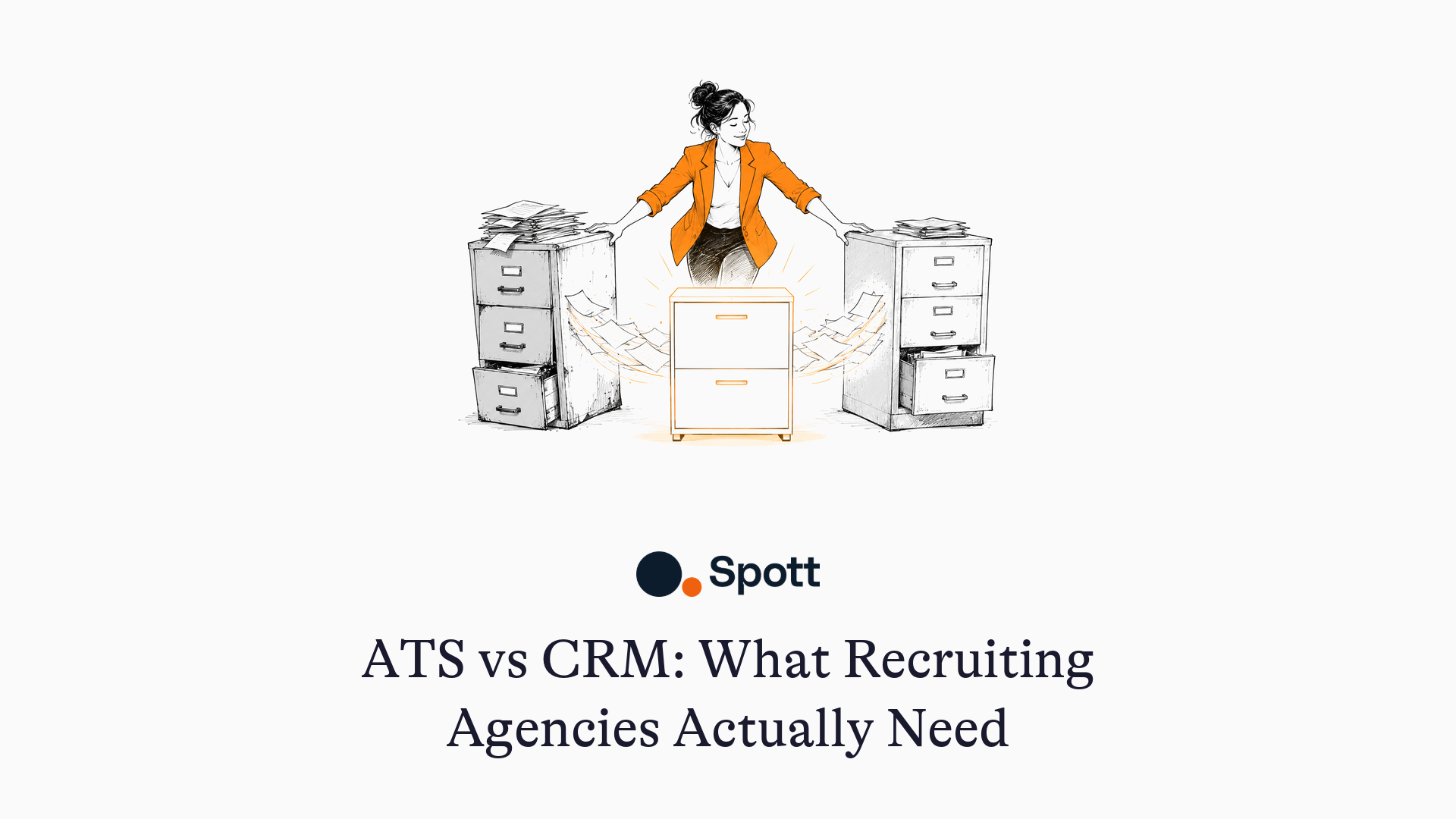
ATS vs CRM: What Recruiting Agencies Actually Need
TL;DR
An ATS tracks candidates through a hiring pipeline; a CRM builds relationships with candidates and clients before and after any specific role exists. Recruiting agencies need both capabilities, but running them as two separate tools creates data silos, sync failures, duplicate records, and recruiters who switch context dozens of times a day. The answer in 2026 isn't choosing between an ATS and a CRM; it's choosing a platform where both are views of one data model, and checking that the "integration" goes deeper than a shared login.
If you run a recruiting agency, you've probably asked this question: do we need an ATS, a CRM, or both?
The short answer: you need both. But you don't need two separate systems.
Here's why that distinction matters more than most vendors want to admit, and what to look for when you're evaluating platforms in 2026.
ATS vs CRM: What's the Actual Difference?
An ATS (Applicant Tracking System) and a CRM (Candidate/Client Relationship Management) solve different problems at different stages of the recruiting process.
An ATS is reactive. It manages candidates who have already applied or been submitted for a role. It tracks them through your hiring pipeline - application, screening, interview, offer, placement. It handles compliance reporting, job board distribution, and the operational side of filling roles.
A CRM is proactive. It manages relationships before a role exists. It tracks passive candidates you've sourced, nurtures talent pools you've built over time, manages client relationships and business development, and handles outreach campaigns. It's the system that builds your pipeline so you're not starting from zero when a new mandate comes in.
The ATS fills the role. The CRM builds the relationships that make filling roles faster next time.
For in-house HR teams at companies, an ATS alone often works fine. They post jobs, process applicants, and hire. The pipeline is inbound.
For recruiting agencies, that model breaks down immediately.
ATS vs CRM vs Integrated: At a Glance
| ATS | CRM | Integrated ATS/CRM | |
|---|---|---|---|
| Primary Focus | Active candidates in the hiring process | Passive candidates + client relationships | Both - candidates and clients in one system |
| Workflow | Reactive - processes applicants through stages | Proactive - builds pipeline before roles open | Both - builds pipeline and processes candidates in one flow |
| Data Captured | Applications, CVs, interview notes, compliance | Outreach, engagement signals, relationship history | Everything - CVs, calls, messages, notes, engagement, compliance |
| Key Metrics | Time-to-fill, stage conversion rates | Pipeline health, engagement rates, re-engagement | Full-funnel - from sourcing to placement |
| Client Management | Limited or none | Core capability | Built in - client and candidate in one view |
| AI Capability | Resume parsing, basic screening | Engagement scoring, outreach automation | Contextual matching across all data - calls, notes, messages, CVs |
| Best For | In-house HR teams processing applicants | Business development and sourcing teams | Recruiting agencies managing candidates and clients |
Why Agencies Can't Choose Just One
Recruiting agencies operate a two-sided business. You manage relationships with candidates AND clients. You build talent pipelines AND win new mandates. You source passive candidates AND process active applicants.
An ATS without CRM functionality means:
- No structured way to manage client relationships and BD pipeline
- No nurture sequences for passive candidates
- No engagement tracking across your talent pool
- Starting from scratch every time a new role comes in
A CRM without ATS functionality means:
- No compliance reporting or audit trail for placements
- No structured workflow for processing candidates through stages
- No job board distribution
- No formal hiring pipeline management
Most agencies end up needing both capabilities. The question is whether you run them as separate tools or as one integrated platform.
The Hidden Cost of Running Separate Systems
This is where the "just integrate them" argument falls apart.
When you run a standalone ATS and a separate CRM, you're creating two sources of truth for the same candidate and client data. In theory, API integrations keep them in sync. In practice, the problems compound fast.
Data Silos Kill Context
Candidate notes from a BD call live in the CRM. Interview feedback lives in the ATS. The message you sent on LinkedIn lives in neither. When a recruiter picks up a candidate record, they're seeing a fragment of the relationship, not the full picture.
This isn't a minor inconvenience. It's a structural problem that directly costs placements. When a client calls with a new mandate and your recruiter can't quickly surface candidates who mentioned interest in similar roles six months ago, because that conversation was logged in a different system, you lose time. And in recruiting, time is placements. (It's also sign 3 of the five signs your ATS is holding back your agency.)
Sync Failures Create Duplicate Records
API integrations between separate ATS and CRM tools rarely sync perfectly. Data mapping errors, sync delays, and inconsistent field structures create duplicate records, contradictory candidate information, and gaps that require manual cleanup. Agencies that consolidate from two systems into one routinely discover during migration just how much duplicate and contradictory data the split created.
Context-Switching Destroys Productivity
University of California research famously found that knowledge workers need over 20 minutes to fully refocus after an interruption. For a recruiter alternating between an ATS and a CRM dozens of times a day, the tab-switching tax adds up to hours of lost focus every week, time spent navigating between tools instead of talking to candidates and clients.
Compliance Gets Complicated
GDPR, data retention policies, and audit trail requirements don't get simpler when your candidate data lives in two systems. If your CRM doesn't have the same compliance controls as your ATS, running candidate data through it creates legal exposure, especially in regulated EU and UK markets.
What "Integrated" Actually Means (And What It Doesn't)
Not every platform that calls itself an "integrated ATS/CRM" earns the label.
There are three levels of integration in the market right now:
Bolted-Together
Two originally separate products connected via API or acquisition. The ATS and CRM modules share a login but not a data model. You'll notice this when candidate records look different depending on which module you access them from, when data changes in one side take time to appear in the other, or when reporting can't span both functions in a single view.
Unified but Legacy
A single platform built 10+ years ago that includes both ATS and CRM features in one database. Better than bolted-together, but often constrained by a data model designed before AI, before omnichannel communication, and before relationship intelligence was possible. The ATS and CRM share the same data, but the system doesn't do much with that data beyond storing it.
AI-Native Integrated
A platform built from the ground up where ATS and CRM aren't modules; they're different views of the same intelligent data model. Every interaction - calls, messages, notes, emails - feeds into one system that understands context across the entire relationship. (The architecture behind this is worth understanding; see what an AI-native ATS actually is.)
In this architecture, when a passive candidate from your CRM talent pool gets submitted for a role, the ATS side already has every prior conversation, every outreach, every piece of engagement history. Nothing is lost in the handoff because there is no handoff. It's one system.
What to Look for When Evaluating Platforms
If you're choosing between separate tools or evaluating integrated ATS/CRM platforms, here's what to test:
1. Is the data model truly unified, or is it two databases with a shared UI?
Ask the vendor: if a recruiter logs a call note in the CRM, does it immediately appear on the candidate's ATS record? If a candidate is submitted for a role via the ATS, does their full relationship history from the CRM travel with them? If the answer is "after sync" or "with some delay," the integration is surface-level.
2. Can you manage clients and candidates in one view?
Recruiting agencies need both sides. If the platform treats candidates and clients as fundamentally separate objects that live in different sections, you'll spend your day switching between modules. Look for a unified workspace where everything is accessible in context.
3. Does the AI work across both functions?
In many platforms, AI features are isolated. The ATS has AI matching; the CRM has AI-driven outreach. But the matching doesn't use CRM relationship data, and the outreach doesn't know about ATS placement history. Ask: does the AI draw from the full picture, or does it only see what's in its own module? (For what full-context matching looks like in practice, see how AI finds your best candidates.)
4. What's the total cost, including all the tools you're replacing?
Running separate systems means multiple licenses. But some "integrated" platforms nickel-and-dime with add-ons: matching as a paid extra, notetaking as a paid extra, analytics as a paid extra. Calculate the true all-in cost per user per month and compare it to what you're paying across multiple tools today. Our recruitment CRM roundup compares the field on exactly this.
5. What does migration actually look like?
Consolidating from separate ATS and CRM tools into one platform means migrating two datasets. Ask how long the migration takes, whether data is cleaned and validated during the process, and what the vendor's track record is with similar migrations. Some vendors quote 16+ weeks; others do it in 4. The week-by-week process is in our migration playbook.
6. Does the platform support all your business models?
Executive search, permanent placement, temporary staffing, and contract workforce all have different workflow requirements. If the platform only supports one model well, you'll still need supplementary tools, and you're back to the fragmentation problem.
Why This Matters More in 2026
AI adoption in recruiting is accelerating year over year, and most agencies plan to increase their technology investment rather than trim it. But AI only compounds when it has full context to work with. An AI matching engine that only sees CV data from the ATS misses the candidate who mentioned during a CRM-logged call that they're open to new opportunities. An AI outreach tool that doesn't know a candidate was already placed through the ATS six months ago sends tone-deaf messages.
The firms that will pull ahead aren't the ones with the most tools. They're the ones running a single platform where every interaction - sourcing, outreach, calls, submissions, placements, client conversations - feeds into one intelligent system that gets smarter with every data point.
That's not a feature. It's an architecture decision.
The Bottom Line
ATS and CRM solve different problems, and recruiting agencies need both capabilities. The question isn't which one to choose; it's whether to run them separately or as one integrated platform.
Separate systems create data silos, sync failures, productivity loss, and compliance risk. Integrated platforms eliminate those problems, but only if the integration goes deeper than a shared login.
The most capable platforms in 2026 are AI-native and integrated from the ground up. Not two tools bolted together. Not a legacy platform with CRM features added later. A single system where ATS and CRM are different views of the same intelligent data model.
See It in Action
If you want to see what an integrated, AI-native ATS/CRM looks like in practice - one system for candidates, clients, matching, outreach, notes, and reporting - book a Spott demo. Migration from your current tools included, most agencies live in roughly 4 weeks.