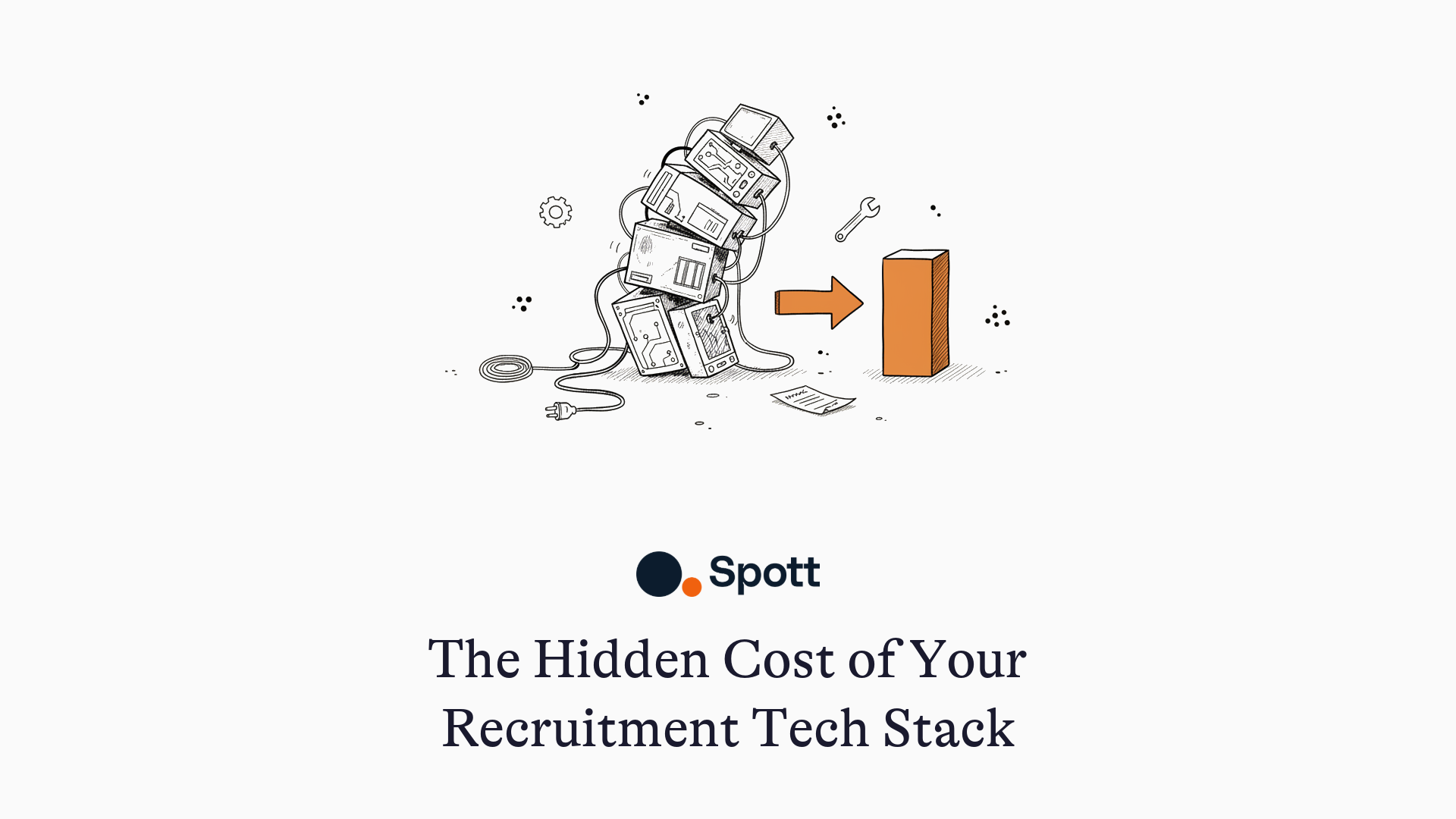
The Hidden Cost of Your Recruitment Tech Stack (And How to Cut It in Half)
TL;DR
The average US recruiting agency runs 4 to 7 tools: an ATS/CRM, a sourcing and outreach tool, a contact database, LinkedIn Recruiter, an AI note-taker, a texting tool, and a scheduler. Based on list and reported 2026 prices, that recruitment tech stack costs a 10-person firm roughly $100,000 to $140,000 per year, or $10,000 to $14,000 per recruiter. And the subscriptions are the visible half. The hidden half is training every new hire on six systems, sync failures and duplicate records, candidate data scattered across tools, and paying three vendors for the same feature. Most 5 to 50 seat agencies can cut the total roughly in half by auditing usage, keeping 2 or 3 anchor tools, and consolidating the rest onto a platform that covers ATS, CRM, outreach, note-taking, and enrichment natively.
How did agency tech stacks get this bloated?
I talk to US recruiting and search firm owners every week, and the same picture keeps showing up. Nobody designed their tech stack. It accumulated.
A search firm partner described it to me like this: "I felt like we needed to pick up every trinket and trash and put it into our tech stack." Each tool solved a real problem on the day it was bought. A sourcing tool because the ATS search was weak. An outreach tool because the sourcing tool could not sequence. A note-taker because nothing captured calls. A texting tool because candidates stopped answering email.
A 30-plus seat professional staffing firm recently listed their stack for us on a call: a legacy ATS, an automation add-on, an analytics add-on, a texting tool, a sourcing and outreach tool, an enrichment database, and payroll. Seven vendors, seven renewals, seven logins, one candidate.
That is the norm, not the outlier. So let's put numbers on it.
What does a recruitment tech stack actually cost per recruiter?
Here is the typical US agency stack with 2026 pricing. Bullhorn now publishes small-agency tiers on its site; most of the other big-ticket vendors do not publish prices, so those figures are buyer-reported (sources at the foot of this post).
| Tool category | Example vendor | Cost (2026, list or reported) | Overlaps with |
|---|---|---|---|
| ATS + CRM core | Bullhorn | $99 (Starter) to $165 (Core)/user/mo list; $150-250 buyer-reported once common add-ons land | In theory, everything below |
| Sourcing + outreach | SourceWhale | ~$2,500-3,500/user/yr buyer-reported | ATS outreach, enrichment, analytics |
| Contact data / enrichment | ZoomInfo | Contracts commonly reported at $15K-30K+/yr | Sourcing tool's enrichment, ATS enrichment |
| Sourcing database | LinkedIn Recruiter (Corporate) | ~$10,800-12,000/seat/yr reported after the 2026 increase | Sourcing tool, outreach (InMail vs sequences) |
| AI note-taker | Fireflies.ai (Business) | $19/user/mo list (annual billing) | ATS notes, CRM activity logging |
| Texting | TextUs | $99-199/mo platform fee plus $0.02/message, list | Outreach tool, ATS messaging |
| Scheduling | Calendly (Teams) | $16/user/mo list (annual billing) | ATS scheduling, note-taker booking links |
Run the math for a 10-recruiter firm: the ATS at Bullhorn's published Core rate of $165/user/mo is about $20,000 a year. A sourcing and outreach tool at a buyer-reported ~$3,000/user is $30,000. ZoomInfo contracts are commonly reported at $15,000 to $30,000. Three LinkedIn Recruiter seats run a reported $32,000 or so. Add the note-taker, texting, and scheduling and you are looking at another $8,000 to $13,000, depending on message volume.
Total: roughly $100,000 to $140,000 per year. That is $10,000 to $14,000 per recruiter, every year, before anyone makes a placement.
Two line items deserve their own scrutiny. LinkedIn Recruiter is usually the single biggest, and after the reported 15% price increase for 2026 renewals, more firms are questioning how many seats they actually need; we broke down what LinkedIn Recruiter costs and when a seat still earns its keep separately. And the ATS line rarely stays at the entry tier: on Bullhorn's own pricing page, AI, automation, and real-time analytics sit in the custom-priced Pro tier, with AI Search and Match as a further optional add-on, a pattern we dissected in the Bullhorn trap.
What are the hidden costs beyond the subscriptions?
The subscriptions are the half you can see on a spreadsheet. The hidden half shows up on the desk, and in my experience it costs more than the software does.
- Training tax on every hire. A new recruiter has to learn six or seven systems before they are productive. Every tool added to the stack extends ramp time for every future hire, forever.
- Sync failures and duplicates. The outreach tool writes back to the ATS, except when it doesn't. Now there are two versions of the same candidate with different phone numbers, and someone has to decide which one is real.
- Nobody has the full picture. The call recording lives in the note-taker, the reply in the outreach tool, the text thread in the texting app, the profile in the ATS. When a colleague picks up a candidate, they see a fraction of the relationship. Scattered context is one of the clearest signs your ATS is holding your agency back.
- Admin time reconciling systems. Someone, usually your best operator, spends hours a week exporting, deduping, and re-importing so reports roughly agree.
- Renewal and seat management overhead. Seven vendors means seven contracts, seven auto-renew dates, seven negotiations, and seats you keep paying for after people leave.
- Paying for overlap. Look at the right-hand column of the table again. Three tools include sourcing. Two include sequences. Two include enrichment. You are paying multiple vendors full price for features you can only use in one place.
Should you consolidate your recruitment tech stack?
Honest answer: consolidation has a trade-off. A specialist point tool is usually deeper at its one thing than a platform's built-in version. If your entire business is high-volume cold outreach, a dedicated sequencing tool may still earn its line item. Keep it.
But for most 5 to 50 seat agencies, the math points the other way. The integration tax, meaning the sync failures, the scattered data, the training burden, and the overlapping subscriptions, outweighs the specialist edge on most line items. The 20% extra depth in a point tool rarely covers the cost of your candidate context living in five places.
This is where AI-native platforms changed the equation. A platform built around one data model can cover ATS, CRM, outreach campaigns, AI note-taking, and data enrichment natively, because every call, note, and message feeds the same candidate record. That removes whole line items rather than discounting them: the note-taker, the scheduler, much of the enrichment contract, and the outreach tool stop being separate subscriptions. It is also why we keep arguing that ATS vs CRM is a false choice; splitting them is where the duplicate-data problem starts. If you want the current landscape, we compared the field in our guide to the best AI recruiting tools of 2026.
And if you do migrate, the switch is smaller than most owners fear: moving a database typically takes from a day to a few weeks, depending on database size and feedback speed.
How do you cut your tech stack cost in half?
You do not need a consultant. You need a spreadsheet and an honest hour. Here is the audit framework we walk firms through.
- Inventory everything. List every tool, its owner, seats paid for, cost per seat, and renewal date. Include the add-ons buried inside your ATS invoice. Most owners find at least one subscription they forgot existed.
- Mark the overlap. For each tool, write down what it does that nothing else in the stack does. If the unique-value column is empty or thin, flag it.
- Measure actual usage. Pull login and activity data for the last 90 days. Paid seats nobody uses and tools only two people touch are the fastest cuts. A tool used at 20% capacity is a discount you are giving your vendor.
- Identify your 2 or 3 anchor tools. These are the systems your placements genuinely depend on. For most agencies that is the ATS/CRM platform and one or two true specialists (often LinkedIn Recruiter, sometimes payroll for temp).
- Consolidate the rest. Everything flagged in steps 2 and 3 either gets cancelled at renewal or folded into an anchor platform that covers it natively. Time the moves to renewal dates, and negotiate the survivors with your usage data in hand.
Run that honestly against the table above and the "cut it in half" claim stops sounding like marketing. For the 10-person firm we priced, the sourcing/outreach tool, the enrichment contract, the note-taker, and the scheduler alone are roughly $50,000 to $70,000 of the $100,000 to $140,000 total, all coverable by one platform.
The bottom line
Your tech stack grew one reasonable decision at a time, and it now costs five figures per recruiter per year plus a hidden tax in training, duplicates, and scattered context. The fix is not another tool. It is an hour with a spreadsheet, an honest usage audit, and consolidating everything that is not an anchor onto a platform built to do the whole job on one candidate record.
Spott covers ATS, CRM, outreach campaigns, AI note-taking, and enrichment natively, with pricing published on our site rather than hidden behind a sales call. Bring your tool inventory to a Spott demo and we will show you, line by line, which subscriptions you can stop paying for.

Frequently Asked
Based on list and reported 2026 prices, a typical US agency stack (ATS, sourcing and outreach tool, contact database, LinkedIn Recruiter, note-taker, texting, scheduling) costs roughly $10,000 to $14,000 per recruiter per year for a 10-person firm. Hidden costs like training, duplicate-data cleanup, and admin reconciliation come on top.
Most US agencies we speak with run 4 to 7 recruiting-specific tools: an ATS/CRM, a sourcing or outreach tool, a contact-data or enrichment database, LinkedIn Recruiter, an AI note-taker, a texting tool, and a scheduler. Larger temp firms add payroll and analytics on top.
Usually LinkedIn Recruiter. A Corporate seat is reported at $10,800 to $12,000 per year in 2026 (LinkedIn does not publish this pricing), so even three seats can exceed the entire ATS bill for a small firm. Enrichment databases like ZoomInfo are typically second, with contracts commonly reported at $15,000 per year and up.
Specialist tools go deeper at one job, and a firm built entirely around one motion may keep one. For most 5 to 50 seat agencies, though, the integration tax of point tools (sync failures, scattered candidate data, per-tool training, overlapping subscriptions) outweighs the extra depth, which favors one AI-native platform plus 1 or 2 true specialists.


Outp(l)ace everyone.
You can’t win tomorrow’s placements
with yesterday’s tools.