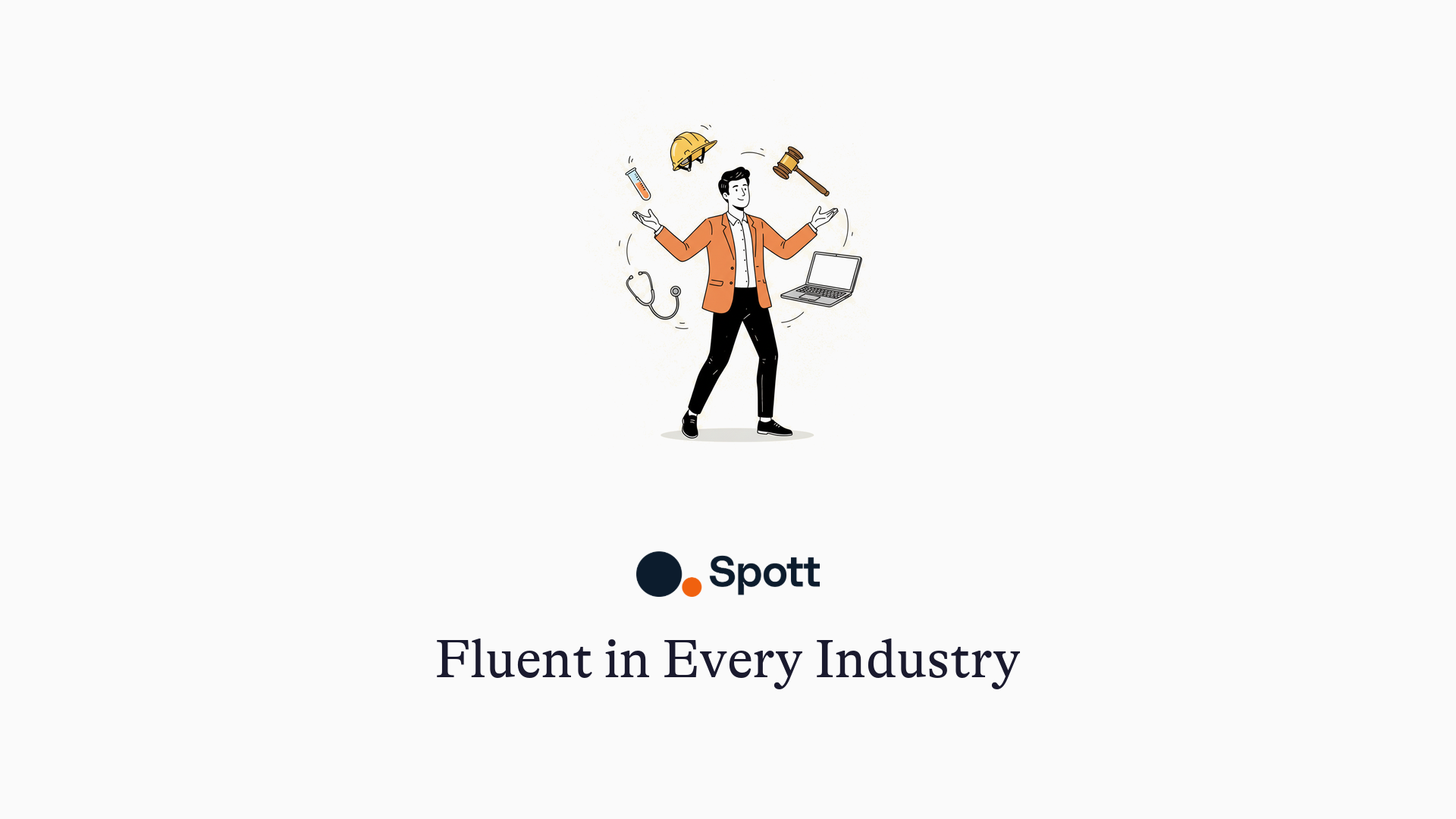
Fluent in Every Industry: How One AI Platform Serves Hedge Funds and Specialty Chemicals
TL;DR
Niche recruitment agencies have always faced a bad choice: generic software that doesn't speak their industry's language, or vertical-specific tools with small teams and slow roadmaps. AI dissolved that trade-off. A platform that understands meaning rather than matching keywords is automatically fluent in any vertical, because the same capability that knows "delta one" belongs to trading also knows "downstream formulation" belongs to chemicals. The fluency comes from reading your notes, calls, and placements, not from a vendor's industry template. For multi-niche and expanding agencies, this quietly removes a wall that used to define the market.
Walk through a recruitment software directory from a few years ago and you'd find the market organized like a pharmacy: software for legal recruiters, software for healthcare staffing, software for construction, each promising that generic tools don't understand your niche.
They had a point. A keyword-based ATS genuinely doesn't know that a "quant researcher" and a "systematic strategies analyst" might be the same hire, or that "GMP experience" matters enormously for one chemical plant role and not at all for another. So niche agencies bought niche tools and accepted the trade: industry fluency in exchange for small vendor teams, dated interfaces, and roadmaps measured in years.
Here's the claim I want to defend: AI ended that trade-off, and it's worth understanding exactly why, because it changes who needs specialized software (almost nobody) and what to demand instead.
Why software used to need an industry template
Traditional ATS "understanding" was taxonomy: lists of job titles, skills, and synonyms that someone, somewhere, typed into a configuration. Industry fit meant the vendor had pre-built the taxonomy for your vertical: the legal version knew "associate" sat below "partner"; the healthcare version knew "RN" and "registered nurse" matched.
Taxonomies have two fatal properties. They're always incomplete (no list anticipates that a client will call a head of data engineering a "platform lead"), and they're always stale, because language moves faster than configuration. Every niche agency knows the workaround: an internal wiki of search synonyms and a senior recruiter who "just knows" what the terms mean. The expertise lived in people because the software couldn't hold it.
What changed: models that already speak everything
Modern language models arrive having read more or less the entire written output of every industry: the trading papers and the polymer patents, the clinical trial protocols and the Kubernetes documentation. They don't need to be told "delta one relates to equity derivatives" any more than a fluent English speaker needs to be told "barrister relates to court."
For recruitment software built natively on these models, industry fluency stops being a configuration and becomes a property of the platform. Concretely, in Spott:
- An intake call with a hedge fund client mentions "someone who's run market-making infra, ideally low-latency background, FPGA a plus." The AI notetaker structures that correctly without a finance template, and matching surfaces the candidate whose notes say "built execution systems at a prop shop", no shared keywords required.
- A specialty chemicals search for a "technical sales manager, downstream formulation, REACH-aware" finds the candidate described in a 2024 call summary as "chemist who moved commercial, knows EU compliance cold."
- A biotech role asking for "CMC experience through Phase II" matches the profile that never uses the acronym but describes exactly that work.
Same platform, same week, zero vertical configuration. The model's general fluency does what a decade of taxonomy maintenance never could. (The mechanics, embeddings and meaning-space, are in our vector databases explainer; the matching pipeline is in how AI finds your best candidates.)
The deeper point: your niche lives in your data, not the vendor's template
Here's what the vertical-software pitch always got backwards. Your agency's edge was never a vendor's industry taxonomy; it's the accumulated context only you hold: which CFOs actually move for equity, which plants run which processes, which candidate said "never again" about which employer. That context arrives in calls, notes, and messages, in your niche's own dialect.
So the real requirement for niche fluency isn't industry templates. It's a platform that captures your conversations and reads them the way a colleague would. The AI's general fluency decodes the dialect; your data supplies the niche. After a few months, the system is fluent not in "finance" or "chemicals" but in your desk, which is the only specialization that was ever worth paying for.
This has a strategic consequence agency owners feel immediately: verticals stop being walls. The finance-search boutique can take its first fintech-engineering mandate without buying a tech-recruitment tool. The multi-division agency can run life sciences and industrial desks on one database, and discover the cross-over candidates both desks would have missed in siloed systems. Expansion into an adjacent niche becomes a hiring decision, not a software migration.
Where specialist tools still genuinely win
Honesty clause: the argument above is about understanding, and understanding isn't everything.
- Workflow specialization is real. Retained executive search runs on assignments and client portals (it's why Ezekia keeps 99.7% of its exec-search customers), and high-volume temp staffing runs on shift-filling and pay & bill that a perm-focused platform doesn't provide.
- Regulated credentialing (healthcare licenses, certified safety tickets) benefits from purpose-built compliance tracking; check it's in the platform or honestly integrable.
The line to draw: choose software for your staffing model (perm, temp, retained, contract), not your industry vocabulary. The vocabulary problem is solved; the workflow differences are real. Our recruitment CRM roundup maps the field along exactly that line.
Your niche expertise was never in the software's template. It's in your conversations, and for the first time, your software can actually read them.
See Spott handle your vertical's hardest vocabulary live: book a demo and bring your most jargon-dense role spec.