7 Best Loxo Alternatives for Recruiting Agencies in 2026
In depth review
Discover the ideal ATS/CRM solution for your business as we
compare the top contenders for you in our head-to-head series
TL;DR
The 7 best Loxo alternatives in 2026 are Spott (AI-native, contextual matching, branded client reports), Bullhorn (enterprise scale and back-office), Recruiterflow (automation and support quality), Recruit CRM (budget entry point), JobAdder (job board distribution), Vincere (UK/APAC back-office suite), and Ezekia (retained executive search). The right pick depends on whether you're leaving Loxo over pricing trajectory, AI depth, client-facing deliverables, or regional hosting.
Why agencies are looking for a Loxo alternative in 2026
Loxo is a genuinely strong product. It scores 4.6 out of 5 on both G2 and Capterra, its built-in sourcing database of roughly 1.2 billion profiles is the most differentiated feature in the category, and reviewers consistently say it feels "built by recruiters for recruiters." For US agencies whose biggest constraint is outbound sourcing volume, it earns its reputation.
The reasons agencies evaluate alternatives in 2026 cluster around four themes.
The pricing trajectory. Loxo's Basic plan is now $169 per user per month, and Professional contracts typically land between $250 and $400 per user per month depending on seat count and modules. Multiple Capterra reviewers report automatic 5% annual price increases written into contracts, and contact-credit overage pricing isn't publicly disclosed. The free tier is a great entry point. The exit trajectory is what catches agencies off guard.
Client-facing deliverables under-deliver. Reviewers flag resume formatting and CRM function as weak spots, and Loxo's candidate report output has historically been a sore point. When the document you send a client is the product of your work, that matters.
Integrations feel bolted together. Several G2 reviewers describe Loxo's integrations as "clunky and half-baked," with some requiring paid add-ons or custom development. Agencies running omnichannel outreach across email, LinkedIn, and WhatsApp tend to hit these edges first.
Support and hosting. Loxo's support is chatbot-first, and users report that reaching a human takes effort. The platform is also US-centric, with limited regional data residency for European agencies with GDPR-driven hosting requirements.
If any of that resonates, the seven platforms below are the alternatives most often shortlisted against Loxo in 2026.
Comparison at a glance
| Platform | Best for | Distinct strength |
|---|---|---|
| Spott | Agencies wanting AI built into every workflow | Contextual AI matching, branded reports, omnichannel inbox |
| Bullhorn | Large staffing firms with back-office needs | Scale, VMS integrations, ecosystem |
| Recruiterflow | Small-to-mid agencies focused on automation | Automation maturity, support quality |
| Recruit CRM | Cost-sensitive teams under 20 seats | Entry pricing, fast setup |
| JobAdder | ANZ/UK agencies leaning on job boards | 200+ board ecosystem |
| Vincere | UK/APAC temp and contract operations | Back-office depth, analytics |
| Ezekia | Retained executive search firms | Assignment management, client portals |
| Loxo | US agencies constrained by sourcing volume | 1.2B-profile sourcing database |
How we evaluated each platform
The platforms below were assessed against five criteria that consistently come up when agencies tell us why they're moving off Loxo:
- AI depth. Is AI part of the core data model, or a layer for sourcing only? Does it understand context (notes, calls, messages) or just keywords?
- Total cost trajectory. Not the entry price, but what you'll actually pay in year two and three once credits, modules, and indexation kick in.
- Client deliverables. Can you send a client a candidate report in your own branding without rebuilding it in Word?
- Workflow fit by staffing model. Perm, temp, contract, and retained search have different needs.
- Support and hosting. Can you reach a human, and can you host data where your compliance team needs it?
Pricing is quoted from public information and recent reviews. Always confirm current pricing with the vendor before signing.
1. Spott
Founded: 2024 | HQ: San Francisco | Pricing: From $139/user/month
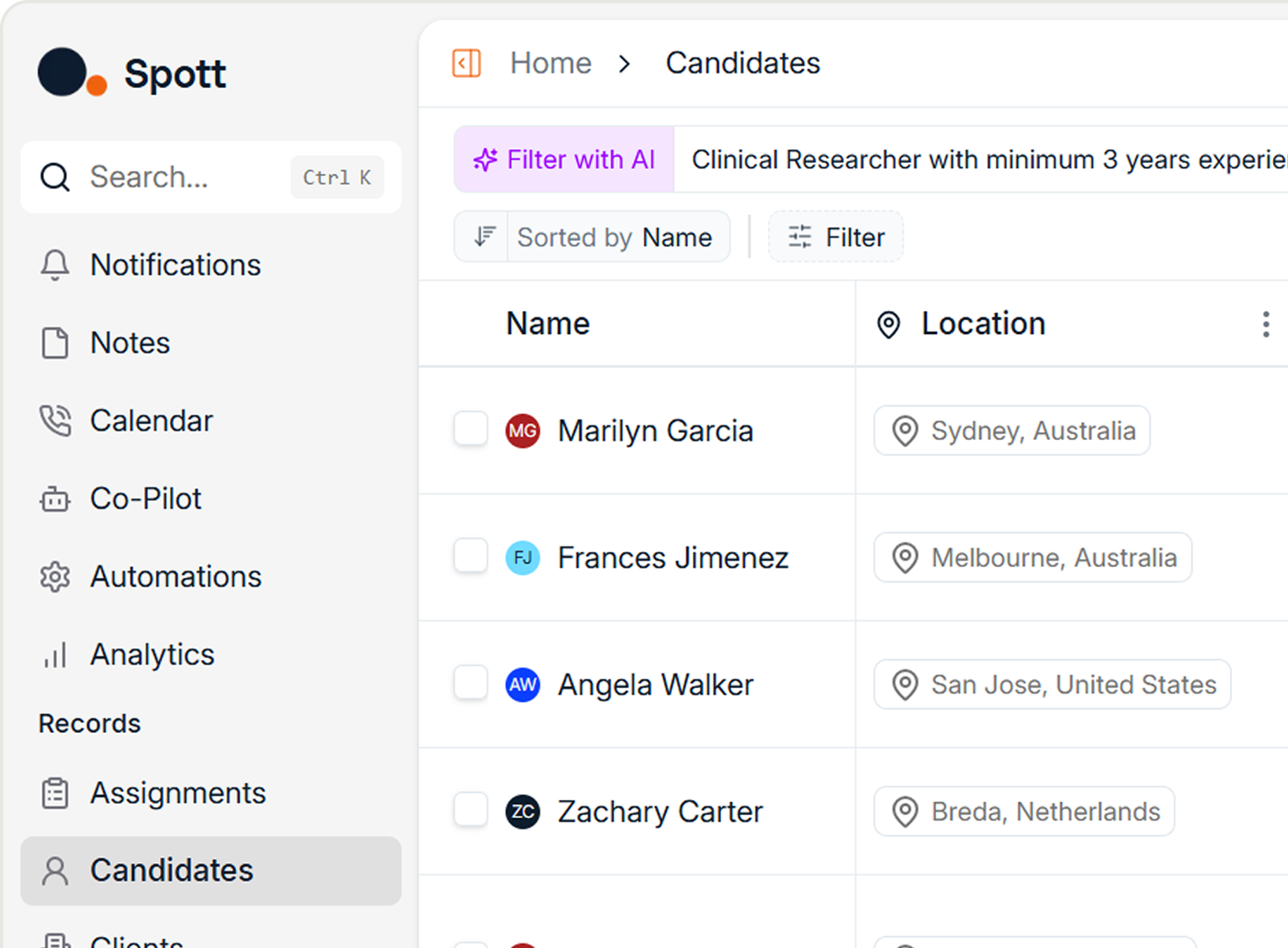
Spott is an AI-native ATS/CRM built from inception around AI rather than retrofitted with it. Where Loxo's AI focuses on sourcing, Spott's AI runs through the entire workflow: matching that reads context (full work history, notes, call transcripts, messages) instead of keywords, an AI notetaker that updates candidate profiles automatically, data enrichment, outreach campaigns across email and WhatsApp, and analytics, all in one seat price.
Where Spott stands out vs Loxo:
- Client deliverables you'd actually send. Spott generates candidate presentation reports in your own Word or PowerPoint templates. Loxo's report output is a recurring complaint in user reviews.
- Pricing that holds. One transparent seat price with matching, notetaking, and reports included. No credit-overage surprises, no automatic annual indexation written into the contract.
- Searchable context. Notes, transcripts, and messages are searchable and feed the AI matching. Ask a natural-language question ("who did we interview last year with pricing experience in SaaS?") and get an answer, not a saved-search project.
- EU hosting and ISO 27001. EU-hosted option, GDPR compliant, ISO 27001 certified. For European agencies, this is a structural difference, not a checkbox.
- Human support. Direct access to the team, with a roadmap that ships weekly.
"The precision of the AI matching stood out immediately."
— Kristof Stevens, United Consulting
What to keep in mind:
- No built-in sourcing database. Loxo Source's 1.2B profiles have no direct equivalent in Spott; sourcing runs through LinkedIn Recruiter and enrichment instead.
- No native VoIP or SMS module; Spott integrates with VoIP providers rather than running telephony in-house.
- Founded in 2024, so it's the youngest platform on this list, backed by Y Combinator and shipping weekly.
Best for: Agencies of 5-200 recruiters running perm, contract, or retained search who want AI in the whole workflow, branded client deliverables, and a price that doesn't escalate.
Bottom line: If you're leaving Loxo over pricing trajectory, report quality, or AI that stops at sourcing, Spott is the most direct answer. For a side-by-side breakdown, see the full Spott vs Loxo comparison.
2. Bullhorn
Founded: 1999 | HQ: Boston | Pricing: Starter $99/user/mo, Core $165/user/mo (published, July 2026); Pro and add-ons quote-only
Bullhorn is the legacy market leader: 10,000+ customers, 300+ integrations, and a proven track record at 500+ seat firms.
Where Bullhorn stands out vs Loxo: enterprise scale, deep temp/contract back-office (timesheets, pay & bill, 110+ VMS integrations), and the Amplify AI suite, which is the most substantive AI investment among legacy vendors.
What to keep in mind: the seat price is not the total cost. Automation, analytics, and Amplify are typically priced as separate modules, buyer reports and reviews cite implementation fees in the low thousands, and customers report annual price indexation in multi-year contracts. Reviews consistently flag slow, dense UX and support queues.
Best for: Larger staffing firms with VMS-driven contracts and serious back-office requirements.
Bottom line: The move if you're outgrowing Loxo into enterprise temp/contract. Budget for the add-ons. Side-by-side detail in our Spott vs Bullhorn comparison.
3. Recruiterflow
Founded: 2016 | HQ: San Francisco | Pricing: From $119/user/month, AIRA plan around $149/user/month
Recruiterflow serves 1,700+ agencies and built its name on automation and unusually good support (responses often within minutes, per reviewers).
Where Recruiterflow stands out vs Loxo: automation maturity (years of battle-tested sequences and triggers), bundled AI (the AIRA plan includes all current and future agents at one price), and a support reputation that is the opposite of chatbot-first.
What to keep in mind: US-hosted only, which rules it out for agencies with EU residency requirements. AIRA is a recent layer on an automation-first product, and LinkedIn messages aren't a native sequence step. Contacts and candidates live as separate records.
Best for: Small-to-mid US agencies (10-50 recruiters) that prioritize workflow automation and responsive support.
Bottom line: The strongest support-and-automation story on this list. Feature-level breakdown in our Spott vs Recruiterflow comparison.
4. Recruit CRM
Founded: 2017 | HQ: New Jersey | Pricing: Pro $85, Business $125, Enterprise $165/user/month
Recruit CRM is the budget-conscious pick, used in 100+ countries with strong review scores and a setup most users describe in hours, not days.
Where Recruit CRM stands out vs Loxo: entry pricing at half of Loxo's Basic plan, an unlimited free trial, fast onboarding, and native VoIP via Twilio.
What to keep in mind: AI depth trails the AI-native platforms (parsing plus bimetric scoring rather than contextual matching), agencies report configurability and reporting ceilings past 20-30 users, and features like open API access sit on higher tiers.
Best for: Small agencies under 20 recruiters that want the basics done well at an accessible price.
Bottom line: If Loxo's price is the only reason you're leaving, Recruit CRM is the cheapest credible landing spot. Expect to outgrow it. Details in our Spott vs Recruit CRM comparison.
5. JobAdder
Founded: 2007 | HQ: Sydney | Pricing: ~$135-160+/user/month, custom quotes
JobAdder brings 26,000+ users, a clean interface, and a 200+ job board ecosystem including native SEEK integration.
Where JobAdder stands out vs Loxo: job board distribution breadth (the inverse of Loxo's outbound-sourcing strength), an 18-year track record with 99% CSAT, and a dedicated in-house recruitment edition.
What to keep in mind: AI arrived late (Adder Intelligence launched November 2025) and requires the Essential plan or higher. Reporting depth is the most-flagged weakness in reviews, and the European footprint outside the UK is thin.
Best for: ANZ and UK agencies whose sourcing strategy runs on job board distribution rather than outbound.
Bottom line: A sensible swap only if your sourcing model is inbound. Full comparison in our Spott vs JobAdder comparison.
6. Vincere
Founded: 2012 | Owned by: The Access Group | Pricing: From £69/user/month, AI Copilot from £25/agency/month
Vincere is a full-stack recruitment operating system with CRM, ATS, analytics, and genuine back-office (timesheets, pay & bill, invoicing), strongest in the UK and APAC.
Where Vincere stands out vs Loxo: back-office depth Loxo doesn't attempt, 50+ built-in reports, and sharper entry pricing than it had two years ago.
What to keep in mind: post-acquisition customer experience under Access Group is a recurring review theme (support responsiveness, contract renewal practices), releases are quarterly at best, and modular pricing complicates budgeting.
Best for: UK/APAC agencies running temp and contract that need integrated back-office.
Bottom line: The like-for-like choice for temp-heavy UK/APAC operations, with the Access Group ownership as the asterisk. Side-by-side in our Spott vs Vincere comparison.
7. Ezekia
Founded: 2015 | HQ: London | Pricing: ~£120/user/month
Ezekia is purpose-built for retained executive search: assignment management, polished client portals, BD pipelines, and branded reporting, with 550+ firms and a 99.7% retention rate.
Where Ezekia stands out vs Loxo: the exec-search workflow is native rather than adapted, and the client portal experience is the most polished in this list. Loxo serves exec search, but as one model among many.
What to keep in mind: Ezekia covers retained exec search only; perm, temp, and contracting are out of scope. It added OpenAI-based features but isn't AI-native, integrations are limited (Outlook, Zapier), and migration fees have been reported as high as £5,000.
Best for: Boutique retained executive search firms that want depth in one model.
Bottom line: The specialist play. If your firm is 100% retained search and Loxo feels generic, Ezekia fits like a glove; if you run mixed models, it can't follow you. More in our Spott vs Ezekia comparison.
When Loxo is still the right call
Not every Loxo customer should leave. Loxo remains your best option if outbound sourcing volume is your defining constraint and the 1.2B-profile database genuinely replaces a separate sourcing stack for you, you're US-based with no EU hosting requirements, and your contract economics still work after factoring in the annual increases. The sourcing database is the killer feature, and nothing on this list replaces it one-for-one.
If sourcing isn't your bottleneck, though, you're paying a premium for a database you don't fully use, and the alternatives above will likely fit better.
How to choose your Loxo alternative
If AI depth is the driver: Spott is the most AI-native option on this list, with matching, notes, reports, and outreach designed around AI from inception rather than added to a sourcing tool.
If you're enterprise temp/contract: Bullhorn or Vincere. Bullhorn for VMS depth and ecosystem, Vincere for sharper pricing and analytics.
If you're cost-driven: Recruit CRM at $85/user/month, with the scalability ceiling as the known trade-off.
If support quality burned you: Recruiterflow's human, fast support is the strongest contrast to chatbot-first service.
If you're retained exec search only: Ezekia.
If EU hosting and GDPR are non-negotiable: Spott (EU-hosted, ISO 27001) is the clearest fit; most other options on this list are US-hosted.
Related reading
The bottom line
Loxo earned its reputation on sourcing, and for agencies whose growth is gated by outbound volume, it still delivers. But if your bills keep climbing while the AI stops at sourcing, your client reports need rework before every send, and support means arguing with a chatbot, the market has moved.
If you want to see what an AI-native ATS/CRM does across your whole workflow, not just sourcing, book a Spott demo. Migration is handled in-house by our team, go-live takes a day to a few weeks, depending on database size and feedback speed, and the AI is in the seat price, not the next tier up.
Research current as of June 2026. Pricing and feature claims are based on vendor websites and publicly available reviews at the time of writing. Always confirm current pricing directly with the vendor.