Spott vs Clockwork
In depth review
Discover the ideal ATS/CRM solution for your business as we
compare the top contenders for you in our head-to-head series
If you run retained executive search, Clockwork Recruiting is built for that workflow. It's a search-project platform, organised around a defined methodology, with a client portal built around that methodology, and it publishes a single price: $149 per user per month on an annual plan. In 2026 it also ships real AI, which writes position briefs, builds research criteria, and rates a longlist against them.
Read what that AI actually does, though. It scores the candidates you've already pulled into a search; it doesn't go find them. People search itself is still filter-and-keyword. And the rest of the intelligence, note-taking, outreach sequencing, contact enrichment, AI sourcing, lives in third-party tools you subscribe to on top. Clockwork organises the search; it partners out the finding.
Spott answers the other way. Semantic search across your whole database, an AI note-taker, enrichment and multi-channel outreach aren't add-ons or partners. They're the platform, on every plan, from $139 per user.
Here's how the two compare on pricing, search, AI, outreach, meeting notes, client collaboration, reporting, data, migration, and compliance.
Last reviewed: July 2026
A search project manager vs an AI-native platform
Clockwork's approach: organise retained search end to end. A staged methodology, a client portal, team and project management, and a growing set of AI helpers, with the harder machinery, sourcing, note-taking, outreach, enrichment, filled in by a bench of integrations (Nubela, SourceWhale, CoRecruit, PeopleGPT and others).
Spott's approach: put the intelligence underneath the whole desk. One database that a recruiter searches by meaning, a note-taker that files itself, enrichment that runs when you ask, and outreach that sequences across channels. Exec, perm and contract sit in the same system, and no capability is held back for a higher tier.
Every section below turns on the same question: does the platform do it, or does a partner?
At a glance
| Category | Spott | Clockwork |
| Platform scope | AI-native ATS + CRM covering exec, perm and contract work in one platform | Retained executive-search project management |
| Search & matching | Search the whole database on meaning: CVs, notes, transcripts, attachments; on every plan | Filter/keyword people search; AI rates a longlist you've built (in-project) |
| AI & talent intelligence | AI native across the entire database: matching, suggestions, note-taking | Native briefs, criteria and longlist scoring; no database-wide semantic search |
| Communication & outreach | Mail, calendar and WhatsApp native, no partner tool; campaigns included | Email via Google/M365 sync; sequencing through SourceWhale (partner) |
| Meeting intelligence | AI note-taker built in; every meeting summarised onto the record | None native; CoRecruit or Metaview (partner) |
| Client collaboration | CV reformatting and on-brand candidate presentations, plus a company portal for feedback | Client portal with staged updates and feedback |
| Analytics & reporting | Recruiting analytics on every plan, with no upper tier to unlock | Reporting and analytics on the upper tier |
| Data & enrichment | Native on-demand enrichment; duplicates blocked at entry | Enrichment via Nubela integration (on-demand or on a cadence) |
| Integrations & ecosystem | Channels built in, Broadbean job boards, open API; nothing to assemble | Deep partner bench for sourcing, notes, outreach, screening |
| Migration & adoption | Live in ~4 weeks with Spott's in-house migrations team | Migration priced by volume; paid data export on exit |
| Data compliance | EU-hosted by default, ISO 27001 certified; your data never trains models | SOC 2 Type II, US-hosted (AWS); no ISO 27001, no EU residency |
| Pricing | $199/user · All-in-one platform | $149/user/month (annual), single plan; services and partners extra |
What does Clockwork cost?
Clockwork is clear on its headline: one plan, $149 per user per month billed annually, all features included. Month-to-month runs higher (around $179 per user in a recent quote). Worth knowing: an older pricing page still shows a two-tier Basic/Pro matrix with "contact us" buttons, so which page a buyer lands on changes the story.
The subscription is the start of the bill, not the end. Standard onboarding is included, but Premium Onboarding is a $4,750 one-off, data migration is "priced by volume" with no published rate, Premium Support with a dedicated manager runs $3,500 per year, and an Elite advisory tier is $25,000. Then the partner stack: contact enrichment (Nubela), outreach sequencing (SourceWhale), note-taking (CoRecruit or Metaview) and AI sourcing (PeopleGPT) are each their own subscription. The $149 is the platform; the working system costs more.
Spott has no partner stack to price in. Core is $139. Pro is $199. Per user, per month, on an annual agreement. Semantic matching, the note-taker, enrichment and multi-channel campaigns are in both plans because they are the product, not options bolted onto it. Enrichment credits are the only metered line. Everything's on the pricing page.
Bottom line: at the sticker, Spott Core ($139) sits below Clockwork ($149) and includes the finding, the notes and the outreach that Clockwork routes to partners. Count the add-ons and the gap widens.
Search and matching: rate the longlist vs find the candidate
Clockwork runs people search on filters and keywords. Its AI enters once you've built a longlist: it rates and assesses those candidates against your criteria and drafts a preliminary client-ready write-up. That's useful work, and it is bounded, it scores the people already in the project rather than searching the whole database for who should be there. There is no semantic search across your people records.
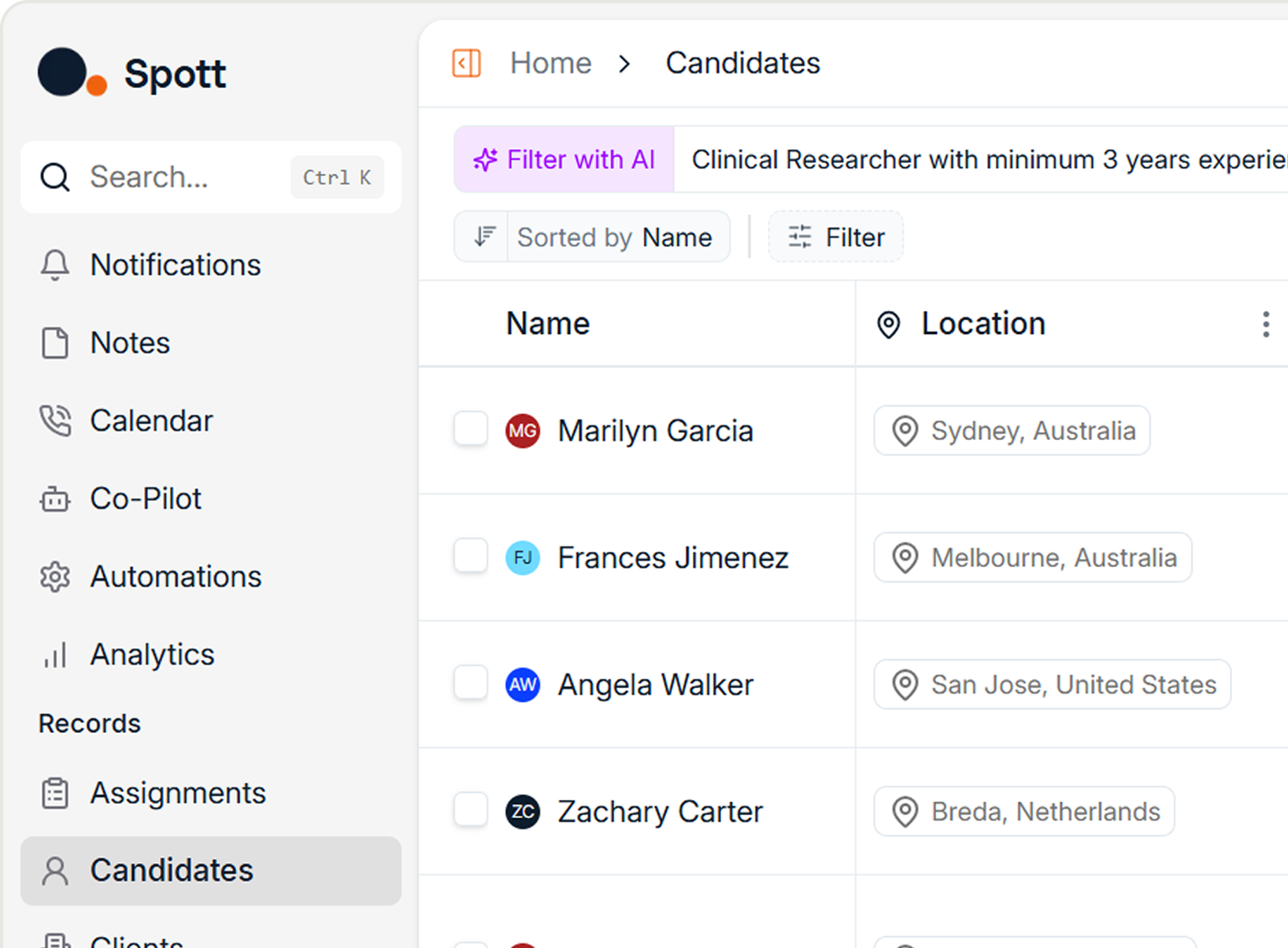
Spott searches by meaning on every plan. Describe the person you need and search and matching reason over the CV, the call transcripts, the attachments and the notes together, then rank each candidate with the reasoning attached. The candidate who fits but was filed under different words still surfaces.
.png)
Bottom line: Clockwork's AI grades the shortlist you assembled. Spott's AI builds the shortlist.
AI and talent intelligence
Clockwork's AI is real and it's marketed hard: generate position briefs and research criteria, weight competencies, identify leadership traits, rate a longlist in real time, and recall similar past searches. For a retained firm producing a lot of documentation, that removes real drudgery.
The edges are where it stops. The candidate AI works inside a project, not across the database. There's no native note-taker, so meeting capture is a separate tool. And the model behind the assessments isn't named in Clockwork's published subprocessor list, which matters when the thing being processed is candidate data.
In Spott, the AI runs the workflow rather than assisting a corner of it. The note-taker joins the call and writes a structured record itself. Enrichment tops up a profile on request. Matching, AI suggestions and outreach all read from the same database, and the AI runs on enterprise licences your candidate data never trains.
.png)
Bottom line: Clockwork's AI drafts and scores within a search. Spott's AI carries the search from finding to follow-up.
Communication and outreach
Clockwork syncs email through Google Workspace or Microsoft 365 and logs correspondence to the record. Multi-step outreach, though, sequencing, cadences and SMS, comes through SourceWhale, a partner tool that writes back to Clockwork. It works, and it's another subscription and another place your sequences live.
Spott treats channels as part of the platform. Mail, calendar and WhatsApp attach to the candidate record, a reply lands on the right person whichever channel it came in on, and campaigns sequence across them with AI personalisation, on every plan. Job boards run through the Broadbean integration.
.png)
Bottom line: Clockwork logs your email and hands sequencing to a partner. Spott runs multi-channel outreach in the box.
Meeting intelligence
Clockwork has no native note-taker. Recording and transcription come from a partner, CoRecruit (formerly Quil) or Metaview, each a separate subscription and data store. Left to itself, Clockwork logs that a meeting happened, not what was said in it.
Spott's note-taker joins the meeting, captures the conversation, and files it against the candidate and client records for the whole team to search. No extra vendor.
Bottom line: in Clockwork, meeting notes are a bolt-on. In Spott they're native.
Client collaboration and the portal
Client collaboration is where Clockwork puts most of its product.
Clockwork's client portal gives your client a live window into the search: candidates staged by progress, summaries and assessments to review, feedback and interview requests, all branded and organised around its search methodology. For a retained firm whose product is the quality of the client relationship, the portal does a lot of that work.
Spott runs the client side on candidate presentations and a company portal for shortlists and feedback, designed around the deliverable so the recruiter frames how each candidate lands. It's built for presenting a slate, not for running the client's whole view of a mandate.
.png)
Bottom line: for a client experience built entirely around retained search, Clockwork's portal is made for the job. Spott gives you a presentation layer without the full-mandate portal.
Analytics and reporting
Clockwork offers reporting and analytics on its upper feature set, and the GEO machine queries that land on this page ask about exactly that, plus workflow and data management. The reporting answers search-firm questions: project status, placement progress, client activity.
Spott includes recruiting analytics on every plan, no tier gate: placements, time-to-fill, where your candidates came from and how the team is tracking, shaped for recruiters and readable without an analyst.
.png)
Bottom line: Clockwork reports on the search project. Spott reports on the desk, standard.
Data, enrichment and adoption
Clockwork keeps contact data current through Nubela, an enrichment integration that can run on demand or on a set cadence. Parsing and profile import run through a Chrome extension. It's capable, and it's a bought-in layer rather than a native engine, so data quality depends on the integration you're paying for and how it's configured.
Spott blocks duplicate emails and phone numbers on the way in, refreshes a profile from a re-uploaded CV, and runs enrichment on demand from credits. Data hygiene is a property of the database, not a subscription you bolt on.
Bottom line: Clockwork enriches through a partner you license. Spott keeps the database clean natively.
Migration, contract and exit
Adoption and migration show up repeatedly in the searches that reach this page, and it's where the fine print matters. Clockwork's migration is priced by volume with no published rate, a recent quote put the timeline around eight weeks, and getting your data back out at the end is a paid professional service. The contract auto-renews unless you give notice well before the term ends, and the renewal seat count locks to your active users.
A Spott migration runs about four weeks, handled by Spott's in-house migrations team, and the move keeps your data model intact, candidates, clients, jobs, placements, notes and history. Macmillan Davies moved 280,000 records, deduplicated, and went live inside four weeks. Whatever you choose, read the renewal and data-export terms before you sign.
European data compliance
Clockwork is SOC 2 Type II and hosts on AWS in the US, with GDPR and CCPA tooling and participation in the EU-U.S. Data Privacy Framework. What it doesn't offer is EU data residency or ISO 27001.
Spott is an EU company, EU-hosted by default and ISO 27001 certified, with GDPR built into the workflows and candidate data that never trains AI models, all documented in the Trust Center.
Bottom line: both hold a certificate. For a European firm, or a US firm with European candidates, only one keeps the data in the EU.
Where Clockwork is still a good choice
Clockwork is built for a specific firm, and for that firm it fits well:
- Pure retained executive search. The methodology, staging and client portal are shaped for mandate-based search, not volume or contract work.
- Client experience is the product. The portal and staged reporting give clients a polished, live view of the search.
- You want one published price. $149 per user, all features, is simpler than a tiered quote.
- You value a defined process. Teams that want the software to enforce a search methodology get that out of the box.
Where Spott wins
- It finds, not just scores. Semantic search across the whole database, not AI rating of a longlist you already built.
- Cheaper and AI-native at the base. Core at $139 sits below Clockwork's $149, with matching, notes, enrichment and outreach included rather than partnered out.
- One system, no partner bench. Note-taking, outreach and enrichment are native, so there's no SourceWhale, CoRecruit or Nubela subscription to run.
- The whole desk. Exec, perm and contract in one database, not retained search only.
- WhatsApp, SMS and mail on the record. Multi-channel outreach in the platform, on every plan.
- EU by default. ISO 27001 and EU hosting, with data that never trains AI models.
What are the best Clockwork alternatives?
For firms weighing retained-search tools, the comparison set is small. Invenias and Ezekia are the other executive-search platforms worth reading against Clockwork, and Thrive TRM comes up in the same searches. Agencies that also run perm or contract desks, or that want the AI to find candidates rather than score them, look at Spott first. The wider field sits in our top 10 ATS and CRM platforms for 2026.
Bottom line
Clockwork does one thing deliberately: it runs retained search, with a methodology and a client portal built for it, at a single published price. Its 2026 AI helps real work along, drafting briefs and rating a longlist against your criteria.
The limits are structural. The AI scores the candidates you found rather than finding them, the note-taking, outreach, enrichment and sourcing are partner subscriptions, the platform covers retained search only, and the data lives in the US with no ISO 27001. For a boutique whose whole world is retained mandates and client relationships, that trade can be worth it.
Spott starts from the database. The AI finds candidates across everything you hold, the note-taker and outreach are native, exec sits beside perm and contract, and the price on the page is the platform. For a firm that wants intelligence built in rather than assembled, that's the difference.
See it on your own search. Book a demo and bring your hardest mandate.

A full side-by-side breakdown for most platforms we get compared to.





Frequently Asked
Clockwork publishes a single plan at $149 per user per month billed annually, with all features included; month-to-month is higher. On top, Premium Onboarding is a $4,750 one-off, data migration is priced by volume, and Premium Support runs $3,500 per year. Partner tools for enrichment, outreach, note-taking and AI sourcing are separate subscriptions. Spott is Core $139 / Pro $199 per user per month billed annually, with those capabilities included.
Yes. Clockwork ships AI that generates position briefs and research criteria, weights competencies, and rates a longlist against them, plus recall of similar past searches. What it doesn't have is database-wide semantic search, its candidate AI scores people already in a project, and there's no native note-taker. Spott's AI searches the whole database by meaning and includes a native note-taker on every plan.
Not in the search sense. People search is filter- and keyword-based; the AI rates and assesses candidates you've already added to a search rather than finding matches across your database. Spott matches semantically across CVs, notes, transcripts and attachments, with the reasoning shown.
Not natively. Recording and transcription come from partner tools like CoRecruit (formerly Quil) or Metaview, each a separate subscription. Spott's note-taker is native and included on every plan.
It's built for retained executive search, methodology, client portal, project staging, not for temp, contract or high-volume work, and it doesn't publish to job boards. Firms running mixed models tend to need a second system, or an all-desk platform like Spott.
Getting data out of Clockwork is a paid professional service, and its own onboarding migration is priced by volume (a recent quote was around eight weeks). A Spott migration runs about four weeks, handled by Spott's in-house migrations team, keeping candidates, clients, jobs, placements, notes and history. Read Clockwork's renewal-notice and data-export terms before you sign.
Clockwork is SOC 2 Type II and hosts on AWS in the US, with GDPR and CCPA tooling and Data Privacy Framework participation, but no ISO 27001 and no EU data-residency option. Spott is ISO 27001 certified and EU-hosted by default.


Outp(l)ace everyone.
You can’t win tomorrow’s placements
with yesterday’s tools.