Spott vs Loxo
In depth review
Discover the ideal ATS/CRM solution for your business as we
compare the top contenders for you in our head-to-head series
Recruitment today moves faster than most ATS systems were designed for. A single workflow now spans WhatsApp, email, calls, voice notes, AI tools, job boards, and spreadsheets, often all within the same hour.
Loxo has grown quickly in response to this shift. With 13,200+ teams, 125,000+ users, $115M in funding, and an 800M+ talent graph, it's one of the stronger iterations of the all-in-one recruiting platform.
But the modern recruiter's reality tells a different story. Recruiters still jump between 6 to 12 tools a day, send 80+ messages, and lose 30 to 40% of their time to manual updates and disconnected workflows. That's 8 to 10 hours of admin every week that could be spent making placements.
Most platforms store data well but leave it to the recruiter to keep it updated and connected to how they actually work.
"Recruiters no longer struggle because they lack tools. They struggle because their tools don't talk to each other."
Loxo and Spott answer that in two different ways.
Traditional vs AI-Native Platform
Both Loxo and Spott use AI across the product. The difference is the data model underneath: where the source of truth lives, and what keeps it current.
Loxo's approach: Loxo is a "Talent Intelligence Platform" built around an 800M+ talent graph it owns, positioned as a built-in alternative to a separate sourcing subscription, alongside ATS, CRM, outreach, AI agents and reporting in one platform. Its intelligence is anchored in that vendor-owned database: you search it, enrich from it, and keep your own records up to date against it.
Spott's approach: Spott anchors the source of truth in your own activity. Communication, context and data stay aligned as work happens, so the record updates from the calls, emails and messages your team is already having, not from a separate database you maintain on the side. Built around AI from day one.
That difference shows up in data freshness, how quickly teams move, matching quality, and how much manual work remains in the daily workflow.
At-a-Glance Comparison
| Category | Spott | Loxo |
| ATS/CRM Core | AI-native ATS/CRM; records update from your calls, emails and messages | All-in-one ATS/CRM built around an 800M+ vendor talent graph |
| Sourcing & Data Quality | On-demand enrichment + context captured from every conversation | 800M+ talent graph; Self-Updating CRM Agent refresh on the quote-only tier |
| Search & Matching | Semantic AI matching in the base plan; no manual title grouping | Boolean/keyword search; Natural Language + semantic search on the quote-only tier |
| Communication | WhatsApp + email conversations auto-linked to each record; AI follow-ups | Email/SMS outreach campaigns + Outreach GPT |
| Client Presentation | Live branded client portal; on-brand candidate reports and CV reformatting | Hiring Manager Portal + Candidate Status Reports |
| Business Development | Vacancy import, client-prospecting campaigns, cross-channel reporting | Sales CRM + Account-Based Prospecting |
| Compliance | EU-hosted with ISO 27001 certification, GDPR-first; no training on your data | EU transfers via Standard Contractual Clauses; SOC 2 Type II on Enterprise |
| Support & Migration | Direct human support (Priority Support on Pro); ~4-week migration, no external consultants | Support across tiers; dedicated migration function |
| Pricing | $199/user · All-in-one platform | Free tier + $169 Basic; AI agents + sourcing quote-only |
Sourcing Accuracy & Data Quality
Loxo's pitch is an 800M+ talent graph it owns, built into your ATS in place of a separate sourcing subscription, with a Self-Updating CRM Agent that refreshes candidate records against its data. Two things shape how that lands in practice: the refresh draws on Loxo's own talent graph and third-party data, and the AI agents that power it sit on the quote-only Professional tier, not the published Basic plan.
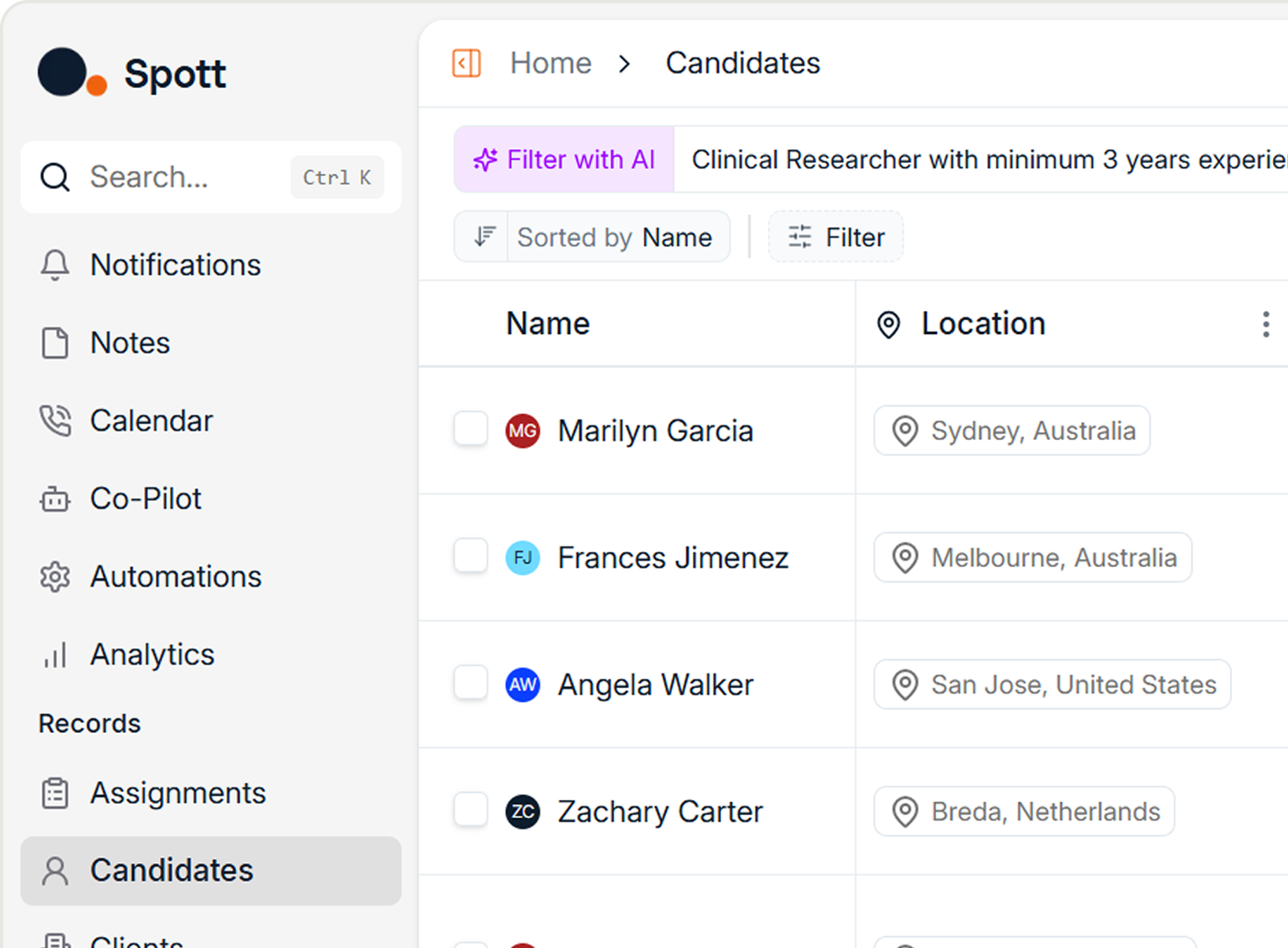
Spott keeps your own database current from a different input: your team's activity. Enrichment runs on demand against external providers when you need contact data, and every interaction (a WhatsApp message, a call note, an email reply) feeds back into the candidate record. The result is a talent pool that reflects your own conversations, on the base plan, without a separate sourcing subscription.
Bottom line: Loxo gives you access to a large vendor database, with its self-updating layer on the quote-only tier. Spott keeps the records you actually work with current from your own activity, on the base plan.

Search & Matching Quality
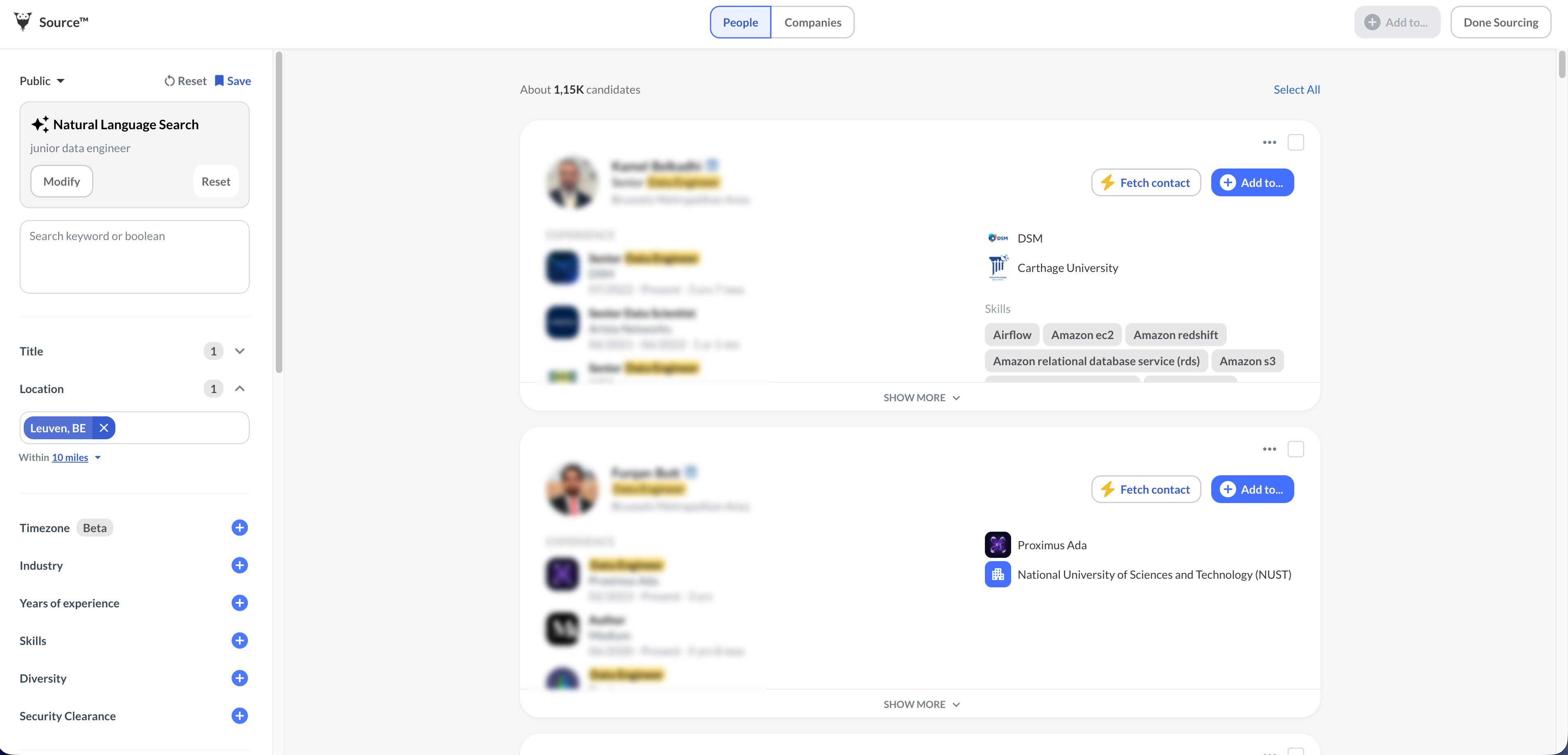
Loxo offers Boolean and keyword search across its tiers, with title groupings to widen results. Its Natural Language Search and AI Recommendations (semantic matches surfaced at the top of the list) are AI capabilities that sit on the quote-only Professional tier.
Spott's matching is semantic by default and included from the base plan. Search for "Python developer" and Spott surfaces candidates with TensorFlow, Django and data-engineering backgrounds because it reads how skills, roles and seniority relate. Matching draws on your notes, call transcripts, attachments and CVs, so results improve as your team works, without predefined aliases.
Bottom line: Loxo's semantic search is an upgrade on the quote-only tier. Spott's is in the base plan.
Multi-Channel Communication
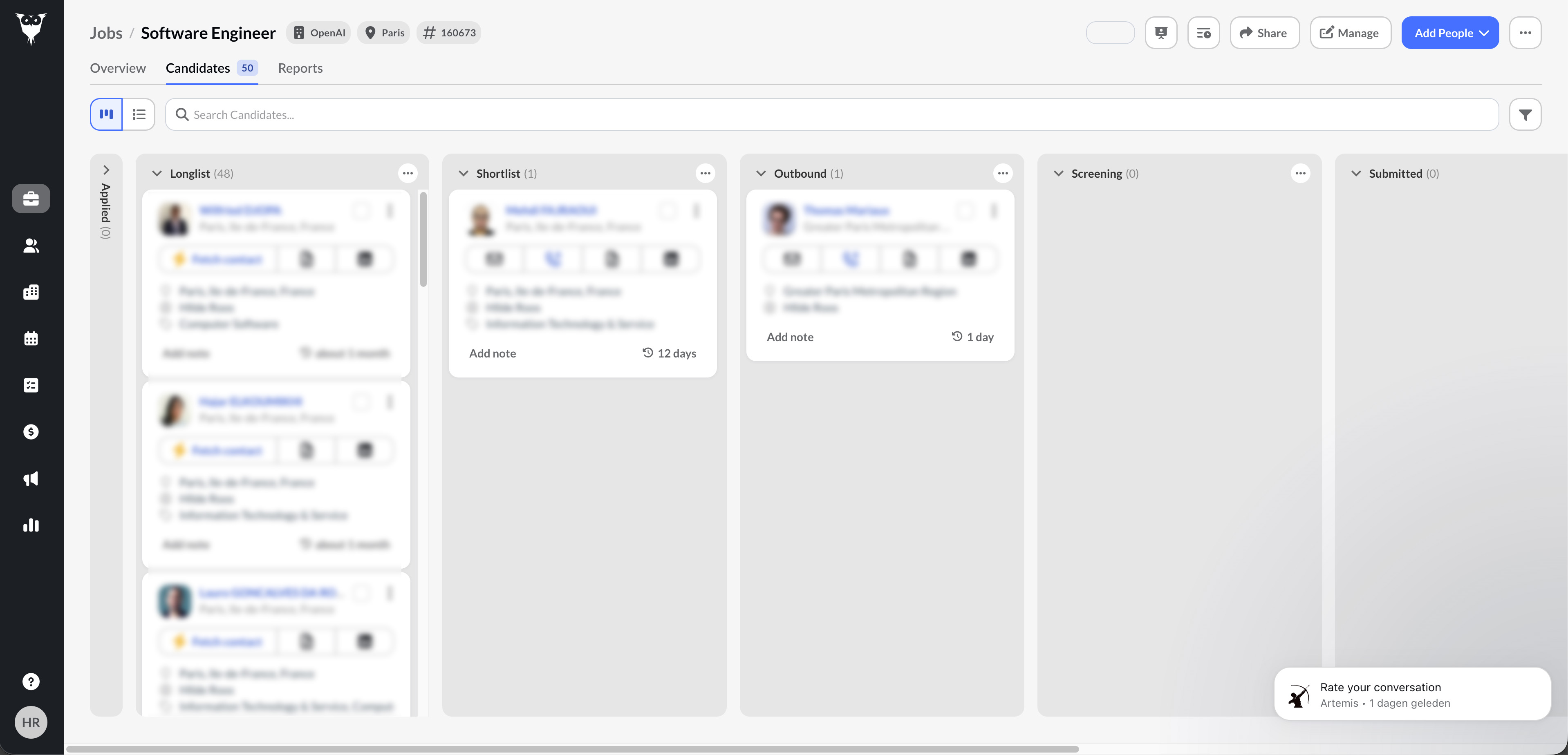
Loxo runs mass outreach across email and SMS with dynamic personalization, plus Outreach GPT to draft messages and campaign automation to manage ongoing sequences.
Spott brings WhatsApp and email into the workflow and auto-links every conversation to the right candidate or contact record. Automated summaries, follow-ups and contextual outreach cut manual monitoring, and two-way sync keeps the record and the conversation in step.
Bottom line: Loxo automates outreach across email and SMS. Spott ties each conversation back to the record it belongs to.
Candidate & Client Presentation
Loxo covers client-facing work with its Hiring Manager Portal and a Candidate Status Reports product for structured updates.
Spott was built for candidate presentation. Clients get a live, on-brand portal where they can review candidates and progress across multiple concurrent searches from a single link. Spott's AI reformats CVs and generates on-brand candidate reports from calls, notes and job descriptions in seconds, so recruiters spend less time formatting and more time placing.
Bottom line: Both cover client delivery. Spott delivers it through a live portal and AI-generated presentations built from your own conversations.
Business Development & Reporting
Loxo handles business development through its Sales CRM and Account-Based Prospecting, finding and engaging target companies alongside the recruiting workflow.
Spott is built for outbound business development too. Vacancy import surfaces new opportunities, client-prospecting campaigns let agencies pitch talent proactively, and automated briefs and presentations save hours. Reporting spans every channel, including WhatsApp engagement and outreach replies, so leadership sees more than email open rates.
Bottom line: Both support BD. Spott folds it into the same AI-native workflow as sourcing and delivery.
Customer Support & Vendor Experience
Loxo offers support across its tiers, with priority and strategic account management higher up the plan ladder, and a dedicated function for data migration.
Spott's support is direct and human, with Priority Support on the Pro plan. Migration is handled in about four weeks with no external consultants, and go-live is typically measured in days once your data is in.
Bottom line: Both offer human support. Spott's team is the one building the product, and migration is part of the engagement.
Pricing
Spott publishes every plan in USD, EUR, AUD and GBP. Core is $139. Pro is $199. Per user, per month, on an annual agreement, with Enterprise custom. AI search, note-taking, matching and recommendations are included from the base plan up, not a paid upgrade; the only usage-based cost is enrichment credits for sourcing contact data. Migration is a four-week engagement in the cost, not an upsell.
Loxo publishes two of its four tiers: Free for a single user, and Basic at $169 per user/month (billed monthly or annually). The Talent Intelligence Platform capabilities (the 800M+ talent graph, all Loxo AI agents, Natural Language Search, AI Notetaker, outreach automation and the client report generator) sit on the quote-only Professional and Enterprise tiers.
Bottom line: Loxo's published price covers a Sales CRM, job posting and analytics; its AI and sourcing live on a quote-only tier. With Spott, every tier is on the page and AI is in the base plan.
European Data Compliance
For any agency handling European candidate data, where the data lives and how it moves matters.
Loxo handles EU data transfers through Standard Contractual Clauses, per its GDPR page, and offers SOC 2 Type II reporting on its Enterprise tier.
Spott is EU-hosted by default, ISO 27001 certified, and built GDPR-first, and never uses your candidate or client data to train AI models. For agencies in Belgium, the Netherlands, the UK and broader Europe, EU hosting by default is how local data-protection officers expect a recruitment platform to be configured.
Bottom line: Both are GDPR-compliant. Spott's default is EU hosting and ISO 27001 certification, with your data kept out of model training.
Switching Patterns
Teams choose Loxo for good reasons: the owned talent graph is a real draw, the free tier lowers the barrier, and the platform is quick to get started on.
Over time, as a team grows, the pull toward better context, fewer tools and less manual admin gets stronger. Agencies that move to Spott describe the same shift: everything in one place, matching that reflects their real conversations, and noticeably less manual work than before.
It's less about the size of the agency and more about how much efficiency and clarity you want in the daily workflow.
Where Loxo Is Still a Good Choice
Loxo is a strong choice if:
- You want a built-in sourcing database of 800M+ profiles with contact info baked into your ATS, instead of paying for a separate sourcing subscription.
- You value strong US market presence and brand recognition.
- You want a free entry point. Loxo's free ATS/CRM plan lets small firms start without commitment.
- Your team prefers structured, traditional workflows and is comfortable running sourcing from a vendor database.
Where Spott Wins
- You want a single AI-native platform that unifies sourcing, CRM, outreach, reporting and multi-channel communication, replacing fragmented tools.
- You want records that stay current from your own conversations, with enrichment on demand when you need contact data.
- Client delivery matters. A live branded portal and AI-built candidate presentations set you apart from generic reports.
- You care about European compliance. EU hosting by default, ISO 27001 certification, and no training on your data.
- You want pricing you can read on the page: every tier published, AI in the base plan, migration in the cost.
- Support should be human and direct, from the team building the product.
What are the best Loxo alternatives?
The best alternative depends on your priorities. For AI-native recruitment with multi-channel communication in one workflow, Spott is the option built for it. For back-office depth, Bullhorn can offer more temp/flex infrastructure. We've published in-depth comparisons for Bullhorn, Vincere, Recruiterflow and others.
Bottom Line
The gap between traditional ATS platforms and what recruiters now expect from one grows every quarter. Loxo built an all-in-one workflow over more than a decade; the trade-offs against an AI-native platform show up in data freshness, where context lives, and the pricing of AI capabilities.
Spott was built for the way recruiters work today: across channels, with context, at speed. AI-native from day one.
Ready to see the difference? Book a demo and we'll show you how your team can make more placements with less manual work.

A full side-by-side breakdown for most platforms we get compared to.





Frequently Asked
Loxo is worth considering if you value a built-in sourcing database and want a free entry point. The trade-off is that its AI agents, Natural Language Search and 800M+ talent graph sit on the quote-only Professional tier, not the published Basic plan. For firms that need unified multi-channel communication, semantic AI matching in the base plan, and a live client portal, Spott delivers more depth for the published price.
Loxo is an all-in-one platform built around a vendor-owned talent graph, with its AI agents on a quote-only tier. Spott is an AI-native ATS/CRM where the source of truth is your own activity. The difference shows in data freshness (Spott updates records from your calls, emails and messages), search (semantic in the base plan vs on the quote-only tier), communication (conversations auto-linked to records), and client delivery (a live branded portal and AI-built reports).
Loxo publishes two of its four tiers: a Free plan for a single user, and Basic at $169 per user/month, billed monthly or annually. The Professional and Enterprise tiers, where the 800M+ talent graph, AI agents, Natural Language Search and client report generator live, are quote-only. Compared with Spott, which publishes Core at $139 and Pro at $199 per user/month with AI search and matching in the base plan, agencies should weigh how much of Loxo's platform sits behind a quote.
The best alternative depends on your priorities. For AI-native recruitment with multi-channel communication in one workflow, Spott is the option built for it. For budget-focused teams, Recruit CRM offers lower pricing. For back-office depth, Bullhorn has more temp/flex infrastructure. For exec search specifics, Ezekia is purpose-built.
Loxo handles EU data transfers through Standard Contractual Clauses and offers SOC 2 Type II reporting on its Enterprise tier. Agencies with strict EU-residency requirements should confirm the configuration they need. Spott is EU-hosted by default, ISO 27001 certified, built GDPR-first, and never uses your data to train AI models.
Spott typically completes full migrations in about four weeks with virtually zero data loss. The process covers data import, field mapping and hands-on onboarding from the Spott team, with no external consultants. Go-live is usually measured in days once your data is delivered.
Loxo includes AI features, including Natural Language Search and AI Recommendations that surface semantic matches, on its quote-only Professional tier; its lower tiers rely on Boolean and keyword search with title groupings. Spott's semantic matching is included from the base plan and reads the relationships between skills, roles and seniority without manual configuration.
Among modern recruitment platforms, Spott is AI-native, with AI embedded in the data model rather than layered on top. That shows in records that update from your own conversations, semantic search in the base plan, AI-built candidate reports, and call transcription with context capture. Loxo, Bullhorn and others have added AI features, with some, like Loxo's AI agents, sitting on higher tiers.




Outp(l)ace everyone.
You can’t win tomorrow’s placements
with yesterday’s tools.