What Is an AI-Native ATS?
Every ATS claims AI now. Open any recruiting software website and you'll see the same language: AI-powered matching, AI-driven insights, intelligent automation. The term "AI" has become a checkbox on every feature list.
But there's a meaningful difference between an ATS that added AI features to an existing platform and one that was built around AI from the start. That difference is architecture - and it determines what AI can actually do for your firm.
This post explains what "AI-native" means in the context of recruiting technology, how it differs from AI-powered and AI-enabled systems, and why that distinction matters more than any feature list.
What Does "AI-Native" Actually Mean?
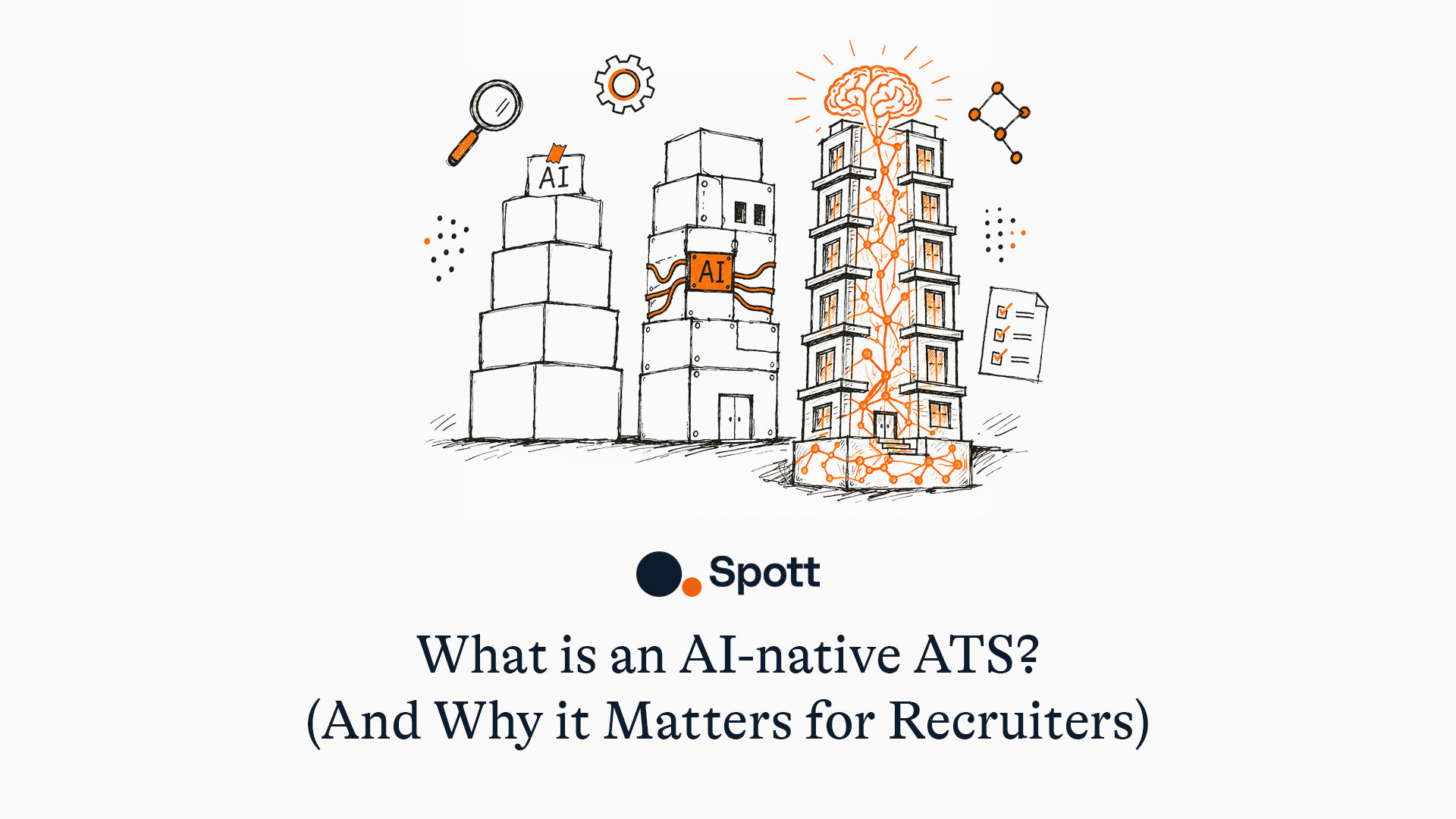
An AI-native ATS is a recruiting platform built from inception with intelligence as a core design principle - not retrofitted onto an existing system.
That's the definition worth remembering, because it draws a clear line. In an AI-native system, intelligence isn't a module you turn on or a tab you click. It's the foundation everything else is built on. The data model, the matching engine, the way notes are captured, the way profiles stay current - all of it assumes AI from the ground up.
Think of it this way: Netflix was built as a streaming platform. Blockbuster tried to add streaming to a DVD rental business. Both offered "streaming," but the architecture determined which one could actually deliver the experience. The same dynamic is playing out in recruiting technology.
When an ATS vendor says "we have AI," the question that matters is: Was the AI designed into the architecture, or was it layered on top of software that existed before AI was viable?
Three Tiers of AI in Recruiting Software
Not all AI is equal. The recruiting software market has settled into three distinct tiers based on how deeply AI is integrated into the product.
AI-Enabled
The entry level. These platforms have basic AI features - resume parsing, chatbot responses, job description generators. The AI handles isolated tasks but doesn't change how the core platform works.
You'll recognize AI-enabled systems by what they can't do: the matching is keyword-based, profiles don't update themselves, call notes don't auto-map to candidate records. The AI is a feature, not an architecture.
Some platforms in this tier wrap a ChatGPT integration around their existing search and call it "AI matching." It produces results, but they're shallow - the AI doesn't have access to the context that makes matching accurate for senior or niche roles.
AI-Powered
The middle tier. These platforms have invested in meaningful AI capabilities - semantic search, predictive analytics, some degree of intelligent automation. The AI does more than basic tasks.
The limitation: it's built on top of a legacy architecture. The AI layer can only work with what the original data model gives it. If the platform was designed 10 or 15 years ago as a database with forms, the AI is constrained by that structure. It can process the data that's there, but it can't fundamentally change how data is captured, connected, or used.
You'll often see AI-powered features sold as paid add-ons - separate line items for AI matching, AI notetaking, AI analytics. That pricing structure tells you something about the architecture: the AI is modular because it was added after the fact.
AI-Native
The AI isn't a feature or a layer. It's the foundation.
In an AI-native ATS, the data model was designed from day one to feed intelligence. Every conversation captured, every message synced, every profile updated - it all flows into a system that was architected to learn from that data and act on it.
Matching doesn't scan keywords. It draws from call transcripts, meeting notes, email threads, and messaging history to understand candidates in full context. Profiles don't wait for manual updates. They self-update through continuous data enrichment. Notes from calls don't sit in a text field. They're transcribed, parsed, and mapped to the relevant candidate records automatically.
The AI is included in the base price - not because it's basic, but because it can't be separated from the platform. It IS the platform.
Why Architecture Matters More Than Feature Lists
Here's where the distinction gets practical.
Every ATS vendor can add a checkbox that says "AI matching." But what that checkbox means depends entirely on the architecture underneath.
In an AI-powered system, "AI matching" typically means the platform scans CV text for keyword overlap with a job description, applies some semantic expansion, and returns a ranked list. It works for straightforward roles with clear requirements. It falls apart for senior positions, niche specializations, or candidates whose career paths don't follow a template.
In an AI-native system, "AI matching" means the platform draws from every data point it has - call transcripts, recruiter notes, email exchanges, Social Media messages, meeting summaries - and matches based on the full picture. The candidate who mentioned during a call three months ago that they're open to advisory roles gets surfaced for a board-level mandate. That's not keyword matching. That's contextual intelligence.
The same pattern applies across every capability:
- Notes. AI-powered: you take notes manually; the AI might summarize them. AI-native: calls are transcribed automatically and the relevant information maps into candidate profiles without you copying and pasting.
- Profiles. AI-powered: candidate data goes stale unless you manually update it. AI-native: profiles self-update through data enrichment. When a prospect changes roles, you know about it.
- Candidate reports. AI-powered: you build presentations manually in PowerPoint or Word. AI-native: the system generates branded candidate presentations in your own templates - ready to send to clients.
- Communication history. AI-powered: email is in one place, Social Media is in another, WhatsApp is somewhere else. AI-native: every channel feeds one unified inbox. The full relationship history is searchable in one view.
The structural difference is this: bolt-on AI can only work within the constraints of a data model that wasn't designed for it. AI-native systems don't have that ceiling.
The Compound Effect
This is the part that matters most over time.
Bolt-on AI gives you a one-time productivity bump. You add the feature, it saves some time on specific tasks, and that's where the gains plateau. The AI processes what you put in, but it doesn't fundamentally change what the system captures or how it connects information.
AI-native compounds. Every call transcribed adds to your relationship intelligence. Every message synced enriches your matching accuracy. Every auto-updated profile means fewer stale records. Every interaction makes the next search faster and more precise.
After six months on an AI-native ATS, the system knows your candidates, clients, and relationships in a way no bolt-on tool can replicate - because the data model was designed to capture and connect that intelligence from the start.
This is why the architectural distinction matters for recruiting firms making technology decisions in 2026. AI use in HR and recruiting tasks jumped to 43% this year, up from 26% in 2024. More than 80% of enterprises now use AI for significant parts of their hiring process. The firms that chose AI-native architecture early will have a compounding advantage over those running AI features on legacy foundations.
What the Market Looks Like Right Now
The recruiting technology market is going through an architectural shift. You can see it in how vendors are responding:
Legacy vendors are scrambling. Platforms built 10, 15, even 25 years ago are rushing to add AI layers. They're launching AI add-ons with names like "Amplify," "Copilot," and "Intelligence." Some are plugging in OpenAI's API and calling it a product feature. These efforts are real, but they're constrained by the architecture they sit on.
AI-native platforms are emerging. A new generation of ATS/CRM platforms - built in 2023 and 2024 - started with AI as the foundation rather than the afterthought. These platforms don't have legacy data models to work around. Their matching, notes, enrichment, and reporting were all designed for intelligence from the start.
Recruiters can tell the difference. The feedback we hear consistently: AI features on legacy platforms feel like a tab you never open. AI in native platforms feels like the system is actively working alongside you.
The gap will widen. Over 50% of talent leaders plan to add autonomous AI agents to their workflows in 2026. Those agents will perform best on platforms where the data model was designed for intelligence - not on systems where AI is reading a database that was built for manual data entry.
How to Evaluate Whether an ATS Is Truly AI-Native
When a vendor says "AI-native," here's how to test the claim:
1. Is AI included in the base price, or is it a paid add-on?
If AI matching, AI notetaking, or AI analytics are separate line items, the AI was bolted on. Native architecture doesn't need add-on pricing because the AI can't be separated from the platform.
2. Does matching use full context, or just CV keywords?
Ask the vendor to match a candidate based on a conversation note from six months ago - not a keyword on their resume. If the system can't do that, the matching is keyword-dependent regardless of what the marketing says.
3. Do candidate profiles self-update?
In an AI-native system, data enrichment is continuous. Profiles stay current without manual research. If you're still manually updating candidate records, the AI isn't embedded in the data model.
4. Are call notes auto-mapped to candidate profiles?
Native architecture transcribes calls and maps the relevant data into the right profiles automatically. If your team is still copy-pasting notes from call summaries into candidate records, that's a workflow the architecture wasn't designed to handle.
5. When was the platform originally built?
This isn't disqualifying on its own, but it's informative. A platform built 15 years ago can add impressive AI features, but it can't rebuild its data model without essentially starting over. A platform built in the last 2–3 years had the opportunity to design for AI from the start.
6. Can the AI generate branded deliverables?
AI-native systems can produce polished, on-brand candidate presentations - not just text summaries. If the AI's output stops at plain text, the integration between AI and the rest of the platform is shallow.
What This Means for Your Firm
The firms that will have the biggest advantage in 2026 and beyond aren't the ones with the most AI features on a checklist. They're the ones whose AI is embedded in a system designed for it.
That means choosing architecture, not features. It means asking vendors about data models, not demo scripts. And it means recognizing that the difference between AI-enabled, AI-powered, and AI-native isn't marketing - it's structural.
Only 26% of candidates trust AI to evaluate them fairly. That trust gap closes when AI is transparent, contextual, and working with full information - not when it's a black-box keyword scanner reading a CV. AI-native architecture makes that transparency possible because the system was designed to capture context, not just parse text.
The recruiting industry is moving fast. The firms that build on AI-native foundations now will compound their advantage every month. The firms that stay on legacy platforms with bolt-on AI will keep getting incremental improvements - until the gap becomes impossible to close.
See the Difference
If you want to see what AI-native looks like in practice - contextual matching, auto-transcribed notes mapped to profiles, branded candidate reports generated in your templates - try Spott free. Migration included, live in 4 weeks.