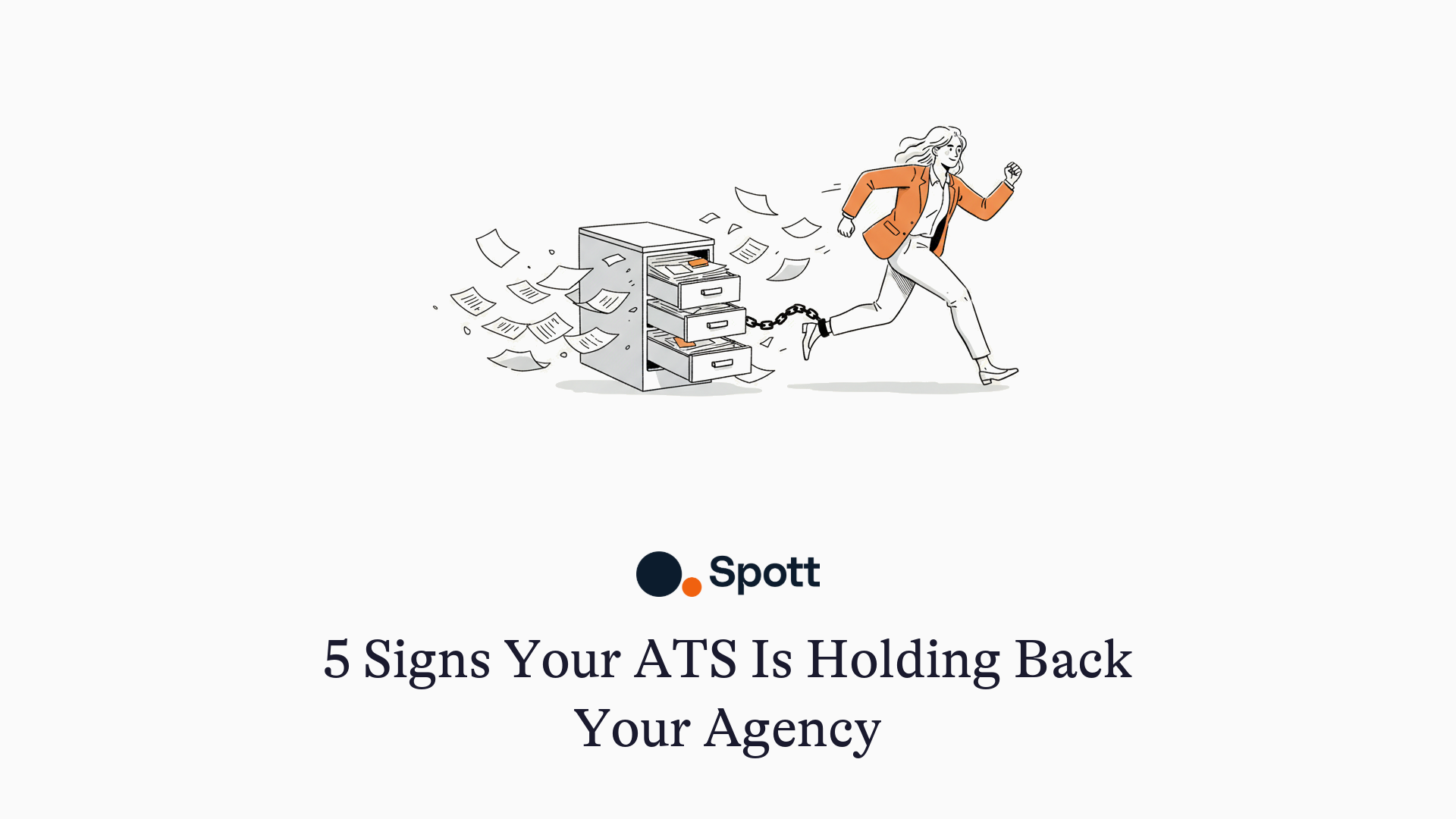
5 Signs Your ATS Is Holding Back Your Agency (and What Each One Costs You)
TL;DR
Your ATS is holding back your agency if: (1) your recruiters search LinkedIn before they search their own database, (2) data entry happens after 6pm or not at all, (3) "checking with the team" is how you find out what a candidate said last month, (4) your candidate submissions take days instead of hours, and (5) your reports get built in Excel. Each sign is testable in minutes. If you score three or more, the problem isn't your team, it's your software.
Most agencies don't decide to switch their ATS. They decide to stop ignoring it.
The frustrations build slowly: a workaround here, a spreadsheet there, a recruiter who quietly keeps her real notes in a personal doc. By the time anyone says "maybe it's the system," the agency has been paying the cost for years, in placements that went to faster competitors.
Here are the five signs that the cost has gotten too high, what each one actually costs you, and a quick way to test for it in your own agency this week.
Sign 1: Your recruiters search LinkedIn before they search your own database
The symptom. A new role comes in, and the first tab your recruiters open is LinkedIn, not your ATS. The database with fifteen years of candidates, interviews, and relationships gets searched second, or not at all.
Why it happens. Keyword search fails on recruitment data. The perfect candidate is in your database described as "backend dev, strong on payments," but the search was for "software engineer fintech," so they never surfaced. After enough misses, recruiters stop trusting the database and rebuild it, one LinkedIn search at a time.
What it costs. You're paying twice for candidates you already know. Agencies typically re-source candidates who are already in their system, complete with interview notes and salary expectations, because finding them externally is more reliable than finding them internally.
The test. Ask three recruiters: "Last role you worked, where did your placed candidate come from?" If the answer is never "our database," your database is a graveyard, not an asset.
Sign 2: Data entry happens after 6pm, or not at all
The symptom. Your recruiters end the day with a backlog of calls to log, notes to write up, and statuses to update. Some of it gets done in the evening. Most of it evaporates.
Why it happens. Legacy systems treat recruiters as data-entry clerks: every call, email, and interview generates manual admin. When updating the system competes with making the next call, the next call wins, and it should.
What it costs. Everything that doesn't get entered doesn't exist. The candidate who mentioned they'd consider relocating, the client who hinted at three more roles next quarter: that context lived in one recruiter's head and left with them at their next job.
The test. Pull up your ten most recently active candidates. How many have notes from their last actual conversation? If it's under half, your ATS records history, not reality.
Sign 3: "Let me check with the team" is your knowledge management system
The symptom. A client asks what happened with a candidate, and the answer requires Slack messages, a walk across the office, or waiting for someone to come back from holiday.
Why it happens. Context lives in fragments: the call recording in one tool, the WhatsApp thread on someone's phone, the email chain in a personal inbox, the real opinion in nobody's system at all. The ATS holds the CV and a status field, which is to say, the least useful 10% of what your agency knows.
What it costs. Every handover loses information, every absence creates a blind spot, and when a recruiter leaves, their pipeline leaves with them. For agency owners, this is the difference between owning your agency's knowledge and renting it from your employees.
The test. Pick a candidate one of your recruiters placed six months ago and try to reconstruct the story (first contact, interviews, objections, final package) using only what's in your systems. Time yourself.
Sign 4: Submitting candidates takes days, not hours
The symptom. The shortlist exists by Tuesday morning, but the client doesn't see it until Thursday, because formatting CVs, writing summaries, and building the presentation deck is half a day of work nobody has.
Why it happens. Most ATS platforms stop at the pipeline stage and leave client-facing deliverables to Word. Every submission means manual reformatting, and every manual step adds a delay between "we found them" and "the client met them."
What it costs. Speed is the agency's product. In contested searches the first credible shortlist usually sets the bar, and a 48-hour formatting delay is 48 hours for the candidate to take another interview, for the client to try another agency, or for the requirement to change.
The test. Measure the gap on your last five placements between "candidate identified" and "candidate presented." If the median is over a day, the bottleneck isn't sourcing, it's paperwork.
Sign 5: Your real reports get built in Excel
The symptom. Month-end means someone exports CSVs from the ATS and rebuilds the numbers in a spreadsheet, because the system's own reporting can't answer the questions that matter.
Why it happens. Legacy reporting was designed around activity counts (calls made, CVs sent) rather than the questions agency leaders actually ask: which clients are slowing down, which recruiters' pipelines are hollow, where deals die. If the answer isn't a preset report, it's an export.
What it costs. Decisions lag reality by a month, and the person who should be analyzing the business spends days assembling it instead. Worse, data that everyone knows is stale stops being trusted, so decisions revert to gut feel.
The test. Count the spreadsheets that touched your last board or partner meeting. Each one is a report your ATS failed to produce.
Scored three or more? It's the software, not the team
Each sign on its own is survivable. Together they compound: untrusted search (sign 1) means less data entry (sign 2), which means less shared context (sign 3), slower submissions (sign 4), and reporting nobody believes (sign 5). Agencies respond by hiring more admin support, which treats the symptom and raises the cost base.
The fix isn't discipline. Your recruiters are behaving rationally inside a system that punishes good behavior. The fix is software that does the admin itself.
This is the design principle behind AI-native platforms: the system captures context automatically from calls, emails, and messages instead of waiting for manual entry, search understands meaning instead of matching keywords, and client-ready candidate reports generate in minutes in your own branding. Spott was built around exactly these five failure points, which is why the first thing most new customers notice is the absence of evening admin.
Ready to see what an ATS that works for your recruiters looks like? Book a Spott demo and bring your hardest search with you.