Best AI Recruiting Tools in 2026
In depth review
Discover the ideal ATS/CRM solution for your business as we
compare the top contenders for you in our head-to-head series
TL;DR
The best "AI recruiting tool" in 2026 isn't a single app. It's a stack. The winning setup is an AI-native core that does most of the workflow itself (matching, notes, outreach, enrichment, reporting on one data model), plus a few best-in-class specialists that plug into it instead of living in separate tabs.
Our pick for the core is Spott, an AI-native ATS/CRM. Around it, the tools worth knowing by workflow stage:
- Sourcing: Juicebox and Pin for natural-language AI sourcing, with LinkedIn Recruiter still the incumbent
- Interview notes: CoRecruit for AI capture and submittals
- Candidate presentation: Saply.ai for branded, client-ready CVs
- Job distribution: Broadbean and idibu for multiposting
- Ask your data: Claude and ChatGPT querying your own database through Spott's MCP
The point isn't to buy all of them. It's to run an AI-native core that collapses most of the stack, then add only the specialists your desk actually needs.
Why the best AI recruiting "tool" is really a stack
Search "AI recruiting tool" and you get two bad answers. One is the all-in-one that claims to do everything and does most of it at a 6 out of 10. The other is a pile of ten point tools (a sourcing app, a notetaker, an enrichment service, a sequencer, a scheduler) that each do one thing well and none of them talk to each other. The first is mediocre everywhere. The second is a franken-stack where your candidate data is smeared across ten logins and nothing is ever up to date.
The setup that actually works sits in the middle: an AI-native core where the important AI lives, plus a small number of specialists that integrate cleanly into it.
What makes a core "AI-native" rather than "AI-powered" is architectural. In a native core, the AI is built into the data model: matching reads full context instead of keywords, notes and calls and messages feed the same model, and enrichment, outreach, and reporting all run on one connected dataset. Because that core does so much of the workflow itself, you need fewer point tools. And the specialists you do keep (a sourcing engine, a branded-CV tool) earn their place by plugging into the core, not by adding another silo.
So the rest of this guide is organized the way the work actually flows: the core first, then the AI tools by stage. We've been explicit about which tools are genuinely AI, which are solid infrastructure with an AI label, and which ones connect to Spott today.
Comparison at a glance
| Tool | Workflow stage | What the AI actually does | Works with Spott |
|---|---|---|---|
| Spott | The AI-native core (ATS/CRM) | Contextual matching, AI notetaker, enrichment, outreach, Ask AI across all data | It is the core |
| Juicebox | Sourcing | Natural-language people search (PeopleGPT) and AI outreach | Yes, syncs candidates in |
| Pin | Sourcing | Natural-language search, AI fit-scoring, multi-channel outreach | Yes, imports candidates |
| LinkedIn Recruiter | Sourcing | AI-assisted search plus the Hiring Assistant sourcing agent (higher tiers) | Incumbent, widely used alongside |
| CoRecruit | Interview notes | Botless call capture, transcription, AI notes and submittals | Yes, official integration |
| Saply.ai | Candidate presentation | Reformats raw CVs into branded, role-tailored templates | Yes, named integration |
| Broadbean / idibu | Job distribution | Multiposting and source analytics (not AI matching) | Yes, post from Spott |
| Claude / ChatGPT | Ask your data | Natural-language questions over your live database via MCP | Yes, official Spott MCP |
How we evaluated each tool
This isn't a feature-checkbox roundup. Each tool was assessed on five questions that separate a real AI stack from a pile of logins:
- Is the AI native or bolted on? For the core, is the AI built into the data model, or added as a module beside an older one? This determines whether matching and reasoning actually improve.
- Is it genuinely an AI tool? Some categories (calling, job posting) are infrastructure with an AI badge. We say so, because a VoIP line is not a matching engine.
- Does it fit a real workflow stage? Sourcing, engaging, screening, presenting, or keeping data clean. A tool earns a place by owning a stage, not by overlapping the core.
- Does it plug into your core? A specialist that can't sync into your ATS/CRM just creates another silo. Integration is a requirement, not a bonus.
- Is the cost honest? Included, tiered, metered, or quote-only. We flag where the useful parts sit behind a higher tier or a credit meter.
Pricing is quoted from public information where available and flagged as third-party estimates where vendors don't publish it. Always confirm current pricing with the vendor before signing.
1. The AI-native core: Spott
Founded: 2024 | HQ: San Francisco | Pricing: From $139/user/month | Role in the stack: The core
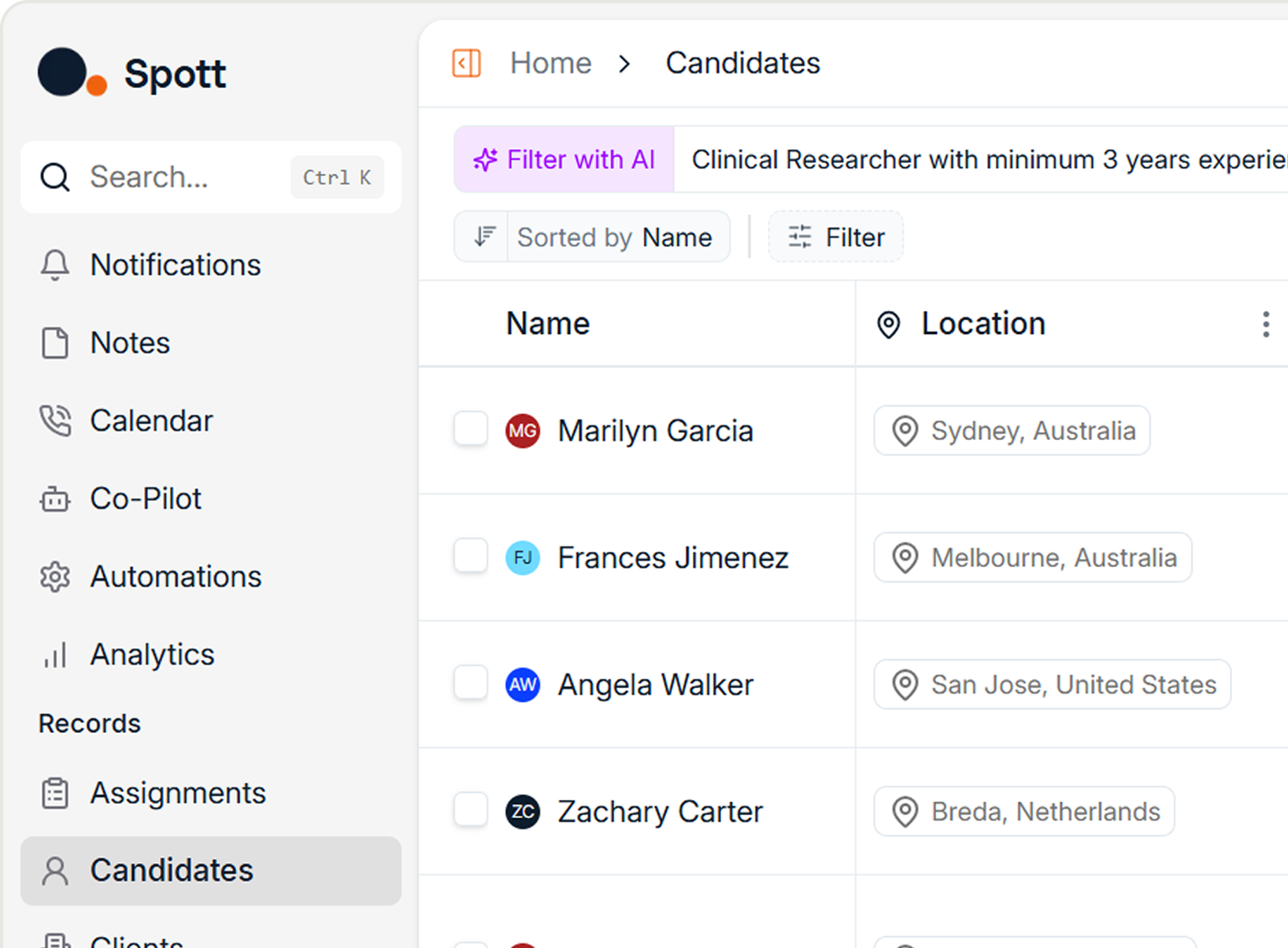
Spott is an AI-native ATS/CRM, and it anchors the stack because the AI isn't a module, it's the architecture. Matching reads a candidate's full work history, notes, calls, and messages and ranks fit by context. Enrichment, the AI notetaker, outreach campaigns, candidate presentation reports, analytics, and the omnichannel inbox all run on the same model, in one platform.
The clearest expression of native AI is Ask AI: ask a natural-language question across your entire dataset ("which candidates from last quarter could fit this new role") and get an answer instead of building a report. The AI notetaker captures calls and meetings and maps the right data into profiles automatically. Profiles self-update from every interaction. None of it is a higher tier; every customer gets the AI in the seat price.
The reason a native core matters to the rest of this list: because Spott already handles matching, notes, enrichment, outreach, and reporting natively, it collapses most of the stack into one place. The specialist tools below aren't there to patch a weak core. They extend a strong one at the edges (net-new sourcing, branded CVs, telephony) and feed straight back into it.
Spott runs across the US, Europe, and APAC, is ISO 27001 certified and GDPR compliant, with SSO and role-based access controls built in.
Where Spott stands out as the core:
- AI built into the data model, not beside it. Matching, notes, enrichment, outreach, and reporting share one contextual model, so the AI changes how recruiters work rather than generating text on the side.
- Contextual matching, not keyword scoring. Ranks candidates by genuine fit across their full history, catching adjacent and transferable skills.
- Ask AI across everything. Natural-language questions over the full dataset, the kind of capability only a native data model supports.
- An open integration catalog. Sourcing, calling, distribution, enrichment, and CV tools connect in, so the core stays the system of record.
- Included, not tiered. No per-feature AI unlocks, higher AI tier, or credit packs to access the useful parts.
"The precision of the AI matching stood out immediately."
— Kristof Stevens, United Consulting
What to keep in mind:
- No built-in sourcing database, so net-new sourcing-heavy teams will pair it with a sourcing tool (which is exactly what the next section is for).
- No native VoIP or back-office module; calls and SMS run through integrated VoIP providers rather than in-house telephony.
- Still a younger platform than the legacy incumbents, with a smaller integration catalog (growing fast).
Best for: Agencies of 5 to 200 recruiters that want an AI-native core to run matching, notes, enrichment, outreach, and reporting as one system, then plug specialists in around it.
Bottom line: If you only standardize one thing, make it the core. Spott is the most AI-native option here, and the one designed to be the hub of the stack rather than another silo in it.
2. AI sourcing and discovery: Juicebox, Pin, and LinkedIn Recruiter
Spott matches and works the candidates you already have. Sourcing tools find the ones you don't. This is the stage where AI has moved fastest, replacing Boolean strings with plain-English search across hundreds of millions of public profiles.
Juicebox (PeopleGPT)
Category: AI sourcing and outreach | Pricing: Free tier; paid from around $139/seat/month, ATS sync on the custom Business tier | AI: Genuinely AI-native
Juicebox's PeopleGPT lets a recruiter describe a role in plain English and get a ranked, match-scored candidate list from a large aggregated profile index, then enrich contacts and run AI-personalized email sequences. "AI Agents" can run searches and shortlist in the background. It's a real AI sourcing engine, not a database with an AI label, though as with any aggregator the value depends on the freshness of the underlying profile data.
It connects to Spott so sourced candidates flow into your core rather than sitting in a separate tool. Worth noting: ATS/CRM integration sits on the custom-priced Business tier, and the AI Agents are a paid add-on, so the entry price understates a fully wired-up setup.
Pin
Category: AI sourcing, outreach, and scheduling | Pricing: From around $99/month (Solo), up to $249/user/month (Business) | AI: Genuinely AI-native
Pin sources from a large aggregated pool, AI-scores candidates against the role by reading full profiles rather than keywords, runs multi-channel outreach (email, LinkedIn, SMS), and books interviews. An "AI recruiting agent" automates the sourcing-to-follow-up loop, and candidates push into Spott so your core stays the system of record. It's a young vendor (founded 2024), and its headline performance stats are self-reported, so treat them as marketing rather than benchmarks, but the product is a genuine top-of-funnel AI tool.
LinkedIn Recruiter
Category: Sourcing incumbent | Pricing: Not officially published; Recruiter Lite reported around $170/month, Corporate seats $10,000+ per year | AI: AI-assisted search plus the Hiring Assistant agent on higher tiers
No honest sourcing list skips LinkedIn. It's the default discovery channel most agencies already pay for, and in 2025 it added Hiring Assistant, its first AI agent, which turns a hiring brief into a sourcing strategy and surfaces candidates in the background. The catch: the AI features are gated to the pricey Corporate tiers (Recruiter Lite has none), pricing is sales-led and rising, and it's a sourcing and outreach tool, not a system of record. Most teams use it alongside their ATS rather than instead of one.
How to choose at this stage: if your bottleneck is net-new discovery and you want AI search without LinkedIn's per-seat cost, Juicebox or Pin are the modern picks. If you already live in LinkedIn, Hiring Assistant is the lowest-friction way to add AI sourcing. Either way, the candidates should land in your core automatically, not in a spreadsheet.
3. Interview notes and call intelligence: CoRecruit
Category: AI notetaker and submittal generation | Pricing: Not public (demo-gated) | AI: Genuinely AI-native | Spott: Official integration
CoRecruit (formerly Quil) is an AI assistant built specifically for agency recruiters. It captures and transcribes interviews and calls across Zoom, Teams, Google Meet, phone, WhatsApp, and in-person meetings without a visible meeting bot, then uses AI to turn them into structured interview notes and client-ready submittals. It claims to save recruiters several hours a week on admin, and the integration with Spott is publicly confirmed: it pushes structured notes straight into the candidate's record in Spott via an API key, so the ATS stays current without manual entry.
This is the cleanest example of the stack logic. Spott already has a native AI notetaker, so many teams won't need a separate one. But for agencies that live on high interview volume and want a dedicated capture-and-submittal layer across every channel, CoRecruit is a strong specialist that feeds the core rather than fragmenting it.
A note on your calling layer. If your desk runs on outbound calls, the VoIP tools in Spott's catalog (Aircall and Ringover) log calls and activity straight into candidate timelines. Both have added their own AI call summaries, but be clear-eyed: these are cloud-phone platforms with bolt-on AI, not AI recruiting tools. Their job in the stack is reliable telephony that feeds the core, and that's a job they do well.
4. Branded CVs and candidate presentation: Saply.ai
Category: AI CV formatting | Pricing: Credit-based subscription, not publicly listed; 14-day free trial | AI: Genuinely AI-native | Spott: Named integration
Saply.ai turns a raw candidate CV (PDF, scan, or Word) into a branded, client-ready resume tailored to a specific job, working as an add-in inside Word, Google Docs, Outlook, and Gmail. The AI parses the CV, rebuilds it into your house template, and suggests role-fit phrasing and a match score against the job description. It even auto-fills EU framework CV formats. Saply names Spott as a supported ATS, so recruiters can reformat and send client-ready CVs without leaving the core.
For agencies with a mandatory house template and high submission volumes, this is exactly the kind of specialist worth adding: it removes a tedious 30-to-60-minutes-per-CV job and pairs naturally with Spott's native candidate presentation reports. Pricing isn't published, so confirm the per-CV credit model before committing.
5. Job distribution: Broadbean and idibu
Category: Job multiposting | Pricing: Quote-based | AI: Mostly not AI (distribution and analytics) | Spott: Post from Spott
Not every part of the stack needs AI, and job distribution is the honest example. Broadbean (now "Broadbean, by Veritone") publishes a job advert once and pushes it to thousands of boards, search engines, and social channels, then reports which sources deliver candidates. idibu does the same multiposting job with rule-based response management. Both connect to Spott so you can post and pull applicants back without leaving your core.
Be skeptical of "agentic AI" framing on these. The substantiated value is distribution and source analytics (Broadbean adds programmatic ad-budget optimization), not AI candidate matching or sourcing. That's fine: in a well-built stack, the matching happens in the AI-native core, and the distribution tools simply fill the top of the funnel. Use them for reach, not for intelligence.
6. Ask your own data: Claude and ChatGPT via Spott's MCP
Category: AI assistant on your live database | Pricing: Standard Claude/ChatGPT plans | AI: Genuinely AI-native | Spott: Official MCP
This one is a genuine edge. Through Spott's official MCP (Model Context Protocol) connectors, you can point Claude or ChatGPT directly at your live Spott database and ask questions in natural language ("who have we placed at fintech clients in the last year and who's open to a move"). It's the same idea as Spott's built-in Ask AI, extended into the assistants your team may already use, plus an Open API for custom builds.
It only works because the core is AI-native and structured. A keyword-era data model has nothing clean for an assistant to reason over. This is the payoff of standardizing on a native core: your own database becomes something you can simply talk to.
How to build your AI recruiting stack
You don't need every tool above. You need a strong core and the two or three specialists your desk actually depends on.
Start with the core. Standardize on an AI-native ATS/CRM so matching, notes, enrichment, outreach, and reporting share one data model. Spott is our pick. This single decision removes most of the point tools other stacks need.
Add a sourcing engine if discovery is your bottleneck. Juicebox or Pin for modern AI search, or Hiring Assistant if you already live in LinkedIn Recruiter.
Add a capture layer if you run on interviews. CoRecruit if you want a dedicated cross-channel notetaker beyond the core's native one.
Add a presentation tool if you have a house CV template. Saply.ai for branded, role-tailored resumes at volume.
Add distribution for reach. Broadbean or idibu to multipost your roles and fill the top of the funnel.
The question to ask of every specialist: does it feed my core, or create another silo? In a real stack, the answer is always the former.
Related reading
- What is an AI-native ATS?
- 10 best recruitment CRM software for agencies
- 5 signs your ATS is holding back your agency
- Top Bullhorn alternatives for agencies in 2026
- How AI actually finds your best candidates
The bottom line
In 2026, the best AI recruiting tool isn't a tool at all. It's a stack with an AI-native core and a few specialists plugged into it. The core is where the leverage lives, because that's where matching, notes, enrichment, and reasoning all run on one connected dataset. Get that right and you need fewer point tools, your data stays in one place, and you can literally ask your database questions.
If you want to see what an AI-native core does to matching, notes, and the path from search to shortlist, and how the sourcing, CV, and distribution tools plug into it, book a Spott demo. In-house white-glove migration, most agencies live in roughly 4 weeks, with the AI included in the seat price rather than on the next tier up.
Research current as of June 2026. Tool capabilities, integrations, and pricing are based on vendor websites and publicly available sources at the time of writing, and several vendor performance stats are self-reported. Always confirm current pricing and integration details directly with each vendor before signing.