Spott vs Salesforce
In depth review
Discover the ideal ATS/CRM solution for your business as we
compare the top contenders for you in our head-to-head series
Last reviewed: July 2026
Short answer to the question in the search box: Salesforce is not an applicant tracking system. It's a general-purpose CRM. Agencies run recruitment on it by installing a partner app from the AppExchange, Bullhorn Recruitment Cloud, TargetRecruit, Byner, Seven20 or Asymbl, layering on Agentforce for AI, and paying admins or consultants to configure candidates, jobs and placements into the data model. Salesforce supplies the platform; you assemble the ATS on top of it.
That can be the right call for a large, Salesforce-standardised organisation. For most agencies it means a stack, a partner licence, metered AI, a configuration project and ongoing admin, where a recruitment-native platform ships the same job done on day one.
Spott is that platform: an AI-native ATS and CRM where matching, the note-taker, enrichment and outreach are the product, not apps you bolt on. Core is $139 per user; Pro is $199.
Here's the full picture: what Salesforce is for recruitment, what the stack costs, how the AI is priced, and where each fits.
Is Salesforce an ATS?
No. Salesforce sells Sales Cloud and Service Cloud, general CRM licensed per user. There's no native recruitment product and no candidate, job or placement object out of the box. Those come from an AppExchange partner app built on the Salesforce platform, plus configuration. So "Salesforce for recruitment" always means Salesforce plus something: an ISV app, admin time, and usually a consultant to set it up.
Spott is a recruitment ATS and CRM by design. Candidates, jobs, placements, pipelines, matching and outreach are native objects and native features, configured for recruiting before you log in.
Assemble it vs recruitment-native
Salesforce's approach: a configurable platform. You buy CRM seats, add a recruitment app (Bullhorn Recruitment Cloud, TargetRecruit, Byner, Seven20, Asymbl), turn on Agentforce for AI at a metered rate, connect third-party tools for the gaps, and configure the whole thing to your workflow. Flexible, and it's a build.
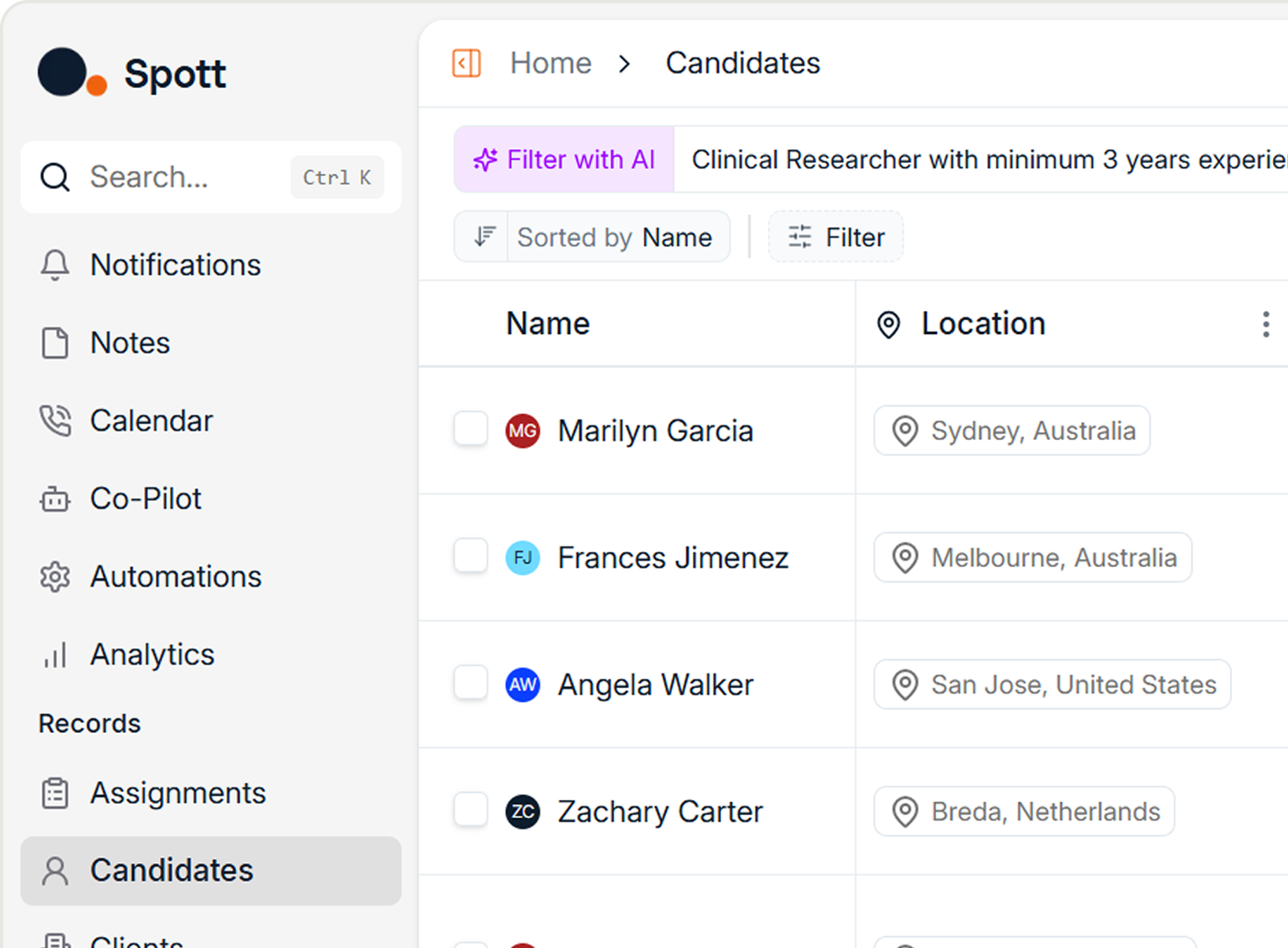
Spott's approach: the recruiting workflow is the product. One database a recruiter searches by meaning, a note-taker that files itself, enrichment on demand and multi-channel outreach, all native, all on every plan. Nothing to assemble.
At a glance
| Category | Spott | Salesforce for recruitment |
| What it is | AI ATS + CRM built for recruitment out of the box | General CRM + a partner recruitment app + config |
| Recruitment objects | Candidates, jobs, placements and pipelines native from day one | Added by the partner app (Bullhorn RC, TargetRecruit, Byner…) |
| Search & matching | Meaning-based search and matching over CVs, notes, transcripts, attachments; built in | Platform/app search; matching depends on the app or add-ons |
| AI | Native AI on every plan; no metering, no per-action bill | Agentforce, metered per action; partner AI agents on top |
| Communication | Mail, calendar and WhatsApp arrive on the record ready to use; campaigns included | Email/CRM native; recruitment sequencing via the app or add-ons |
| Meeting intelligence | AI note-taker built in, not bolted on | Not native; third-party tool |
| Data & enrichment | Clean data by default: deduplication at entry, enrichment on demand | Data quality is a configuration and add-on question |
| Implementation | Live in about 4 weeks with the in-house migrations team, no external consultants | A project: app install + platform config + admin, weeks to months |
| Security & compliance | EU-hosted, ISO 27001; customer data never used for model training | SOC 2, ISO 27001, EU regions via Hyperforce (strong) |
| Pricing | $199/user · All-in-one platform | Sales Cloud seat + app licence + Agentforce metering + services |
The recruitment-on-Salesforce routes
Every route is a separate paid app on the Salesforce platform, plus configuration:
- Bullhorn Recruitment Cloud (formerly Bullhorn for Salesforce, the "force.com" product) is the largest, and the only recruitment ISV at Salesforce's Summit Partner tier. Its AI agents ship under the Amplify brand on Agentforce. Pricing is custom-quoted.
- TargetRecruit is enterprise staffing software built on Salesforce, now Bullhorn-owned, with front, middle and back office and its own Agentforce-powered agents.
- Byner is a staffing and recruitment platform built on the Salesforce platform, covering CRM, ATS and contract admin.
- Seven20 and Asymbl are Salesforce-native recruitment apps, Asymbl having launched its own Agentforce recruiting agents.
The common thread: the app adds the recruitment objects, Salesforce provides the platform seat underneath, and a certified admin or consultant makes it fit your process.
What Salesforce for recruitment costs
The bill has layers. Salesforce Sales Cloud lists Enterprise at $175 per user per month billed annually, the realistic tier for an agency that wants proper CRM objects. Premier Success support adds 30% of your net licence fees. That's roughly $227 per user before recruitment exists. Then the partner app carries its own custom-quoted licence, and platform licensing is typically budgeted as a separate line, so confirm what your quote includes before assuming it's bundled.
AI is metered on top. Agentforce runs on Flex Credits at $500 per 100,000 credits, where a standard agent action is about 20 credits, roughly ten cents each, and a voice action is 30. There's a $2-per-conversation model for external agents, a $125-per-user add-on for unmetered internal use, and Agentforce 1 editions from $550. For a staffing team running thousands of AI actions a day, the cost is real and hard to forecast. Then there's the configuration project itself, weeks to months and five to six figures with a consultancy, plus ongoing admin.
Spott replaces the stack with two numbers. Core is $139. Pro is $199. Per user, per month, on an annual agreement. Matching, the note-taker, enrichment and multi-channel campaigns are included, and enrichment credits are the only metered line. The whole thing is on the pricing page.
Bottom line: on Salesforce, the seat is the smallest line on the invoice. Add the recruitment app, Agentforce metering, implementation and admin, and it's a different order of cost from an all-in recruiting platform.
AI: metered agents vs included intelligence
Salesforce's AI is Agentforce, and it's real, but it's generic and usage-priced. You build or license agents, and every action they take, matching, screening, summarising, routing, draws metered credits. The recruitment-specific agents (Bullhorn's Amplify, TargetRecruit's TR Intelligence, Asymbl's) sit on top of that meter, and none publish a bundled cost. So the AI is capable and its running cost moves with your volume.
In Spott, the AI is included and its cost is predictable. The note-taker joins calls and writes structured records. Matching and AI suggestions read the whole database. Enrichment runs on demand from credits. The AI runs on enterprise licences your candidate data never trains, and it's on the base plan, not a per-action tab.
Bottom line: Agentforce meters every AI step; Spott includes the intelligence and only meters enrichment.
Search and matching
On Salesforce, candidate search is whatever the platform and your partner app provide, keyword and filter search over the objects you configured, with semantic matching depending on the app or a bolt-on. It's as good as the build.
Spott searches by meaning out of the box. Describe the person you need and the engine reasons over CVs, call transcripts, attachments and notes together, then ranks each candidate with the reasoning shown. No configuration, no add-on.
Bottom line: on Salesforce, matching quality is a project input. On Spott it's a default.
Data quality, enrichment and adoption
Salesforce does a lot, and it asks a lot in return. Data quality, deduplication and enrichment are configuration and add-on questions, and the CRM's enterprise-sales interface is one recruiters often need training and admin support to live in. Adoption is a line item.
Spott blocks duplicate emails and phone numbers on entry, refreshes a profile from a re-uploaded CV, and runs enrichment on demand, with an interface built for recruiters rather than sellers. Go-live is measured in weeks.
Bottom line: Salesforce rewards a team with admin capacity; Spott is built to be used on day one.
Security and compliance
This is not where the two differ. Salesforce holds SOC 2 and ISO 27001 and offers EU-region hosting through Hyperforce. That's as strong as enterprise software gets.
Spott is ISO 27001 certified, EU-hosted by default, with candidate data that never trains AI models, documented in the Trust Center. Both vendors clear a serious security bar; compliance is a tie, not a tiebreaker.
Switching to a recruitment-native platform
Agencies leave a Salesforce-based setup when the assembly cost, the licence stack, the metered AI, the admin, the configuration debt, outgrows the flexibility they bought it for. A Spott migration runs about four weeks, handled by Spott's in-house migrations team, and the move keeps your data model intact. Macmillan Davies moved 280,000 records, deduplicated, and went live inside four weeks.
When Salesforce makes sense
For some organisations, building on Salesforce is the right answer:
- You're already standardised on Salesforce. One platform, one admin team, shared data across sales and recruiting.
- You have admin and budget for a build. Certified admins or a consultancy to configure and maintain the org.
- You want deep custom workflows. The platform bends to almost anything, given the time to build it.
- Enterprise procurement and compliance drive the choice. Salesforce's certifications and scale answer that brief.
Where Spott wins
- Recruitment-native from day one. Candidates, jobs, matching and outreach are the product, not an app you install and configure.
- One transparent price. $139 Core / $199 Pro, versus a Sales Cloud seat plus a partner licence plus metered Agentforce plus services.
- AI included, not metered per action. Matching, note-taking, enrichment and campaigns come with the plan; only enrichment is metered.
- Semantic search out of the box. No build to make matching work.
- Weeks, not a project. Go-live in about four weeks, handled by Spott's in-house migrations team.
- Built for recruiters. An interface and data model made for the desk, not a CRM adapted to it.
What are the best Salesforce-for-recruitment alternatives?
If the goal is recruitment on a Salesforce foundation, the honest answer is a partner app, and Bullhorn (whose Recruitment Cloud and TargetRecruit are the main Salesforce routes) is the reference point. If the goal is a recruiting platform without assembling one, agencies compare Spott against those apps directly. The wider field is in our top 10 ATS and CRM platforms for 2026, with in-depth reviews of Vincere and Loxo alongside.
Bottom line
Salesforce is a major platform, and it isn't a recruitment system. To hire on it you buy a partner app, license Agentforce by the action, and run a configuration project with admins to keep it going. For an enterprise already living in Salesforce, that trade can pay off.
Spott is the recruiting platform Salesforce becomes only after you assemble it, native objects, semantic matching, a note-taker, enrichment and outreach, on every plan, at a price that fits on a page and a go-live measured in weeks. For an agency that wants to recruit rather than build, that's the difference.
See it on your own roles. Book a demo.

A full side-by-side breakdown for most platforms we get compared to.





Frequently Asked
No. Salesforce is a general CRM (Sales Cloud / Service Cloud) with no native recruitment product. Agencies turn it into an ATS by installing a partner app from the AppExchange (Bullhorn Recruitment Cloud, TargetRecruit, Byner, Seven20, Asymbl) and configuring candidate, job and placement objects, usually with admin or consultant help. Spott is a recruitment-native ATS and CRM out of the box.
More than one line. Sales Cloud Enterprise lists at $175 per user per month billed annually, Premier Success support adds 30% of net licence fees, and the recruitment partner app carries its own custom-quoted licence on top. Agentforce AI is metered (Flex Credits at $500 per 100,000, about ten cents per standard action), and implementation is a weeks-to-months project. Spott is Core $139 / Pro $199 per user per month, with the AI included and migration in about four weeks.
It's Bullhorn's recruitment application built on the Salesforce platform, the largest Salesforce-based ATS/CRM for staffing, and the only recruitment ISV at Salesforce's Summit Partner tier. Its AI agents ship as Amplify on Agentforce. Pricing is custom-quoted, and Salesforce platform licensing is typically budgeted separately, so confirm what your quote includes.
Through Agentforce, its usage-priced AI-agent platform, plus recruitment agents from the partner apps (Amplify, TR Intelligence, Asymbl). It's capable and generic, and every action is metered, which makes running cost hard to forecast at staffing volume. Spott includes matching, note-taking and AI suggestions on every plan.
If you want to stay on Salesforce, the routes are its partner apps, chiefly Bullhorn Recruitment Cloud and TargetRecruit. If you want a recruiting platform without building one, agencies compare Spott and other recruitment-native ATS/CRMs directly.
About four weeks, handled by Spott's in-house migrations team. Spott keeps your data model, so candidates, clients, jobs, placements, notes and history transfer with virtually zero loss.
Rarely the simplest choice. The licence stack, metered AI, configuration and admin suit larger, Salesforce-standardised organisations; smaller agencies usually reach value faster on a recruitment-native platform.

Outp(l)ace everyone.
You can’t win tomorrow’s placements
with yesterday’s tools.