How True Blue Recruitment Builds a Shortlist in 20 Minutes, Not a Day
Company: True Blue Recruitment
Who: A four-consultant technology recruitment firm in Bangkok, Thailand
What: Tech hiring for businesses in Thailand: AI, software engineering, cloud, cyber security, data, IT sales and tech leadership
Before Spott: JobAdder, inherited from a private-equity-backed group, plus a set of AI tools the founder built in Claude that could not talk to it
Result: Shortlists that took an afternoon or a day now take roughly 15 to 20 minutes
James Hine used to lose an afternoon, sometimes a whole day, building a shortlist. Run a search on LinkedIn. Cross-reference it against the database. Remember who he had spoken to before. Two separate jobs, done by hand.
Today he pastes the job description into one prompt, and the shortlist comes back with people from outside and people already in Spott, ranked together.
"A process that might have taken before an afternoon or a day is now done in, I don't know, 15, 20 minutes, something like that."
James Hine, Founder, True Blue Recruitment
Prefer to hear it from James himself? Watch the interview, or read on for the full story.
The problem: an ATS he could not plug his AI tools into
True Blue is a Bangkok-based recruitment firm that helps businesses in Thailand hire tech talent. It used to be part of a private-equity-funded group of recruitment companies, and the group ran every firm on the same stack.
"The idea behind it was that all of those companies would have the same platform. So you'd have the same website provider, you'd have the same ATS."
When James led the management buyout, True Blue inherited all of it. The business needed stability first, so the stack stayed. But he was never happy with it.
"I was never really happy with the ATS, which was JobAdder, and I really disliked the website as well."
James had been experimenting with AI since before ChatGPT launched. Over time he built his own tools in Claude: one for generating business development leads, one for sourcing candidates. They got good enough to use every day. And every day, they ran into the same wall.
"For a recruitment business, it's your database, it's your bread and butter. So that is the thing that you want to plug into any tools that you're building outside of your ATS. And we couldn't do that."
His tools could find people and companies. They could not tell him whether True Blue already knew them. That was the catalyst.
"I was using them day in, day out. It was like, okay, this is a problem now, that I can't cross-reference what I'm finding through Claude with the ATS system."
(If you are weighing the same move, here is how the options compare: top JobAdder alternatives for 2026.)
Why Spott: the missing piece in the stack
Once the business was stable, James started looking at AI-native ATS platforms. Spott kept coming up.
"It just kept appearing everywhere. It was all over my LinkedIn newsfeed. Other recruiters were talking about it. So I thought, you know what, I'm going to book a demo."
The demo settled it quickly.
"It was what we were missing. It was that piece that I could integrate into all of the other tools that I didn't have before. So pretty much as soon as I saw it, I was like, okay, I'm quite confident that this is the one that we want."
Three things made the difference:
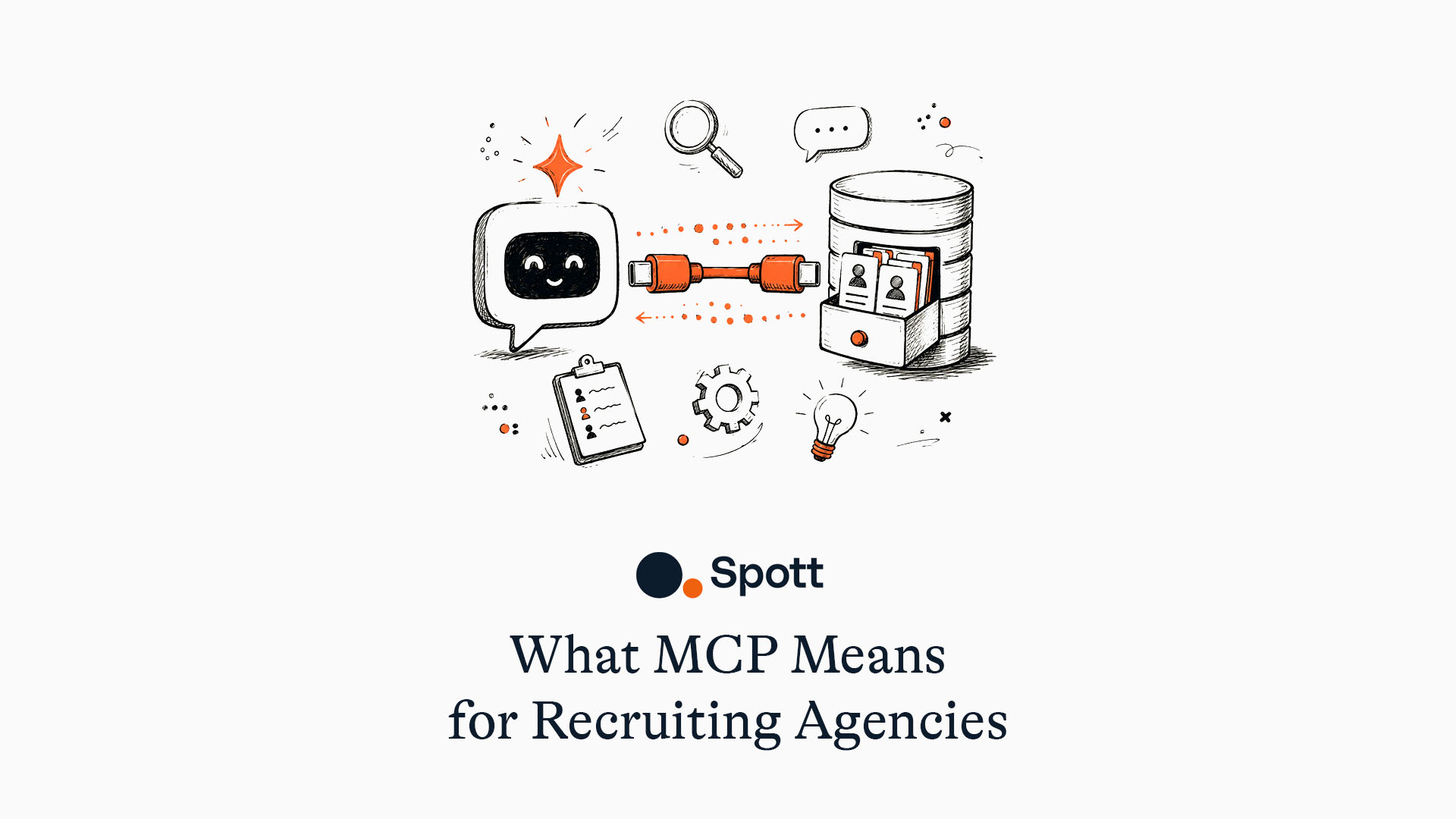
- An MCP connection to Claude. The point of the switch. James calls the setup "idiot proof": anyone can make the MCP connection, and as long as you can prompt well, Claude works out the rest. (New to MCP? Start with what MCP means for recruitment agencies.)
- AI search that reads more than the CV. Spott searches the CV, every note and every other data field, and infers from all of it. "A lot of the old ATS systems, they would just be searching for keywords on a CV and then ranking them based on how many times those words came up."
- A notetaker built in. James was paying for a separate recorder that fed his own tools but not the ATS. Spott's AI notetaker joins the meeting and files the conversation straight into Spott, and it is included in the price, so there is no second subscription.
What changed: one prompt, one shortlist
With Spott plugged into Claude, James's tools see the database. That changes two workflows he runs every day.
Shortlists. Before, external search and database search were two separate steps. Now they are one.
"So I can just put the prompt into the tool, the job description, what I'm looking for. It'll go out. It'll find people externally and it will find people on Spott and it will build that shortlist straight away."
A recent example: a cybersecurity sales role for a Chinese organisation. The client wanted someone who had sold that type of security tool, ideally inside a Chinese company, with experience at a global vendor as a fallback. James put those preferences into the prompt. The tool mapped the target companies in seconds, built a rubric from the brief and scored every candidate against it, with the reasons attached.
"That sort of stuff would have been impossible 12 months ago. You would have had to have done that manually yourself."
True Blue had two candidates in front of the client within days of taking the role. Both were in the interview process when we spoke. The candidates James picks from the shortlist go straight into the pipeline through the MCP, with no re-keying. (For how this kind of matching reads a database, see how AI finds the best candidates.)
Business development. James's BD tool used to hand him raw leads: company A is hiring for this, here is a person to talk to. Then he had to check by hand whether the firm already knew them. Now the report does that for him.
"That report goes from 'this company is hiring for this role, and this is the person you should speak to' to 'by the way, they're in your database, and your colleague spoke to them last week, or you had a role with them two years ago.' So it's just a lot better information."
A new website and job board, built on the Spott API
Moving off JobAdder also meant moving off the old website, because the job board was tied to the old ATS. James took the chance to rebuild the whole site.
Spott gives you two options: use the Spott job board, or pull your jobs through the API and build around them. James chose the API so the job board could match his brand and feed different parts of the site.
"I was able, without an engineering background, to build the website and integrate the job boards natively into Spott."
It is early. The new site had been live for about six weeks at the time of the interview, and James wants six to twelve months of data before he quotes numbers. But the direction is clear: more traffic, and more applicants coming through the website.
Doing more with the team they have
Earlier this year, two people left True Blue. Normally that means a scramble to replace them. This time James did not panic.
"It allows you to do more with less. So I wasn't panicking to think, right, okay, I need to hire two more people. It was like, okay, well, hire good people if they come up. But I actually think we can get more out of the team that we've got at the moment by empowering them and giving them the right tools."
So far, productivity has not dropped. For James, that time goes back into the part of the job software cannot do.
"If it's saving you time doing the admin stuff and the boring stuff, the staring at the computer screen, building shortlists, looking at LinkedIn, it allows you to do more of the stuff that actually makes you money in recruitment, which is the people stuff."
The migration he did not need to worry about
James has moved ATS before, and some of those moves went badly.
"I've been through a few horror ones in the past where the data was just not gone across properly, and you might have a better system, but the data that you've got within that system is a mess."
He had been strict about tagging in JobAdder, and he was worried that clean, accurate data would arrive in the new system in a mess. It did not. True Blue went from first demo at the end of June to working in Spott by the end of July 2026.
"The migration was fantastic. Everything came over as we instructed it. It was where we expected it to be. So that was a concern that I didn't need to have, basically."
(Planning your own move? Our recruitment CRM migration guide covers what to prepare.)
What he says about the team behind it
James still thinks of himself as a startup founder, and he recognises the same hustle at Spott.
"They're very responsive. They listen, they take feedback on board. So far they've been really good. Nothing but good things to say about them."
The product has to be good, he says, but people buy from people they like.
"The fact that everyone is really personable, and they're nice people to deal with, I think that's the cherry on top."
Who he would recommend Spott to
James's answer is broader than you might expect from someone who builds his own AI tools.
"I would recommend Spott to anyone, because I think it can appeal to different people at different levels of capability when it comes to technology."
If you are not technical, the tools already built into Spott change how you work on day one. If you like building your own things and experimenting with AI, the API and MCP give you room to play. Flaire, a Paris tech recruiter, took that second route even further: read how it built an agentic layer on top of Spott.
"I think anyone that thinks that they can do more with their ATS system, it would be good for."
James Hine, Founder, True Blue Recruitment
Want a database your AI tools can actually talk to? Book a demo.