What MCP Means for Recruitment Agencies
We're living through the AI era of recruiting, and MCP is one of the more powerful new ways to make that AI work for you. It lets AI assistants like Claude and ChatGPT connect directly to your recruiting database, so your team has another way to get more done in less time.
If you haven't heard of MCP yet, you will. It's the standard quietly reshaping how AI assistants connect to the tools you use every day, including your ATS. For recruitment agencies, it opens up workflows that simply weren't possible a year ago.
Here's what MCP is, what it lets your team do, and how it fits into a modern AI recruiting stack.
What is MCP?
MCP (Model Context Protocol) is an open standard, originally introduced by Anthropic, that lets AI assistants like Claude and ChatGPT securely read and write data from external systems.
Think of it as the USB-C for AI tools. Before MCP, every integration between an AI model and a software platform had to be custom-built. Now, any platform that exposes an MCP server can be connected to any MCP-compatible AI assistant - in minutes, with the user's own credentials, no engineering team required.
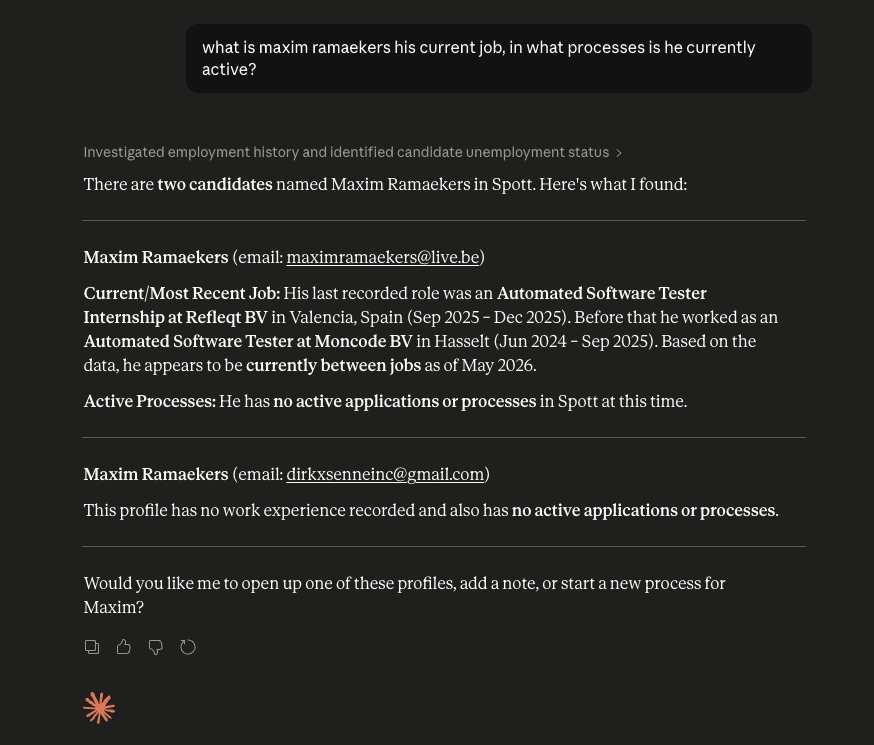
For recruiters, this changes one thing fundamentally: your AI assistant can now work directly with your ATS data.
How MCP fits into a modern AI recruiting stack
It's worth saying upfront: MCP isn't the only AI in your ATS. A modern AI-native platform like Spott already has plenty of intelligence built in - contextual matching, auto-notes from calls, candidate enrichment, AI-generated reports, in-product agents and automations that run quietly in the background.
MCP is an additional way to interact with all of that. It opens a second front: instead of (or alongside) using the AI features inside the platform, you can now talk to your data through Claude or ChatGPT and have those tools work on your behalf.
Some recruiters will live mostly inside Spott and use MCP occasionally for ad-hoc questions. Others will spend half their day in Claude with Spott connected. Both work. The point is that MCP gives your team optionality - and that's where the productivity gains compound.
What you can actually do with Spott's MCP server
Once Spott is connected as a Custom Connector in Claude or ChatGPT, your team can start asking real questions and triggering real actions. A few examples of what's possible today:
Strategic questions for agency owners
- "Which clients haven't given us a new mandate in the last 6 months but were in our top 10 last year?"
- "Show me placement GP by recruiter this quarter, broken down by industry."
- "What's our pipeline conversion rate from longlist to placement over the last 90 days?"
- "Build me a weekly business review based on this week's activity."
Questions that used to require a custom report or 30 minutes of clicking now take 30 seconds inside a chat.
Tactical workflows for recruiters
- "Find every CFO candidate we've spoken to in the last 12 months who mentioned interest in PE-backed roles."
- "Summarise all our interactions with [Company] before my call tomorrow."
- "Which candidates in our database match this new job spec? Score them and tell me why."
- "Draft personalised outreach to these 20 senior product managers based on their last conversation with us."
- "Generate a candidate report for [Name] in our branded template, ready to send to the client."
This kind of work used to mean switching between five tabs and hoping you remembered what was discussed six months ago. Now it's a sentence.
Operational and pipeline work
- "Identify all stalled placements where the candidate hasn't been contacted in 14 days, and draft follow-ups."
- "Map every fintech CFO in London who isn't already in our database."
- "Analyse why our placement-to-shortlist ratio dropped this month."
The pattern across all of these: your AI assistant becomes an analyst, a researcher, and a junior recruiter combined - working directly on your data, not on hypothetical examples.
Recruiting without MCP vs with MCP
MCP, API, and the foundation that matters
Some technical recruitment firms look at the AI revolution and think: "Why don't we just build our own?"
It's a fair instinct, but the core of an ATS/CRM is harder than it looks. Even with 20+ engineers shipping daily on the latest AI tools, getting reliability, security, and the AI layer right takes years - and the work never stops.
Building on top of an existing AI-native ATS is usually the smarter route. That's exactly what Spott's API and MCP server are for. You get a reliable, vectorised database underneath that's already performant and secure - and you can build whatever you want on top.
MCP is essentially an API in a different wrapper — a standardised way for AI assistants to talk to your platform. The foundation underneath matters more than either: a vectorised, secure, performant ATS database makes everything you build on top compound in value, while a weak foundation undermines every AI workflow on top of it.
Why this matters more as AI agents mature
According to Korn Ferry's 2026 TA Trends report, over half of talent leaders plan to deploy autonomous AI agents this year. If 2025 was the year recruiters started using AI, 2026 is the year AI agents start doing more work autonomously.
An AI agent isn't an assistant you ask questions to - it's a system you give a task to. "Source, qualify, and draft outreach to 30 senior engineering candidates for this CTO role, then update me when you're done." An agent runs that workflow on its own, using your tools and data.
Spott already runs a number of agents inside the product - from auto-notes that capture calls to enrichment that keeps profiles fresh. MCP extends that surface area: it gives external AI agents (like the ones built into Claude or ChatGPT) the same secure access to your data, so they can plug into your workflows too.
Having an ATS with both built-in agents and an open MCP server means you can take advantage of either or both - whatever fits the workflow.
How to get started with Spott's MCP server
If your firm is on Spott, you can connect to Claude or ChatGPT in a few minutes.
Each user connects with their own credentials, so the AI can only see and act on data that user already has permission to access. Confidentiality and access controls work exactly as they do inside Spott.
If your firm isn't on Spott yet and you want to see what AI-native recruitment looks like in practice - the matching engine, the in-product agents, and the open MCP layer - book a demo.
The bottom line
MCP is one of the most powerful additions to the modern recruiting toolkit. It turns your ATS from a system of record into something your AI tools can actively work with - on top of everything an AI-native platform already does inside the product.
You don't have to use MCP to get value from an AI-native ATS. But for the agencies that do, it's another lever. Another way to move faster, ask better questions, and get the AI era of recruiting working for them rather than around them.

Frequently Asked
MCP (Model Context Protocol) is an open standard introduced by Anthropic in late 2024 that lets AI assistants like Claude and ChatGPT securely read and write data from external systems. Think of it as the USB-C for AI tools - any platform that exposes an MCP server can be connected to any MCP-compatible AI assistant in minutes, with the user's own credentials and no engineering work required.
MCP lets recruitment agencies connect their ATS directly to AI assistants like Claude and ChatGPT. Instead of copy-pasting candidate data between tools, recruiters can ask AI questions about their live recruiting database and trigger real actions - searching candidates by full context, generating shortlists, drafting outreach, and producing reports. For agencies, this collapses the gap between AI tools and the ATS where the actual value lives.
As of mid-2026, very few recruitment platforms have launched MCP servers. Spott is among the first AI-native ATS/CRM platforms to ship one, allowing direct integration with Claude and ChatGPT at mcp.spott.io/mcp. Most legacy ATS vendors are constrained by older data models and slower release cycles, meaning MCP support will likely remain a competitive edge for AI-native platforms throughout 2026.
With an MCP server connecting their ATS to Claude or ChatGPT, recruiters can ask questions and trigger actions in natural language: "Find every CFO candidate we've spoken to in the last 12 months," "Summarise all interactions with this client before my call," "Draft personalised outreach to these 20 candidates," or "Generate a candidate report in our branded template." The AI works directly with the live ATS data - no copy-paste, no exporting required.
AI agents are systems you give tasks to (e.g. "source, qualify, and draft outreach to 30 senior engineering candidates for this role"), not just questions you ask. For agents to do recruitment work effectively, they need secure, structured access to ATS data. MCP provides that access. Without an MCP server, your ATS is invisible to the agent ecosystem. Korn Ferry's 2026 TA Trends report shows over half of talent leaders plan to deploy autonomous AI agents this year - and they'll work best on platforms where agents can plug in.
Yes. Each user connects with their own Spott credentials, so the AI assistant can only see and act on data that user already has permission to access inside the platform. Role-based permissions, audit logs, and data residency rules apply identically whether someone is working in the Spott UI or through Claude or ChatGPT. There's no separate data layer being exposed and no shared service account.
No. Connecting Spott to Claude or ChatGPT takes two or three minutes and no code. You add a Custom Connector in your AI assistant, paste the server URL (https://mcp.spott.io/mcp), sign in with your usual credentials, and you're done. The whole point of the protocol is to remove the engineering team from the integration path so every recruiter on your team can do it themselves.
An API is how software talks to other software, usually with a custom-built integration for each tool. MCP is essentially an API in a different wrapper, designed specifically for AI assistants. It gives any MCP-compatible AI - Claude, ChatGPT, and others - standardised read and write access to a platform without anyone having to build a one-off integration. APIs and MCP coexist: Spott's API is for developers building products on top of the platform, MCP is for end users plugging AI assistants into their day-to-day work.

Outp(l)ace everyone.
You can’t win tomorrow’s placements
with yesterday’s tools.