Top Vincere Alternatives in 2026
In depth review
Discover the ideal ATS/CRM solution for your business as we
compare the top contenders for you in our head-to-head series
TL;DR
The 7 best Vincere alternatives in 2026 are Spott (AI-native, contextual matching across the full workflow), Bullhorn (enterprise scale and back-office), JobAdder (clean UX and a 200+ job board ecosystem), Recruiterflow (automation and AIRA agents), Recruit CRM (budget-friendly), Loxo (built-in sourcing database) and Carerix (Benelux temp and flex depth). Most agencies leaving Vincere are reacting to the same thing: a platform that changed after The Access Group acquisition. The right replacement depends on whether you're chasing AI depth, back-office capability, lower cost, or freedom from auto-renewing contracts.
Why agencies are looking for a Vincere alternative in 2026
Vincere earned its reputation. Founded in Singapore in 2012, it positioned itself as a full-stack "recruitment operating system" covering front, middle, and back office, and it won real traction (22,000+ recruiters, strong UK and APAC presence) by being the modern alternative to legacy platforms like Bullhorn. For agencies running temp and contract operations, its back-office and analytics depth is genuinely strong, and many will continue to be well served by it.
The reasons recruiters are evaluating alternatives in 2026 are also real, and almost all of them trace back to one event: the January 2022 acquisition by The Access Group, a large UK software conglomerate. The platform was rebranded "Access Vincere Evo," and the experience underneath shifted. The complaints cluster around four themes.
Support quality declined after the acquisition. This is the single most common thread in recent reviews. Users report that human support was partially replaced with AI, that there's no human support on weekends, that emails go unanswered, and that getting responsive help increasingly requires a premium support package. One Capterra reviewer put it bluntly: "This is a product that has collapsed in recent years since its acquisition." Support quality is, in effect, paywalled.
The contract structure is hard to exit. Vincere uses annual contracts with automatic renewal and a 90-day (three-month) cancellation notice window tied to the renewal date. Miss that window and you're locked in for another full year, which in practice can mean giving up to 14 months' notice to leave at the right time. Some customers report the notice terms changed after the Access acquisition, and others report being charged to get their own data back on exit.
Prices rose without matching product gains. A 6.5% price increase landed in April 2025 with no cited product improvements, and pricing remains opaque and modular. The core seat is one line item; Intelligence (analytics), Pay & Bill, TimeTemp, Engage portals, Comms, and Screening are separately priced. The advertised platform price is rarely the all-in number.
AI Copilot is layered on, not built in. To Vincere's credit, the Evo Copilot is included as standard with all plans rather than sold as an add-on, and it does real work: candidate scoring, natural-language search, job description generation, CV formatting, and a claimed 1,000+ automated tasks. But it's an AI layer on a platform whose core matching and search were architected as keyword-driven, and independent user validation of its quality remains thin. Meanwhile the roadmap now moves at conglomerate pace, set by Access Group's portfolio priorities rather than Vincere's recruiters.
If any of that resonates, the seven platforms below are the alternatives most often compared against Vincere in 2026 evaluations.
Comparison at a glance
| Platform | Best for | Distinct strength |
|---|---|---|
| Spott | Agencies wanting AI built into every workflow | Contextual AI matching, AI notetaker, unified omnichannel inbox |
| Bullhorn | Large staffing firms with deep back-office needs | Scale, VMS integrations, Amplify AI suite |
| JobAdder | ANZ/UK agencies leaning on board distribution | 200+ job board ecosystem, clean UX |
| Recruiterflow | Small-to-mid agencies focused on automation | AIRA AI agents, support quality |
| Recruit CRM | Cost-sensitive small agencies under 20 seats | Entry pricing, ease of setup |
| Loxo | US agencies that lean on outbound sourcing | Built-in 1.2B profile sourcing database |
| Carerix | Benelux temp/flex agencies with back-office needs | Dutch market depth, payroll/invoicing connectors |
| Vincere | UK/APAC agencies running temp and contract | Back-office suite, 50+ report analytics module |
How we evaluated each platform
This isn't a feature-checkbox roundup. The platforms below were assessed against five criteria that consistently come up when agencies tell us why they're leaving Vincere:
- AI depth. Is AI built into the core data model and workflows, or layered on as a Copilot over a keyword engine? Does it actually change how recruiters work, or mostly generate text?
- Migration time and cost. Switching ATS systems is expensive, and Vincere's exit terms make it more so. How long is the realistic implementation, what does it cost, and who handles it?
- Pricing transparency and contracts. What's the all-in cost once you add the modules you need? How are contracts structured, and how hard is it to leave?
- Workflow fit by staffing model. Perm, contract, temp, and retained exec search each have different needs, and back-office depth matters more for some than others. Does the platform fit yours?
- Operational fit. What does support, onboarding, and ongoing customer experience actually look like once you're a customer, especially in the regions you operate in?
Pricing is quoted as ranges based on public information and recent reviews. Always confirm current pricing with the vendor before signing.
1. Spott
Founded: 2024 | HQ: San Francisco | Pricing: From $139/user/month
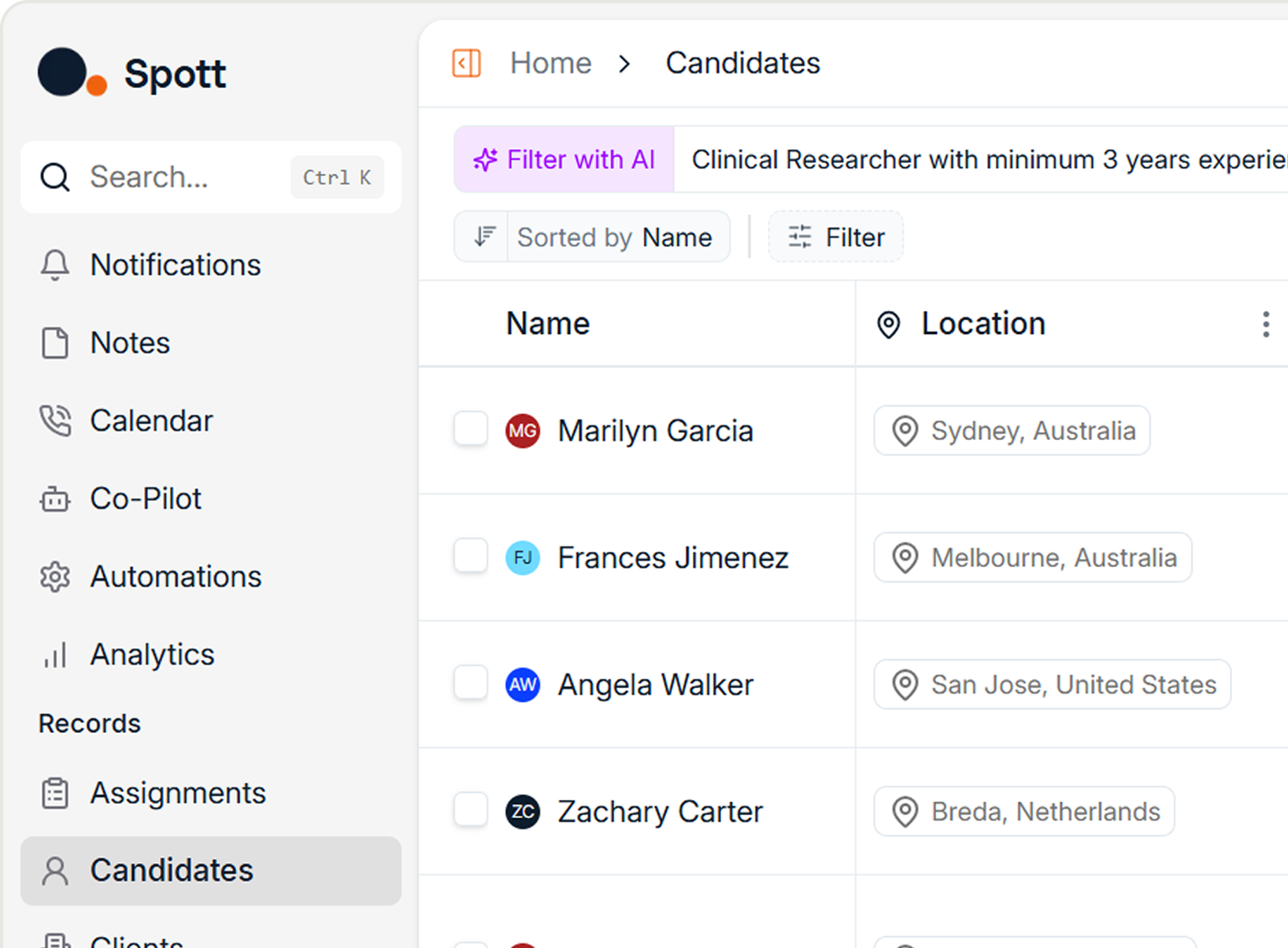
Spott is an AI-native ATS/CRM built for the new era of recruiting. Where legacy platforms accumulated decades of bolt-ons, paid modules, and acquired tools around an aging core, Spott was designed from inception as one all-in-one product. AI matching, notes, enrichment, outreach campaigns, candidate presentation reports, analytics, automations, and the omnichannel inbox are a single platform, not seven modules priced separately.
In practice, that shows up across the recruiter's day. Matching that ranks candidates by context (not keywords). Automatic note-taking from calls and meetings that maps the right data into candidate profiles. AI-generated candidate reports in your own branded templates. Continuous data enrichment. Personalized outreach across email and WhatsApp. All native, with no add-on subscriptions to unlock the useful parts.
Spott runs across the US, Europe, and APAC, from boutique shops to multi-region firms. Customers include CGP Group, a global recruitment firm operating 20 offices across APAC, the US, and Europe. ISO 27001 certified, GDPR compliant, EU-hosted by default, with SSO and role-based access controls built in for enterprise IT and security requirements.
Where Spott stands out vs Vincere:
- AI-native architecture vs a Copilot bolted on. Vincere's Evo Copilot is a genuine, included capability, but it layers AI over a platform whose matching and search were built keyword-first. Spott's AI was the starting point of the platform, and it compounds because the data model was designed for it.
- Contextual matching, not keyword scoring. Spott reads a candidate's full work history, notes, calls, and messages and ranks fit by context. Vincere's core search remains keyword-driven beneath the Copilot layer.
- All-in-one product, not modules. Notetaker, enrichment, outbound campaigns, AI matching, candidate presentation reports, analytics, and CV reformatter are in the seat price. Vincere prices Intelligence, Pay & Bill, TimeTemp, Engage, Comms, and Screening separately.
- No contract trap. Spott offers transparent, all-inclusive pricing with monthly flexibility. No auto-renewing annual lock-in, no 90-day notice windows, no fees to get your data back.
- Unified omnichannel inbox and Ask AI. Email, WhatsApp, SMS, calendar, and VoIP conversations sit in one inbox tied to the candidate record, and recruiters can ask natural-language questions across the full dataset instead of building reports.
- Startup pace vs conglomerate roadmap. Spott ships weekly with a roadmap shaped directly by customers. Inside a large software group, Vincere's releases move at portfolio pace.
"The precision of the AI matching stood out immediately."
— Kristof Stevens, United Consulting
For a side-by-side feature breakdown, see the full Spott vs Vincere comparison.
What to keep in mind:
- Back-office depth for temp and contract is where Vincere genuinely leads. Spott's temp capabilities are growing but don't yet match Vincere's TimeTemp (timesheets, geofencing) and Pay & Bill suite.
- The Intelligence analytics module is broad. Spott includes AI-generated insights and reporting, but Vincere's 50+ pre-built reports and KPI consoles are more mature out of the box.
- No native VoIP or SMS module. Spott integrates with leading VoIP providers but doesn't run telephony in-house.
Best for: Agencies of 5–200 recruiters running perm, contract, retained search, or hybrid models, across the US, Europe, and APAC, who want AI that actually changes the daily workflow, one platform instead of seven modules, and pricing without a lock-in.
Bottom line: If you're leaving Vincere because support, contracts, and pace changed after the acquisition, and because AI feels layered on rather than built in, Spott is the most direct answer. AI-native from inception, EU-hosted and enterprise-ready, transparent pricing with no auto-renewal, and weekly innovation the way Vincere itself once moved before the Access deal.
2. Bullhorn
Founded: 1999 | HQ: Boston | Pricing: Starter $99/user/mo, Core $165/user/mo (published, July 2026); Pro and add-ons quote-only
Bullhorn is the legacy market leader and, for many Vincere customers, the obvious "step up" when back-office and scale are the priority. 10,000+ customers, 1,400 employees, 300+ integrations, and a track record at 500+ seat firms.
Where Bullhorn stands out vs Vincere:
- Scale and ecosystem. 300+ integrations and 110+ VMS connections. If your client mix includes VMS-driven enterprise accounts, Bullhorn handles that operating model in ways most alternatives don't, Vincere included at the top end.
- Back-office depth. Onboarding, timesheets, pay & bill, and invoicing through native modules and partner integrations, at a scale beyond Vincere's.
- Amplify AI suite. Amplify now includes eight AI skills (Enrich, Match, Screen, Message, Outreach, Present, Research, Insight), with Copilot included for Enterprise Edition. Like Vincere's Copilot, it's an AI investment on a legacy core, but it's a substantial one.
Where Bullhorn falls short:
- Add-on pricing. Base seats start in the $99–$165 published range, but Automation (Herefish), Analytics, SourceBreaker, Textkernel, and Amplify modules are typically priced separately. Buyer reports and reviews cite implementation fees in the low thousands, and customers report annual price indexation in multi-year contracts, much like Vincere's modular model, only bigger.
- Legacy UX drag. Slow loads, dense screens, and a steep onboarding ramp are recurring complaints. The architecture predates modern recruiting patterns.
- Support quality. Consistently flagged in reviews as a weak point relative to mid-market alternatives.
- Implementation timeline. Users on G2 describe multi-month rollouts, especially where legacy data migration is involved.
Best for: Larger staffing firms with VMS-driven contracts, multi-entity invoicing, and serious back-office requirements that have outgrown Vincere.
Bottom line: Bullhorn is the move if you're leaving Vincere because you need more back-office and enterprise integration, not less. Just budget realistically: the seat price isn't the total cost, and Amplify, while genuinely improved, doesn't match the cohesion of AI-native platforms where every feature was designed around the AI from the start. For a feature-level look, here's our Spott vs Bullhorn comparison.
3. JobAdder
Founded: 2007 | HQ: Sydney (London office) | Pricing: Around $135–160/user/month (custom, not public)
JobAdder is the clean, well-supported ATS/CRM that competes with Vincere on usability and board distribution rather than back-office depth. 26,000+ users across 20+ countries, 200+ job board integrations, a strong CSAT track record, and an 18-year history. Plans run Lite, Essential, and Pro.
Where JobAdder stands out vs Vincere:
- Job board ecosystem. 200+ board integrations plus a SEEK distribution partnership. If your sourcing leans on board distribution, this is deeper than Vincere.
- Usability and support reputation. JobAdder is consistently praised for a clean interface and solid support, the exact areas where Vincere reviews have slipped post-acquisition.
- Adder Intelligence. Launched November 2025 (Smart Summary, Smart Sync, Smart Job Descriptions, Smart Floats). Newer than Vincere's Copilot and, like it, an AI layer on an established core.
What to keep in mind:
- AI sits behind a paywall. Adder Intelligence requires the Essential plan or higher; Lite users get no AI at all.
- Reporting depth. One of JobAdder's most-flagged weaknesses, with advanced dashboards on the Pro plan. Vincere's analytics are actually stronger here.
- Thin back-office. JobAdder is lighter than Vincere on temp/contract back-office, so it's not a like-for-like swap if pay & bill is your core need.
- Narrow outside ANZ/UK. Limited language and board coverage in continental Europe.
Best for: ANZ and UK agencies that valued Vincere's usability more than its back-office, and whose sourcing depends on broad job board distribution.
Bottom line: JobAdder is the alternative for Vincere customers who want a clean, well-supported platform and a deep board ecosystem, and who don't need heavy temp back-office. If AI depth is the priority, note that Adder Intelligence is paywalled and newer. See our Spott vs JobAdder comparison for detail.
4. Recruiterflow
Founded: 2016 | HQ: San Francisco | Pricing: From $119/user/month, AIRA plan around $149/user/month
Recruiterflow built its reputation on automation and customer service, the latter being a pointed contrast with Vincere's post-acquisition support story. 1,700+ agencies on the platform. AIRA, its suite of AI agents, includes Notetaker, Matchmaker, Enricher, Submission, Research, Job Change Alert, and Task agents.
Where Recruiterflow stands out vs Vincere:
- Automation maturity. Years of investment in email sequences, pipeline triggers, and workflow recipes. The automation engine is well-tested and consistently praised.
- AIRA agents bundled. The AIRA plan includes all current and future AI agents at one price (around $149/user/mo), avoiding the module-by-module pattern of Vincere's pricing.
- Customer support reputation. Fast, personal responses are a real differentiator, and the most direct answer to Vincere's biggest weakness.
- Clean Kanban-style pipelines. Visual workflow management with a unified ATS/CRM view.
What to keep in mind:
- US-hosted only. No EU data residency option, which can be a constraint for UK/EU agencies leaving Vincere for compliance reasons.
- AI grafted onto an automation-first product. AIRA agents are useful, but the underlying matching and data model were designed for keyword search and rule-based automation, not contextual reasoning.
- Thin back-office. Like JobAdder, Recruiterflow isn't a temp/pay & bill replacement for Vincere.
- Contact/candidate separation. The data model separates contacts and candidates, adding clicks during BD work.
Best for: Small-to-mid agencies (10–50 recruiters) on perm or contingent work that prioritize automation and responsive support, and don't have hard EU data residency requirements.
Bottom line: Recruiterflow is a strong mid-market alternative for Vincere customers fed up with support and slow updates, especially those who lean on automation. Regional hosting and the lack of back-office depth are the trade-offs. Feature-level breakdown in our Spott vs Recruiterflow comparison.
5. Recruit CRM
Founded: 2017 | HQ: New Jersey (bootstrapped) | Pricing: Pro $85, Business $125, Enterprise $165/user/month
Recruit CRM is the budget-conscious pick. Used in 100+ countries with strong G2 and Capterra ratings, it's built for small agencies that want a functional ATS/CRM at a price that fits a tight P&L, with setup often measured in hours.
Where Recruit CRM stands out vs Vincere:
- Entry pricing and transparency. Pro at $85/user/month is published openly, a contrast with Vincere's contact-sales, modular model.
- Speed of setup. Most users are comfortable within a few hours.
- AI matching. Recently added bimetric scoring via Sovren and improved resume parsing, a step up from pure ChatGPT-wrapper AI.
- No conglomerate baggage. Bootstrapped and independent, with a customer-driven roadmap.
What to keep in mind:
- Plan-gated features. Open API access, advanced matching, and multi-sequence email sit on higher tiers, so the total cost climbs as you add features.
- Scalability ceiling. Agencies often hit configurability and reporting limits past 20–30 users.
- AI depth trails AI-native platforms. Bimetric matching helps, but the platform isn't architected around AI.
- Thin back-office. Not a temp/pay & bill replacement for Vincere; US-hosted with limited regional residency options.
Best for: Small agencies under 20 recruiters who need a functional, transparently priced ATS/CRM and don't require deep AI or temp back-office.
Bottom line: If budget and pricing transparency are the main drivers of your Vincere replacement decision, Recruit CRM does the basics well and gets you live quickly. Expect to outgrow it as you scale past 20–30 users. Detailed differences in our Spott vs Recruit CRM comparison.
6. Loxo
Founded: 2012 | HQ: Austin | Pricing: Free tier; Basic $169/user/month, Professional typically $250-400/user/month
Loxo positions itself as a Talent Intelligence Platform. The headline is access to roughly 1.2 billion profiles with verified contact information (800M+ verified emails and mobile numbers) built directly into the ATS/CRM, a capability Vincere doesn't offer natively.
Where Loxo stands out vs Vincere:
- Built-in sourcing database. No equivalent in Vincere. For agencies that lean on outbound discovery, 1.2B profiles and verified contact data inside the ATS is a real workflow change.
- Free entry point. Limited but genuine free tier, an easy way to test without commitment, and a contrast with Vincere's contract-first model.
- Natural language search. Describe what you want in plain English instead of writing Boolean strings.
- AI agents. Surface candidates based on job requirements and historical placement patterns.
What to keep in mind:
- Pricing escalation. Several agencies report steep pricing increases over their contract life. The free tier is the entry; paid plans climb quickly.
- US-centric. Strongest in US direct hire and exec search, with limited regional data residency outside the US, a real constraint for UK/APAC Vincere users.
- Candidate report quality. Branded report output has historically been a sore point.
- Support model. Chatbot-first, with human help reported as more friction-heavy than at Recruiterflow or Spott.
Best for: US agencies whose primary workflow constraint is outbound sourcing volume and who want the sourcing database and the ATS in one platform.
Bottom line: Loxo's sourcing database is its killer feature. If you're leaving Vincere primarily because you want sourcing built into the platform, it's the most direct trade, though regional hosting and pricing trajectory are the constraints. Side-by-side detail in our Spott vs Loxo comparison.
7. Carerix
Founded: 2003 | HQ: Rotterdam, owned by PIXID Group | Pricing: Custom (not public)
Carerix is the closest like-for-like on Vincere's strongest dimension: temp and flex staffing with back-office depth, specifically in the Benelux market. 850+ customers, 15,000+ daily users, and enterprise clients including Randstad, Adecco, and Manpower. Four editions (Recruitment & Selection, Temporary Staffing, Secondment, Corporate Recruitment) and a 50+ partner integration ecosystem.
Where Carerix stands out vs Vincere:
- Dutch temp/flex depth. Contract management, time registration, invoicing, and Dutch payroll integration via the Solid Online connector. For Benelux flex operations, this is on par with or beyond Vincere's back-office, with deeper local regulatory knowledge.
- Local market incumbency. Two decades of Dutch labour law and flex-sector compliance baked in.
- EU hosting and Private AI. EU-hosted and GDPR-compliant, with "Private AI" keeping data inside the customer environment, a compliance point that matters to European agencies.
What to keep in mind:
- AI is mostly integrations. Native AI is limited to Assisted Matching, a writing assistant, and a VoIP notetaker; deeper AI comes via third-party partners (Carv, MrWork, theMatchBox), each a separate contract and cost.
- Legacy UX. 20+ years of iterative development show in the interface; Carerix's own help center documents how to address slow performance.
- Conglomerate roadmap. Owned by PIXID Group since 2018, with innovation paced by group-level priorities, the same structural issue Vincere has under Access.
- Concentrated geography. Roughly 70% of customers in the Netherlands and 15% in Belgium; limited appeal beyond Benelux.
Best for: Benelux agencies in the Dutch temp/flex market that need deep local back-office and payroll integration and value 20+ years of regional regulatory knowledge.
Bottom line: If you're a Vincere customer whose core requirement is Benelux temp/flex back-office, Carerix is the most market-specific alternative, with arguably deeper Dutch roots. The trade-offs mirror Vincere's: AI that leans on integrations, legacy UX, and a conglomerate-paced roadmap. Detailed differences in our Spott vs Carerix comparison.
When Vincere is still the right call
Not every Vincere customer needs to leave. The platforms above are alternatives, not replacements everyone should reach for.
Vincere is likely still your best move if you run temp and contract operations that depend on its middle and back office (TimeTemp timesheets with geofencing, Pay & Bill via FastTrack360, automated invoicing, onboarding), you rely on the Intelligence module's 50+ reports and KPI consoles, you operate primarily in UK or APAC markets where Vincere's brand and Access Group infrastructure are strong, and you're comfortable with the modular pricing and annual contract structure that comes with that depth.
In those cases, the rational move is to maximize what you have: lean into the back-office and analytics modules you're paying for, get ahead of your renewal notice window so the auto-renew clause doesn't trap you, and revisit the platform decision when AI capability or support quality materially diverge from what you need.
If that's not your situation, the alternatives above are the ones to evaluate.
How to choose your Vincere alternative
Seven platforms, seven different shapes. To narrow the field, anchor on the question that's actually driving you off Vincere.
If AI depth is the main driver. You want AI built into matching, notes, reports, enrichment, and outreach as one cohesive system, not a Copilot over a keyword core. Spott is the most AI-native option on this list. Recruiterflow's AIRA closes part of the gap with an automation focus. Bullhorn's Amplify is the most substantive AI investment from a legacy player, but inherits 25 years of legacy UX.
If back-office and temp are non-negotiable. Bullhorn and Carerix are the credible options here. Bullhorn has the bigger ecosystem and VMS depth for enterprise temp; Carerix is sharper for Benelux flex with local payroll connectors. Both, like Vincere, charge for that depth.
If you're cost-driven or want pricing transparency. Recruit CRM anchors the budget end with a published $85/user/month entry tier, a clean contrast with Vincere's contact-sales model. Expect to outgrow it past 20–30 users.
If sourcing is your main workflow constraint. Loxo's 1.2B-profile database is the most differentiated feature on this list and the only one that genuinely replaces a separate sourcing stack.
If support and contract freedom are the breaking point. This is the most common reason agencies leave Vincere. Spott offers transparent, all-inclusive pricing with monthly flexibility and direct human support; Recruiterflow is known for fast, personal support. Both avoid the auto-renew trap.
If regional hosting matters. UK/EU operations or local compliance narrow the list. Spott runs ISO 27001-certified infrastructure with EU hosting by default; Carerix is EU-hosted with Private AI. Recruiterflow, Recruit CRM, and Loxo are US-hosted with limited regional alternatives.
If migration cost and timeline matter. Factor in Vincere's exit terms, not just the new platform's onboarding. Spott handles migration in-house with white-glove implementation, and go-live takes a day to a few weeks, depending on database size and feedback speed. Users on G2 describe multi-month Bullhorn rollouts. And give your Vincere renewal notice early: the 90-day window is easy to miss.
Related reading
- Top Bullhorn alternatives for agencies in 2026
- Top JobAdder alternatives for 2026
- Best AI recruiting tools in 2026
The bottom line
Vincere built a genuinely strong full-stack platform, and its back-office and analytics depth remain real assets for temp and contract agencies. Many firms will continue to be well served by it, especially in the UK and APAC.
But the reasons agencies are evaluating alternatives in 2026 are real, and most of them date to the Access Group acquisition. Support that declined, contracts that auto-renew with punitive notice windows, prices that rose without matching product gains, and an AI Copilot layered onto a keyword core rather than built into the data model. The gap between what Vincere was and what it's becoming widens each quarter.
If you want to see what an AI-native ATS/CRM does to your daily workflow, book a Spott demo. In-house white-glove migration handled by our team in a day to a few weeks, depending on database size and feedback speed, with the AI included in the seat price and no auto-renewing contract waiting at the end of year one.
Research current as of June 2026. Pricing and feature claims are based on vendor websites and publicly available reviews at the time of writing. Always confirm current pricing directly with the vendor before signing.