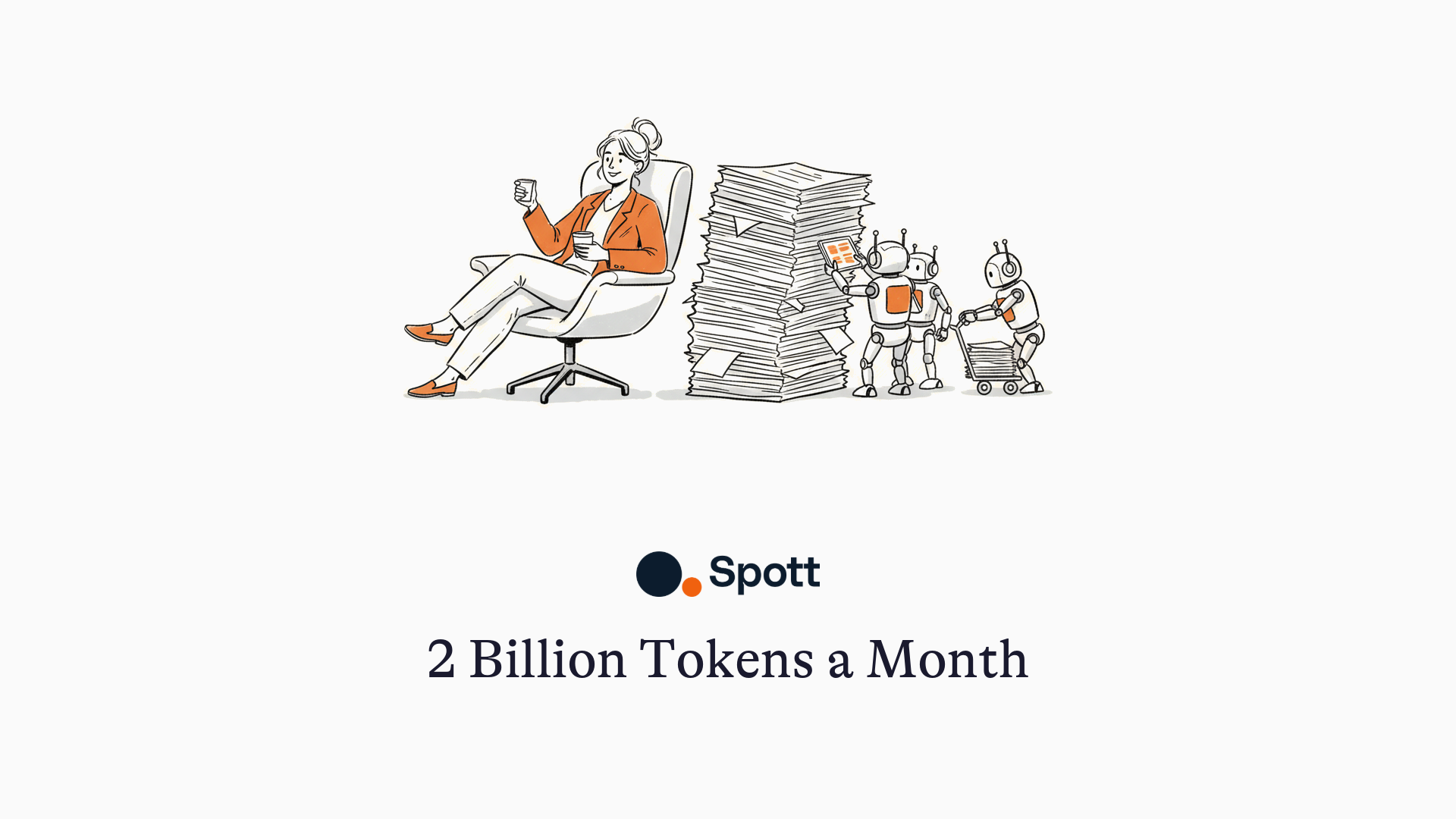
2 Billion Tokens a Month: What 'AI at the Core' Actually Means
TL;DR
Spott's platform processes on the order of 2 billion AI tokens every month. That's not a vanity metric; it's the clearest evidence of an architectural choice. Tokens are the unit of AI work, and 2 billion of them a month means AI isn't a button in our product, it's the engine room: transcribing and structuring every call, updating profiles after every interaction, matching candidates by context, generating reports, and answering recruiters' questions across their whole database. When a vendor says "AI-powered," ask what their AI actually processes in a month. The answer tells you whether the AI is the product or the paint.
Here's a number we don't put on the homepage: Spott processes roughly 2 billion tokens of AI work every month.
I want to explain why that number matters more than most feature announcements, because it answers the question every agency should ask before buying recruitment software in 2026: is the AI real?
First, what's a token?
A token is the unit AI models read and write, roughly three-quarters of a word. When an AI transcribes your intake call, that's thousands of tokens. When it reads a candidate's full history (CV, notes, five years of emails) to rank them against a role, tens of thousands more. Every summary, every matched shortlist, every plain-language question answered across your database: tokens in, tokens out.
So a platform's token volume is something like its AI metabolism. It measures how much actual thinking the system does, as opposed to how many AI labels its pricing page carries.
Two billion tokens a month is, give or take, the equivalent of reading and writing 1.5 billion words: several thousand novels' worth of recruitment context, processed monthly, for a customer base served by a 21-person company. There's no way to fake that number with a chatbot widget.
Where do 2 billion tokens actually go?
Not to a single flashy feature. They go to the unglamorous, compounding work that recruiters used to do by hand:
Listening. Every sales call, intake call, and screening conversation that runs through Spott gets transcribed, summarized, and structured: salary expectations into the salary field, notice period into the notice field, the offhand "I'd move for the right role" into context the matching engine will use eight months from now. This is the largest single token sink, and the most valuable: it's how the database updates itself instead of waiting for recruiters who are rightly busy recruiting.
Reading, before matching. Contextual candidate matching means actually reading everything relevant about every plausible candidate, not comparing two keyword lists. That's expensive in tokens. It's supposed to be. The cheap version is the keyword scoring everyone already knows doesn't work; we wrote up the full mechanics in how AI finds your best candidates.
Writing what clients see. Candidate reports in the agency's own template, CVs reformatted, summaries drafted: deliverable-quality output, generated from context the system already holds.
Answering questions. Every "which of our candidates from last year could fit this?" is a small research project: fetch by meaning, read, reason, answer. Recruiters ask constantly when answers cost seconds instead of a saved-search project.
Maintenance nobody sees. Deduplication judgments, enrichment reconciliation, migration data cleaning. The grunt work that used to make switching systems take four months.
The architectural point hiding in the number
Here's the part I actually care about, as someone who builds this thing.
You only reach this kind of volume if AI sits inside the data path, if every call, email, and profile update flows through models as a matter of course. And that's an architecture you choose on day one or, realistically, never. A platform built around a relational core from 2005 can add an AI assistant on the side, and many have. What it can't economically do is re-route twenty years of plumbing so that every interaction is read, understood, and folded back into a living database. The retrofit isn't a feature gap; it's a different building. (The technical version of this argument is in our vector databases explainer.)
That's the honest meaning of AI-native, a term we use carefully: not "has AI features," but "stops working if you remove the AI." Spott without its models isn't Spott minus a feature; it's a shell. Bullhorn without Amplify is still Bullhorn. That asymmetry is the whole category difference, and the token bill is its receipt.
It's also, frankly, a commitment. Two billion tokens a month is a real infrastructure cost that we choose to include in one seat price rather than meter out as add-ons, because charging per AI feature recreates exactly the add-on trap that drives agencies off legacy platforms.
The question to take into your next demo
I'm not suggesting you pick software by whose token number is bigger; volume without product quality is just an expensive electricity bill. But the underlying question is the sharpest one available:
"What does your AI actually process, and when?"
If the honest answer is "the CV, when you click the AI button," you're looking at AI-labeled software. If the answer is "everything, continuously, that's how the product works," you're looking at AI-native software. The difference shows up in your recruiters' evenings within a month.
Come ask us in person, and bring your messiest role: book a demo.