Vector Databases, Explained for Recruiters: Why Your Next ATS Searches by Meaning
TL;DR
A vector database stores information by meaning instead of by exact words. Every candidate, note, and job is converted into an embedding: a long list of numbers that places it on a map where similar concepts sit near each other. Searching becomes "find what's nearby in meaning," which is why a query for "fintech sales leader" can surface the candidate described only as "ran enterprise deals at a payments scale-up." Traditional databases can't do this; they store exact values and find exact matches. This single architectural difference is most of what separates AI-native recruitment platforms from legacy systems with AI bolted on, because you can't retrofit a meaning-map onto a 20-year-old relational core without rebuilding how the data is stored.
You don't need to understand databases to run a recruitment desk. But one piece of database technology now quietly decides whether your software can do the things vendors keep promising (search by meaning, match by context, answer questions in plain language), so it's worth ten minutes to understand what it is and why it changes the product.
No computer science required. Promise.
What is a vector database?
A vector database is a database that stores and searches information by meaning rather than by exact values.
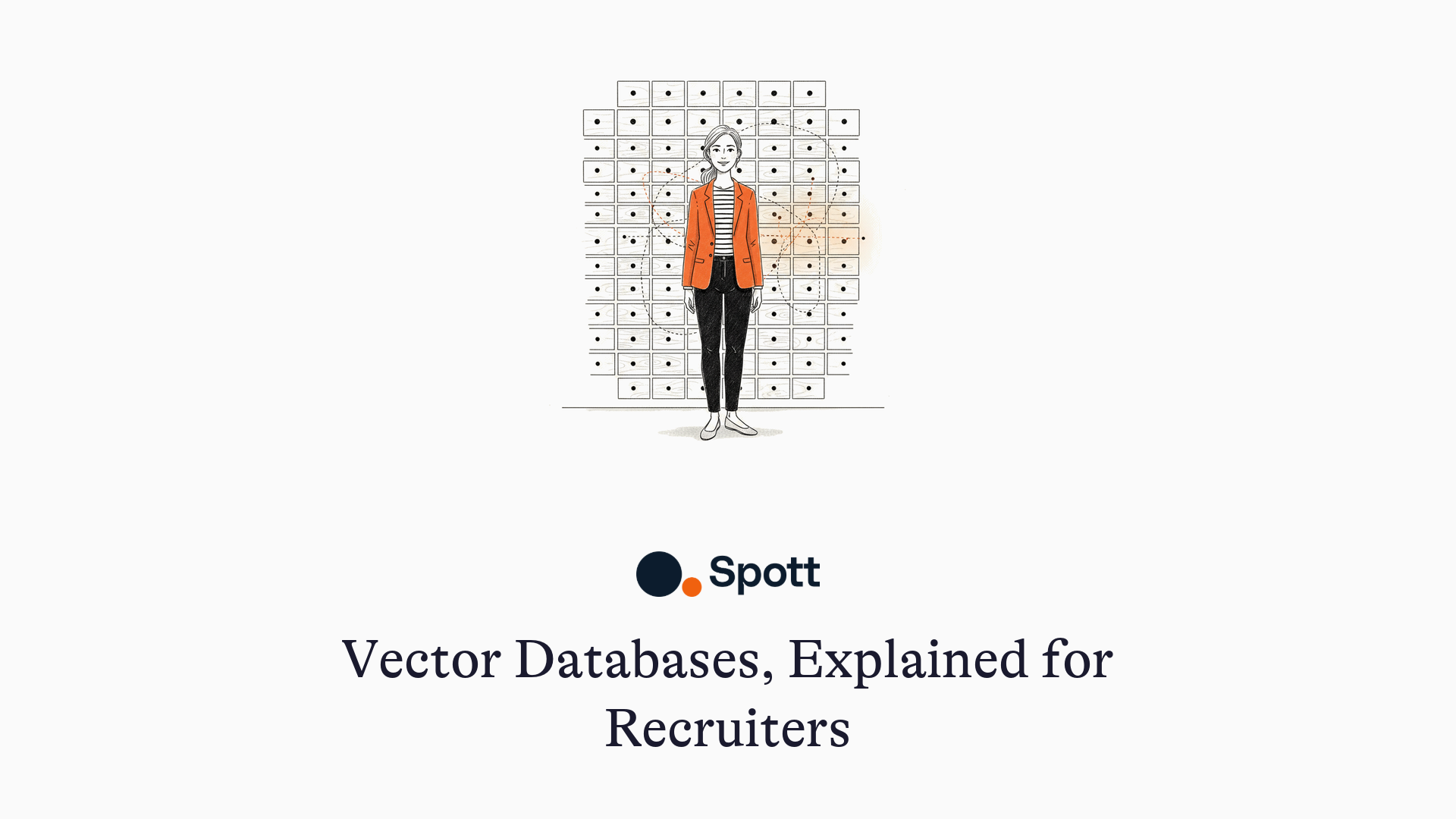
Here's the mental model. A traditional database is a filing cabinet: every record sits in a labeled drawer ("Surname: Janssens", "Skill: Java", "City: Antwerp"), and finding things means knowing the exact label. A vector database is a map: every piece of information is placed at a location, and things that mean similar things sit near each other. "Backend engineer," "software developer, server-side," and "built the platform team's APIs" all land in the same neighborhood, even though they share almost no words.
The conversion from text to map-position is done by an AI model that produces an embedding: a list of hundreds or thousands of numbers representing what a piece of text means, learned from reading enormous amounts of language. You never see these numbers. You just see their consequence: search that finds neighbors-in-meaning instead of matches-in-spelling.
So when a recruiter asks "who do we know that could run a German-speaking enterprise sales process?", the question becomes a point on the map, and the database returns everything sitting close to it: the candidate whose note says "closed DACH accounts at SAP," the one whose call transcript mentions "managing the Munich team," the CV that says "Vertriebsleiter." Zero keyword overlap. Right answers.
Why traditional databases fail recruitment data
Relational databases (the kind under every legacy ATS) are superb at structured facts: salary bands, locations, placement dates. Recruitment's problem is that the valuable information is mostly not structured facts.
Think about what actually predicts a great placement: how someone described their reason for leaving, the energy in a screening call, the note that says "brilliant but needs a hands-off manager," the throwaway line about being open to relocation for the right role. In a relational system this either gets crammed into a free-text field that keyword search reads as a bag of words, or, more often, never gets captured because there's no field for it.
This produces the failure every recruiter has lived: a database of 80,000 candidates that can't answer "who's good with difficult stakeholders?", so consultants search LinkedIn instead of their own system. The data isn't missing; it's stored in a shape the database can't think in.
Vector storage flips this. Unstructured context (notes, transcripts, messages, CVs) becomes the database's native material rather than its junk drawer. The messier and richer your candidate context, the better the system gets, instead of worse.
What this enables in practice
Concretely, a recruitment platform built on vector search can do four things its predecessors structurally couldn't:
- Search by description, not Boolean. "Senior candidate, payments background, has scaled a team, open to Brussels" is a complete, working query, with no AND/OR strings and no synonym lists to maintain.
- Match jobs to candidates by context. AI matching is, at its core, "place the role on the map, return the nearest candidates," using everything known about them. We walk through the full pipeline in how AI finds your best candidates.
- Search inside conversations. Call transcripts, emails, and WhatsApp threads become findable by meaning: "the candidate who mentioned an expiring non-compete" is retrievable even if nobody tagged it.
- Answer questions across the whole dataset. Plain-language questions ("which clients went quiet after a fee discussion?") work because the system can fetch relevant context by meaning and reason over it: the foundation of Ask AI-style features.
One honest caveat: vector search complements structured search; it doesn't replace it. "Must hold an EU work permit" is a hard filter, not a vibe, and serious platforms run both together (filter on facts, rank by meaning).
Why legacy platforms can't just bolt this on
Here's the strategic part, and the reason this article exists.
A 20-year-old ATS is a relational schema with two decades of features, integrations, and customer customizations built on top of it. Moving to meaning-based storage isn't adding a feature; it's changing what the system fundamentally is: every record re-encoded as embeddings, kept continuously in sync as notes and calls flow in, with search, matching, and reporting rebuilt on top of the new foundation, all without breaking the existing product that 10,000 customers depend on.
So legacy vendors do the rational thing: they bolt an AI layer on the side. A chatbot that queries the old keyword index. A matching module that scores CVs against job descriptions in isolation, blind to the notes and calls, because those were never stored in a shape the AI can read. It demos well and underwhelms at the desk, which is precisely the gap we dissect in why most AI recruiting tools aren't really AI.
Platforms built since the vector era, Spott among them, made the opposite trade: the meaning-map is the database. Every call transcript, note, and message lands in it the moment it's captured, which is why search, matching, and Ask AI behave like one brain rather than three add-ons. That's the substance behind the phrase AI-native ATS: it names an architecture, not a marketing tier.
The bottom line
Vector databases are why "search by meaning" went from research paper to product in a few years, and they're the quiet dividing line in today's ATS market: platforms where the meaning-map is the foundation, and platforms where it's a side-car to a filing cabinet. You now know the one question that exposes the difference: "When your AI matches candidates, does it read the notes and call transcripts, or just the CV?"
Ask us that one too: book a Spott demo and bring a role your current system's search has failed on.