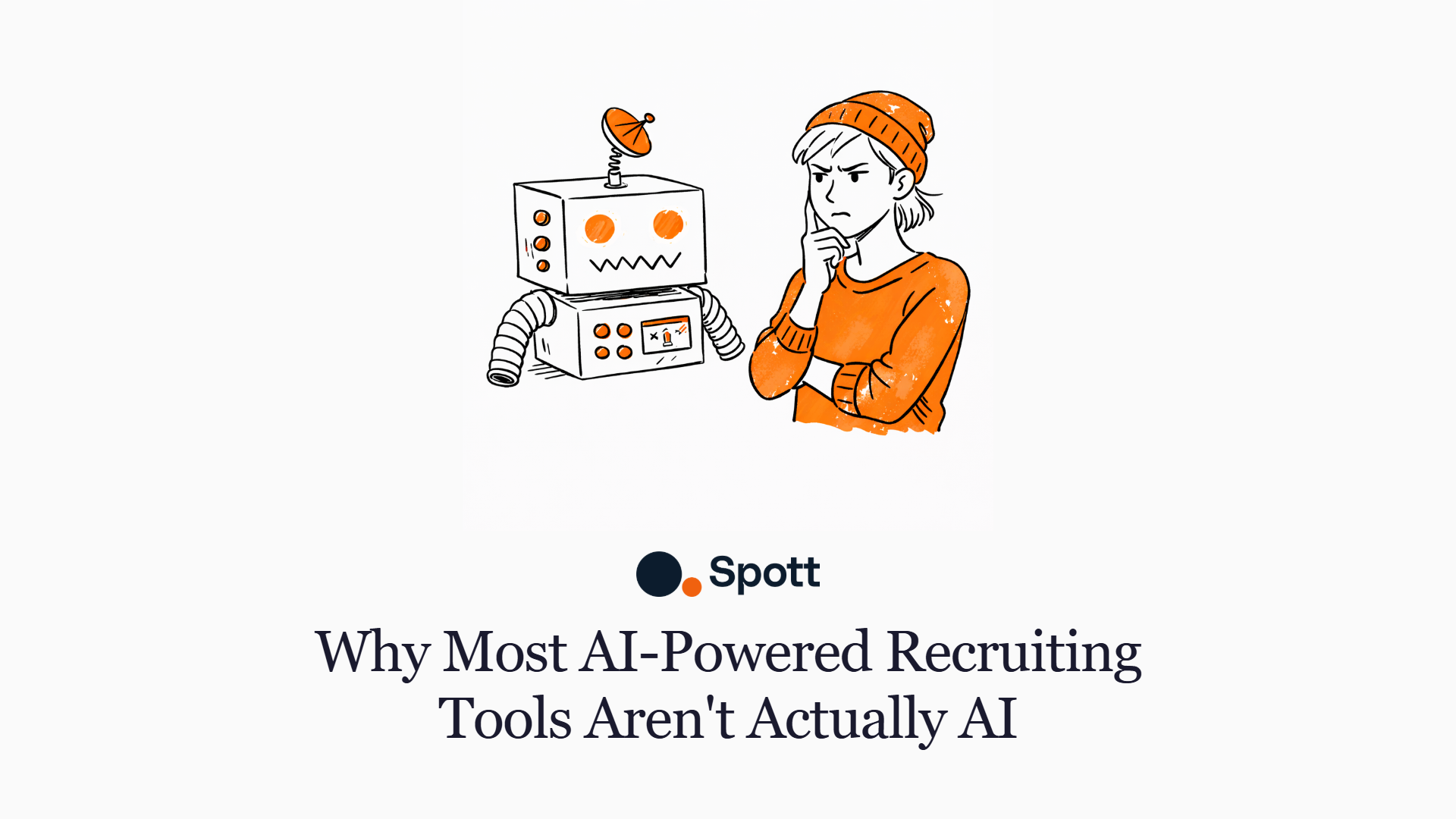
Why Most AI-Powered Recruiting Tools Arent Actually AI
There's a pattern in recruitment technology that's worth calling out: every legacy ATS vendor now claims to be "AI-powered." Bullhorn has AI. Loxo has AI. Your spreadsheet probably has AI at this point.
But here's what nobody's talking about: there's a fundamental difference between slapping AI features onto a 15-year-old database architecture and building a platform where AI is the foundation.
The distinction matters more than most buyers realize.
Signs Your "AI" Isn't Actually AI
Before we get into the technical differences, let's talk about what you're probably experiencing right now. These are the telltale signs that your platform's AI is just marketing:
You're Still Manually Updating Fields
If you're spending your day updating candidate statuses, adding tags, logging call outcomes, and manually moving people through pipeline stages, your AI isn't doing much. Real AI handles the busywork. It updates fields based on what's actually happening in your conversations. It recognizes when a candidate has gone cold. It knows when a deal is progressing without you telling it.
"AI Search" That's Really Just Filters
Some vendors love throwing around terms like "AI search" and "semantic matching." Here's what that often means in practice: they've built a system that creates aliases for your filters. Search for "project manager" and it might include "PM" in the results. Impressive? Not really.
True AI search understands context and meaning. It digs into your notes, your email threads, your call transcripts. That's where the real value is hidden. A recruiter's handwritten note from three years ago saying "brilliant operator, would be perfect for a scaling startup" is gold. Keyword matching will never surface it. Real AI will.
Your Platform Offers 100 Note-Taker Integrations But No Native Solution
This is a red flag. When a platform integrates with every transcription tool on the market but doesn't build intelligence natively, it tells you something: the AI is bolted on, not built in.
Those transcripts sit in a separate system. The "AI" can't actually reason across them. It can't connect what a candidate said six months ago with the job that just landed on your desk. Integration isn't intelligence.
Search Only Works on Structured Data
Try this: search for "candidates who mentioned they're open to relocation during our last call." Or "clients who expressed frustration with their current agency."
If your system can't answer those questions, it's not understanding your data. It's just querying a database. All the valuable context from your conversations, your notes, your emails, it's invisible to the system.
You're Clicking "Generate" All Day
Count how many times you click "Generate" or "Summarize" in a day. Each click is you doing the work. That's not an agent. That's autocomplete with extra steps.
A real agent updates candidate summaries automatically when new emails arrive. It creates follow-up tasks after calls without being asked. It updates fields based on what actually happened, not what you remembered to log. You don't click "Generate." You just work.
The Two Types of "AI" in Recruiting
Type 1: AI-Powered (Retrofitted)
This is what most legacy vendors offer. They've taken their existing system, often built in the 2000s or early 2010s, and bolted on AI features wherever they could fit them.
What this looks like:
- A separate "AI matching" button you click after searching
- AI features that feel disconnected from the core workflow
- Chatbots that sit alongside your main system, not inside it
- "Smart" suggestions that don't actually learn from your behavior
- AI that only works on data you manually structure and tag
The underlying architecture wasn't designed for AI. It was designed for storing records. The AI is an add-on, not the operating system.
Type 2: AI-Native (Purpose-Built)
This is newer. Platforms built from day one with AI at the center. The database structure, the workflows, the user interface: everything assumes AI is doing heavy lifting.
What this looks like:
- AI that works automatically, not just when you click a button
- Context captured from every interaction (calls, emails, notes) without manual tagging
- Matching that improves based on your actual placements, not just keyword overlap
- Workflows that adapt based on patterns the system recognizes
- Data that's structured for machine learning, not just human retrieval
The difference isn't just features. It's architecture.
What AI-Native Actually Feels Like
Let's paint a picture of what's possible when AI is the foundation, not an afterthought:
Suggested Tasks That Actually Make Sense
Your platform knows you placed three backend engineers at fintech companies last quarter. A new backend role comes in from a payments startup. The system doesn't just match keywords. It surfaces the five candidates from your database who fit the pattern, ranked by likelihood based on your historical success. It drafts the outreach. It reminds you that one candidate mentioned wanting to move to fintech during your last call.
Fields That Update Themselves
You finish a client call. Before you've even opened the CRM, the system has already logged the call, extracted the key points, updated the deal stage, and flagged three relevant candidates to discuss in the follow-up. You're not doing data entry. You're doing recruiting.
True Semantic Understanding
You vaguely remember a candidate from years ago. "He was at that YC company, did something with APIs, seemed really senior." You type that into search. The system finds him. Because it actually understood the context of your notes, not just the keywords.
Proactive Intelligence
Your system notices a pattern: candidates from a certain company tend to accept offers after the third touchpoint. It adjusts your outreach sequence automatically. It notices when a client has gone quiet and prompts you before the relationship goes cold.
This isn't science fiction. This is what's possible with AI-native architecture.
Why Retrofitted AI Has a Ceiling
When AI is bolted onto a legacy system, it can only be as good as the underlying data structure allows. Most older ATS platforms store candidate information in rigid fields: name, title, company, skills list.
That's fine for searching. It's terrible for understanding.
AI-native systems capture context: the nuance from your call notes, the sentiment in email threads, the patterns across hundreds of similar placements. They're designed to work with messy, unstructured information, which is what recruitment actually produces.
Why Legacy Vendors Can't Catch Up
Check their roadmap from two years ago. How much of that "AI" they promised actually shipped? GPT-3 came out in 2020. If they're still "working on" basic AI features in 2026, that tells you something about their ability to execute.
The truth is, legacy vendors have teams built for maintenance, not innovation. Ask how many engineers are working on AI versus keeping old systems alive. The ratio tells you where their priorities are.
How to Evaluate "AI" Claims
Before your next demo, ask these questions:
1. "Show me your product changelog. How many AI features actually shipped in the last 12 months?"
Talk is cheap. Shipping is hard. Look for evidence of consistent AI releases, not just announcements and promises.
2. "What was on your AI roadmap 2 years ago? Did it ship?"
GPT-3 came out in 2020. Claude and GPT-4 in 2023. If their "coming soon" AI features are still coming soon, they're not coming.
3. "How many engineers are working on AI versus maintaining legacy code?"
A 10-person engineering team with 2 people on AI is a maintenance shop with a side project. That ratio tells you everything about their priorities.
4. "Run my actual data through it. Right now."
Not their polished demo dataset. Your messy, real-world data. Search for something a candidate mentioned in a call transcript six months ago. Let's see what comes back.
5. "Can I talk to a customer who's been using your AI features for 6+ months?"
Demo magic fades fast. You want to know what it's like to live with the product, not just see the highlight reel.
The Honest Tradeoffs
Let's be fair: legacy vendors have advantages too.
Retrofitted AI (Legacy Vendors):
- Broader feature sets developed over many years
- Larger customer bases and more case studies
- Deeper integration ecosystems
- Often more enterprise support resources
AI-Native (Newer Platforms):
- Better AI capabilities and accuracy
- Faster innovation cycles
- Cleaner, more modern user experience
- Architecture designed for how recruiting actually works today
The right choice depends on what you're optimizing for. If you need every possible integration and feature, a legacy platform might be appropriate. If you're betting on AI being the future of recruiting, and willing to trade some feature breadth for depth, AI-native makes more sense.
The Bottom Line
"AI-powered" has become meaningless as a differentiator. Every vendor uses it. The question isn't whether a platform has AI. It's whether AI is fundamental to how the product works.
Next time you're evaluating recruiting technology, look past the marketing language. Ask about architecture. Ask about how the system learns. Ask when the platform was actually built.
The vendors who've genuinely invested in AI will have good answers. The ones who've just added buzzwords to their homepage won't.
The recruitment technology market is going through a generational shift. Platforms built for the smartphone era are replacing those built for the desktop era, just like those once replaced rolodexes and filing cabinets. Where your tools sit on that timeline matters.

Frequently Asked
Look for five warning signs: you still manually update candidate statuses and tags, the 'AI search' only creates filter aliases instead of understanding call transcripts, the platform relies on dozens of third-party integrations for note-taking instead of native solutions, the system cannot answer questions about unstructured data like 'who mentioned relocation in calls,' and you must click 'Generate' or 'Summarize' buttons constantly rather than seeing intelligence surface automatically. Ask vendors to show their product changelog for the past 12 months, run your actual messy data through the system live, and speak with customers who have used the AI features for six months or more.
AI-powered platforms retrofit AI features onto legacy database architectures that are often 15+ years old -- they bolt on separate matching buttons, disconnected chatbots, and suggestions that only work on manually structured data. AI-native platforms like Spott build AI as the foundational operating system, meaning context captures automatically from all interactions, matching learns from actual placement patterns, workflows adapt based on recognized patterns, and data structures serve machine learning rather than simple retrieval. The practical difference is that AI-native systems work autonomously in the background while retrofitted tools require constant manual triggering.
An AI-native platform performs tasks that are architecturally impossible for retrofitted systems. It autonomously logs interactions after calls, extracts key details, updates deal stages, and flags relevant candidates without recruiter input. It understands semantic searches -- a recruiter typing 'YC company, API work, senior person' retrieves accurate results by comprehending contextual notes rather than matching keywords. It recognizes placement patterns, such as identifying that a recruiter has placed three backend engineers at fintech firms, and proactively surfaces ranked candidates with drafted outreach. These capabilities require AI embedded in the data layer, not layered on top.
Legacy vendors offer multi-year feature breadth, larger customer bases with more case studies, deeper integration ecosystems, and more enterprise support resources -- advantages that matter for agencies with heavily customized existing workflows. AI-native platforms offer superior AI accuracy, faster innovation cycles, modern user experiences, and architecture aligned with how recruiters actually work today. The right choice depends on whether your priority is ecosystem maturity or AI capability depth. Agencies evaluating a switch should weigh how much time recruiters currently lose to manual data entry and context-switching against the cost of adopting a newer platform.

Outp(l)ace everyone.
You can’t win tomorrow’s placements
with yesterday’s tools.