AI Recruiting Software for UK Agencies: What Actually Matters in 2026
TL;DR
UK agencies choosing AI recruiting software in 2026 need to check four things that US-focused buying guides skip: where candidate data is hosted (UK GDPR applies regardless of vendor location, and many popular platforms are US-hosted with no UK/EU residency option), whether the vendor can support lawful AI-assisted decision-making under UK data protection rules, whether the platform actually works for UK workflows (right-to-work checks, UK job boards, IR35-adjacent contract models), and what the all-in price looks like in pounds once add-ons land. The good news: the UK is the most competitive recruitment software market in the world right now, and agencies have real choices at every price point.
The UK has more recruitment agencies per capita than any other major market, and in 2026 it's where the AI recruiting software fight is loudest. London-based startups, Australian incumbents, and US platforms are all competing for the same agencies, which means UK firms have leverage, if they know what to check.
This guide covers what's genuinely different about buying AI recruiting software as a UK agency, and the questions that separate marketing claims from working products.
What does UK GDPR mean for AI recruiting software?
UK GDPR (the post-Brexit retained version of GDPR, alongside the Data Protection Act 2018) governs how your agency processes candidate data, wherever your software vendor is based. Three points matter most for software selection:
Data flows with the EU are stable, for now. In December 2025 the European Commission renewed the UK's data adequacy decisions, running to December 2031. Personal data can keep moving freely between the UK and EU. For agencies placing candidates across both markets, an EU-hosted platform is as compliant a choice as a UK-hosted one.
US hosting is the complication. Several popular mid-market platforms (including Recruiterflow and Recruit CRM) are US-hosted with limited or no UK/EU residency options. That's not automatically unlawful (transfer mechanisms exist), but it adds paperwork, risk assessment, and a question your larger clients' procurement teams will definitely ask. If you serve enterprise or public-sector clients, "where does candidate data live?" stops being theoretical.
AI-assisted decisions need a human in the loop. UK data protection rules (updated by the Data (Use and Access) Act 2025) constrain solely automated decisions with significant effects, and rejecting a candidate qualifies. In practice: AI that ranks, summarizes, and recommends is fine; AI that auto-rejects without human review is a compliance question. Ask vendors where their automation draws this line. The serious ones have a clear answer.
The practical checklist: ISO 27001 certification, UK/EU hosting options, a signed DPA, and a straight answer on automated decision-making. Spott checks all four, with ISO 27001 certification and EU-hosted infrastructure as standard rather than an enterprise upsell.
What should UK agencies look for in the AI itself?
Strip away the "AI-powered" labels and ask what the AI actually does to a UK recruiter's day:
Matching that reads context, not keywords. UK agencies live on niche placements: the candidate described in notes as "strong on FCA-regulated change programmes" should surface for a "financial services transformation" role. Keyword engines miss that; contextual AI matching is built for it.
Admin that does itself. Call notes, interview summaries, CV reformatting, and profile updates are where UK consultants lose their evenings. AI notetaking and auto-generated candidate reports are the features with the most honest time-savings per pound.
One inbox for the channels UK recruiting actually uses. UK candidates live on LinkedIn and increasingly WhatsApp. A platform that syncs WhatsApp, SMS and email 2-way into the candidate record (rather than leaving threads on consultants' phones) is the difference between an agency database and a collection of personal address books.
AI included, not tiered. The UK market's most common pricing trick in 2026 is AI as an add-on: an extra £25-35/user/month for enrichment here, AI licenses for all users there. Compare all-in prices, not headline prices.
How do the main platforms fit UK agencies?
A brief, honest map of the UK market in 2026 (fuller detail in our recruitment CRM roundup):
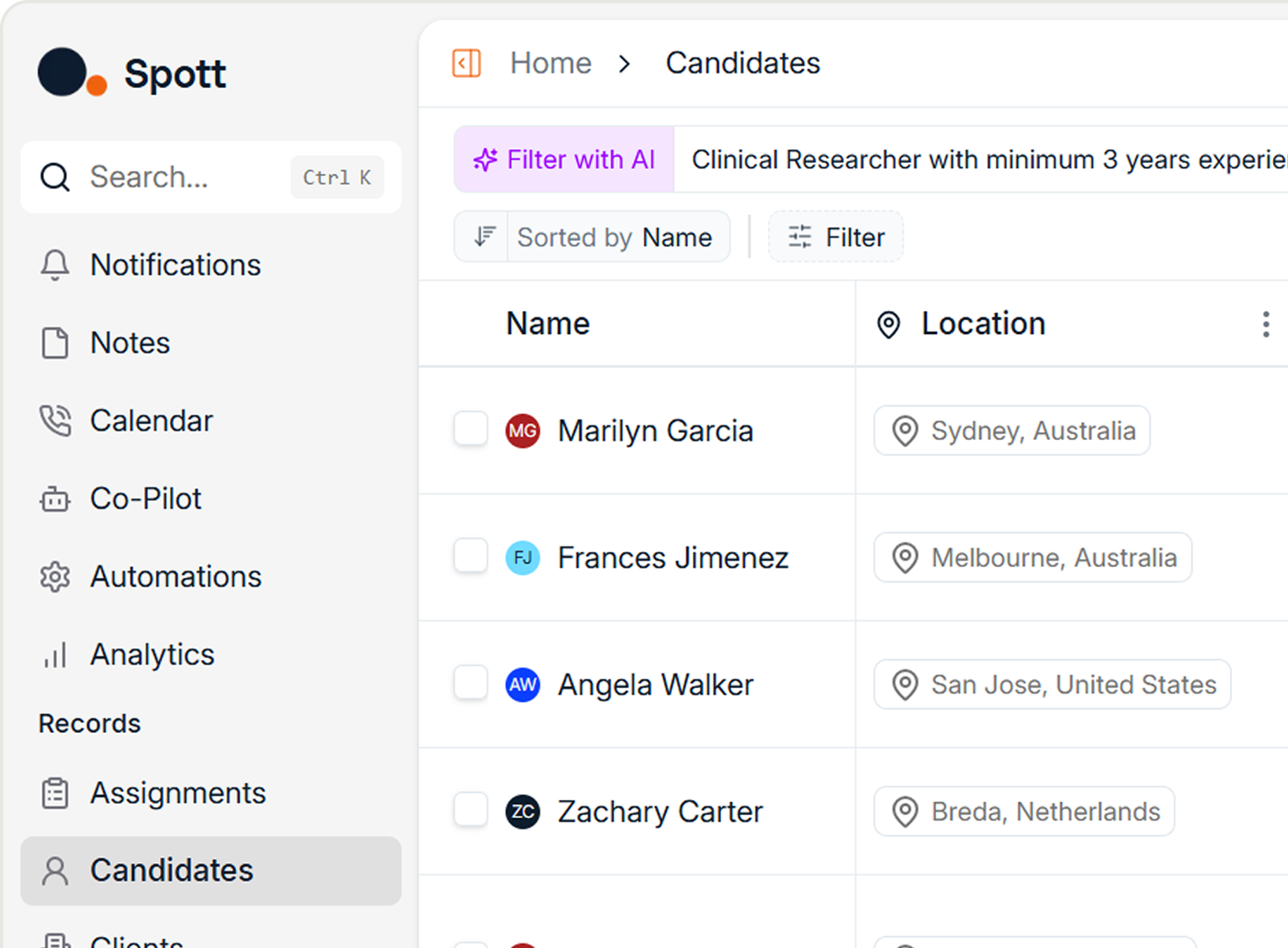
- Spott - AI-native ATS/CRM, EU-hosted, ISO 27001, all AI in one seat price (from $139/user/month). Strongest fit for UK perm, contract, and search agencies of 5-200 seats that want AI through the whole workflow. No temp pay & bill back-office yet, which matters for temp-heavy firms.
- Atlas - London-based, AI-first, real UK momentum among tech recruiters. Users report buggy CV parsing and AI reliability issues, and add-ons (£35 enrichment, £10 WhatsApp) push the core £80 toward £125/user/month.
- Bullhorn - the enterprise standard, deep temp/contract back-office, strong UK presence. Budget for modules and multi-month implementation.
- Vincere - UK-anchored via The Access Group, real back-office and analytics, from £69/user/month. Post-acquisition support is the recurring review complaint.
- JobAdder - clean UX and the SEEK job-board ecosystem; strongest for board-driven sourcing. AI launched late 2025 and sits behind plan tiers.
- Ezekia - London-based retained-search specialist (~£120/user/month) for firms that do exec search and nothing else.
- Recruiterflow / Recruit CRM / Loxo - capable US platforms at attractive prices, but all US-hosted with limited UK/EU residency, which is the first question to resolve before falling in love with the feature list.
Five questions to ask every vendor (UK edition)
- "Where exactly is our candidate data hosted, and can we choose UK or EU?" Accept only a named region, not "cloud infrastructure with global availability."
- "What's the all-in monthly price in pounds for our team, including AI, enrichment, and WhatsApp integration?" Get it in writing; the delta between headline and all-in commonly runs 30-60%.
- "Show me the AI on our data, not your demo data." A vendor confident in their matching will run your hardest live role through it. Marketing-layer AI falls apart here.
- "How does your automation handle UK GDPR's rules on automated decision-making?" You're listening for "human review before rejection," not a blank look.
- "What does migration take, in weeks, and who does the work?" UK agencies report everything from 4 weeks (AI-assisted, vendor-run) to 6 months (CSV templates and good luck). The answer predicts the relationship.
The bottom line
UK agencies are buying in the most competitive recruitment software market in the world, with one extra homework item attached: data residency and lawful AI use are board-level questions now, not IT questions. Settle hosting first, compare all-in pricing second, and make every vendor demo their AI on your data.
Spott is EU-hosted, ISO 27001 certified, and built AI-native, with most UK agencies live in roughly 4 weeks via our in-house migration. Book a demo and bring your hardest role.