
AI in Recruitment: Who Really Wins the Game?
The recruitment landscape is undergoing a transformative evolution, driven by artificial intelligence. As industry leaders like the SHREK firms (Spencer Stuart, Heidrick & Struggles, Russell Reynolds Associates, Egon Zehnder, and Korn Ferry) explore technological frontiers, a critical question emerges: How are AI technologies reshaping executive search across different organizational scales?
The AI Revolution in Talent Acquisition
Artificial intelligence is no longer a futuristic concept but a current necessity for any proactive executive search firm. From sophisticated candidate screening to predictive analytics, AI technologies are creating unprecedented opportunities for more strategic and efficient recruitment processes.
Technological Democratization in Executive Search
The current AI landscape presents a fascinating opportunity for firms of all sizes. While SHREK firms have historically led technological innovation through substantial R&D investments, the democratization of AI technologies through accessible platforms is leveling the playing field.
Modern, AI-native ATS and CRM platforms have significantly lowered entry barriers, making advanced technological capabilities accessible to firms across different organizational scales. This technological democratization means boutique executive search firms can now compete on sophistication, not just personalization or local expertise.
Strategic Advantages Across Firm Sizes
Large SHREK firms bring remarkable strengths to AI integration. Their extensive global networks, comprehensive databases, and robust research capabilities are great sources of untapped potential for implementing complex AI solutions. These firms have the opportunity to leverage machine learning across massive candidate pools, allowing for extremely advanced talent mapping.
Simultaneously, boutique firms possess their own set of unique advantages in the AI era. Their organizational agility allows for more rapid technological adaptation and precise customization of AI tools. A smaller firm can quickly implement and fine-tune AI models to address specific market niches or industry verticals, and use these technological advantages to gain market share.
The Collaborative Potential of AI
In order to assess AI's potential in recruitment, it is important to see it as it is: an intelligent collaborative tool, not a replacement for human expertise. The most successful firms will be those who view AI as an enhancement to human judgment, not a substitute.
Emotional intelligence, cultural understanding, and nuanced interpersonal assessment remain distinctly human capabilities. AI provides the data-driven foundation, while experienced recruiters apply their seasoned interpretation and relationship-building skills.
Economic and Operational Transformation
AI-powered tools significantly reduce administrative overhead across organizations. Natural language processing can screen resumes, conduct initial candidate assessments, and even schedule interviews.
Predictive analytics enable more intelligent candidate sourcing. Instead of relying solely on existing networks, AI can help identify potential candidates who might not be actively job searching but represent perfect matches for specific roles.
Fortune Favors the Bold
For boutique firms especially, AI represents a remarkable opportunity to compete at unprecedented levels. By embracing these technologies strategically, smaller agencies can offer clients sophisticated search capabilities, faster candidate identification, and more nuanced talent matching.
On the other hand, it provides an incredible untapped opportunity for SHREK-level firms to leverage their vast databases that have been amassed over the years, resulting in an unparalleled competitive boost.
Ready to Transform Your Recruitment Strategy?
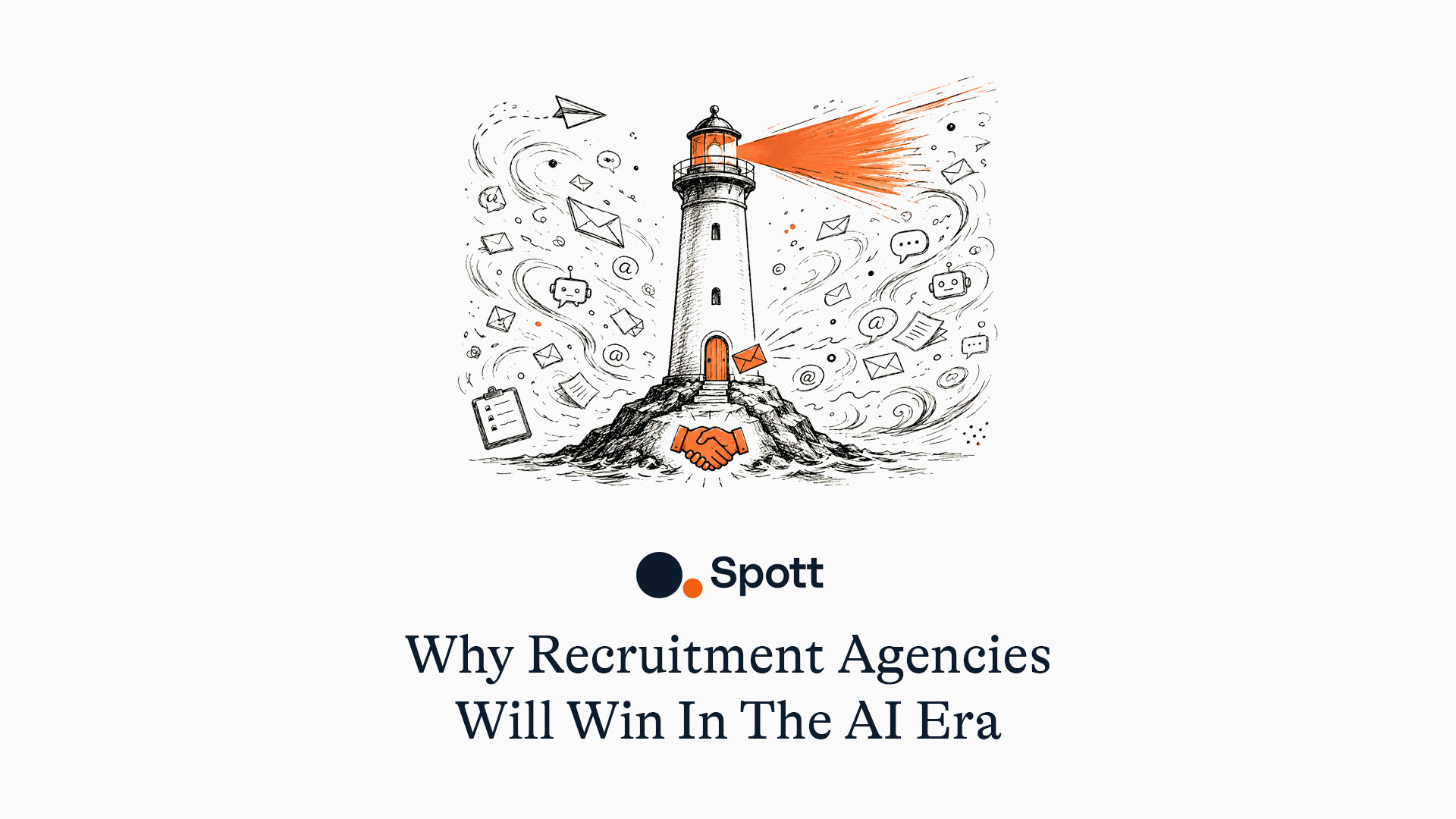
Large recruitment agencies have the advantage of data and manpower, but boutique firms are more agile, adopting new technology with less friction.
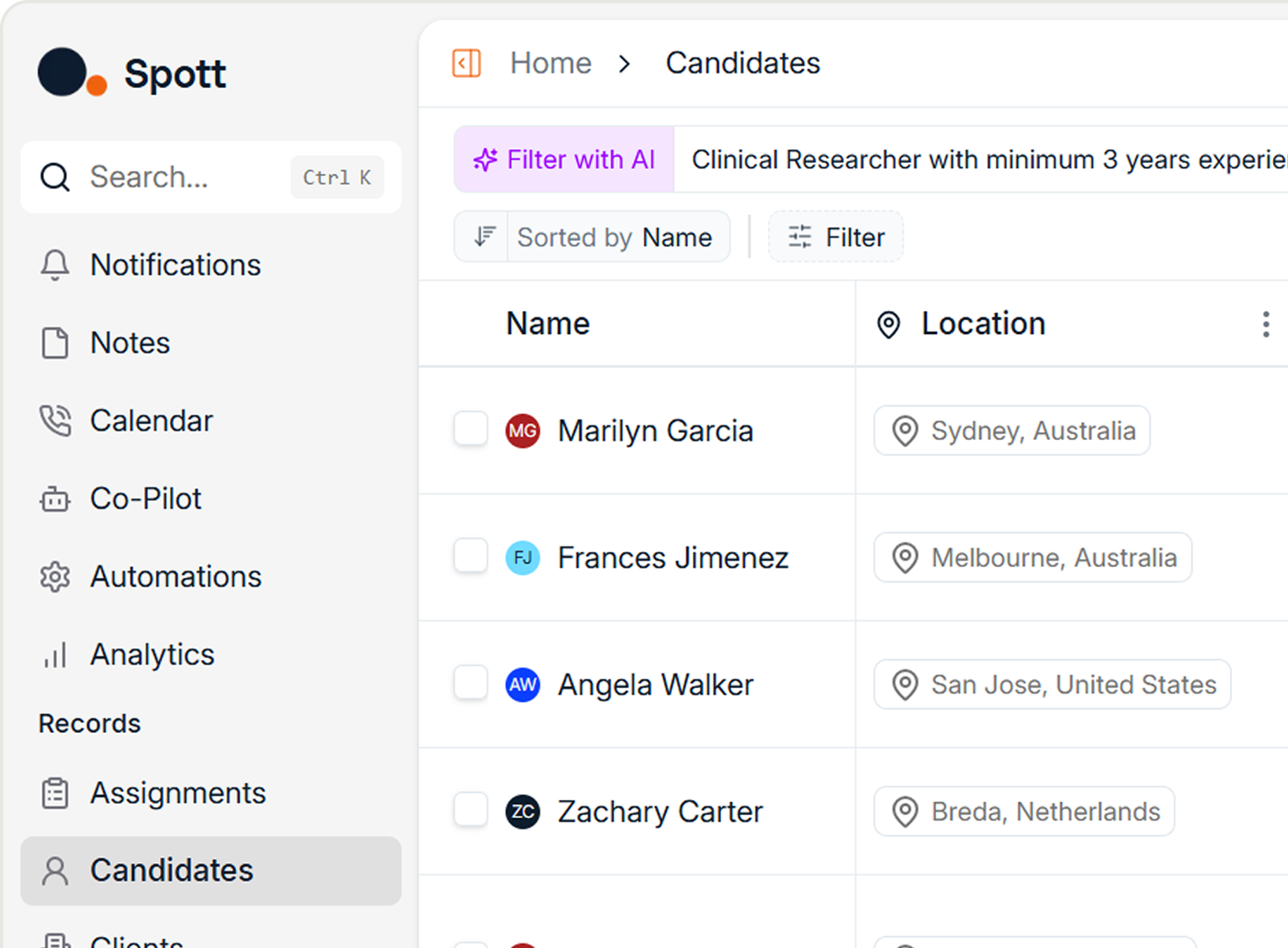
Spott is the next-generation ATS and CRM built to give recruitment firms a competitive edge. Those who adopt it quickly, historically boutique firms, gain a competitive advantage.
Curious about how AI can elevate your recruitment capabilities? Contact us and discover the Spott difference.

Frequently Asked
AI-native platforms have dramatically leveled the playing field by making advanced talent matching and candidate sourcing accessible to firms of every size. Boutique firms gain particular advantage because their organizational agility allows rapid technology adoption and customization for specific market niches. Capabilities that once required the massive databases and research teams of firms like Spencer Stuart or Korn Ferry are now available through platforms like Spott. The firms that adopt AI-native tools quickly gain competitive differentiation regardless of their size.
AI-native ATS/CRM platforms have lowered entry barriers so sophisticated talent matching, predictive analytics, and automated sourcing are no longer exclusive to well-resourced enterprises. Natural language processing streamlines resume screening and candidate assessment for any size firm. Predictive analytics extend sourcing beyond existing personal networks, surfacing qualified candidates that manual methods would miss. This means a 10-person boutique agency can deliver the same caliber of data-driven insights and candidate intelligence that previously required a global research department.
Large firms possess extensive global networks, comprehensive historical databases, and massive candidate pools that become exponentially more valuable when paired with AI. Machine learning algorithms can uncover patterns across millions of candidate records that human analysis would never find. However, many large firms have untapped potential because their legacy systems weren't built to leverage this data effectively. Migrating to an AI-native platform like Spott, with its 4-week migration timeline, lets enterprise firms unlock the full value of their existing data without lengthy disruption.
Firms that delay AI adoption risk falling behind competitors who use AI to source faster, match more accurately, and deliver stronger candidate presentations. As AI-native tools become the industry standard, non-adopters face shrinking margins and lost clients who expect data-driven insights and rapid turnaround. The competitive gap widens with each quarter of delay because AI systems continuously learn and improve from every interaction. The most successful firms view AI as an enhancement to human judgment and move quickly to integrate it into their daily workflows.



Outp(l)ace everyone.
You can’t win tomorrow’s placements
with yesterday’s tools.