
How United Consulting Replaced Bullhorn in Under 4 Weeks
About United Consulting
United Consulting is a Belgian consulting group placing interim management and freelance consultants across four business units: Finance, HR, Supply Chain, and Marketing. Based in Niel with 30 team members, the firm manages complex placements where candidates are simultaneously freelancers, potential clients, and long-term relationship partners, often on rolling quarterly contracts.
The Challenge: An Agency ATS Forced Onto a Consulting Firm
United Consulting had been running Bullhorn as both their ATS and CRM. But Bullhorn was designed for recruitment agencies doing fast, transactional placements: close a vacancy, move on. United Consulting's model was fundamentally different.
Their recruitment team keeps vacancies permanently open. A "Finance Consultant, 5 years experience" search doesn't close after one hire. It runs continuously, building a bench of available talent across rolling contracts. Bullhorn couldn't accommodate this.
"Bullhorn is mainly tailored to agencies, fast placements and closing out vacancies. We run completely counter to that. Our vacancies never close." — Recruitment Team Lead, United Consulting
The team was maintaining Bullhorn as a "glorified database" alongside Excel spreadsheets for every meaningful metric. And Bullhorn's search was only as good as its structured fields. Years of valuable recruiter notes were locked in unsearchable free-text fields.
When it came time to renegotiate, Bullhorn offered zero flexibility: one year or nothing. That's when United Consulting decided to look at alternatives seriously.
The Solution: An ATS That Works Like a Consulting Firm Actually Works
United Consulting first saw Spott in September 2025. Two separate demos were scheduled, one for the sales and CRM team, one for recruitment. Both surfaced the same core insight: they needed a system that treated placement tracking and continuous recruiting as first-class features.
Searchable Everything: Notes, CVs, LinkedIn, and Beyond
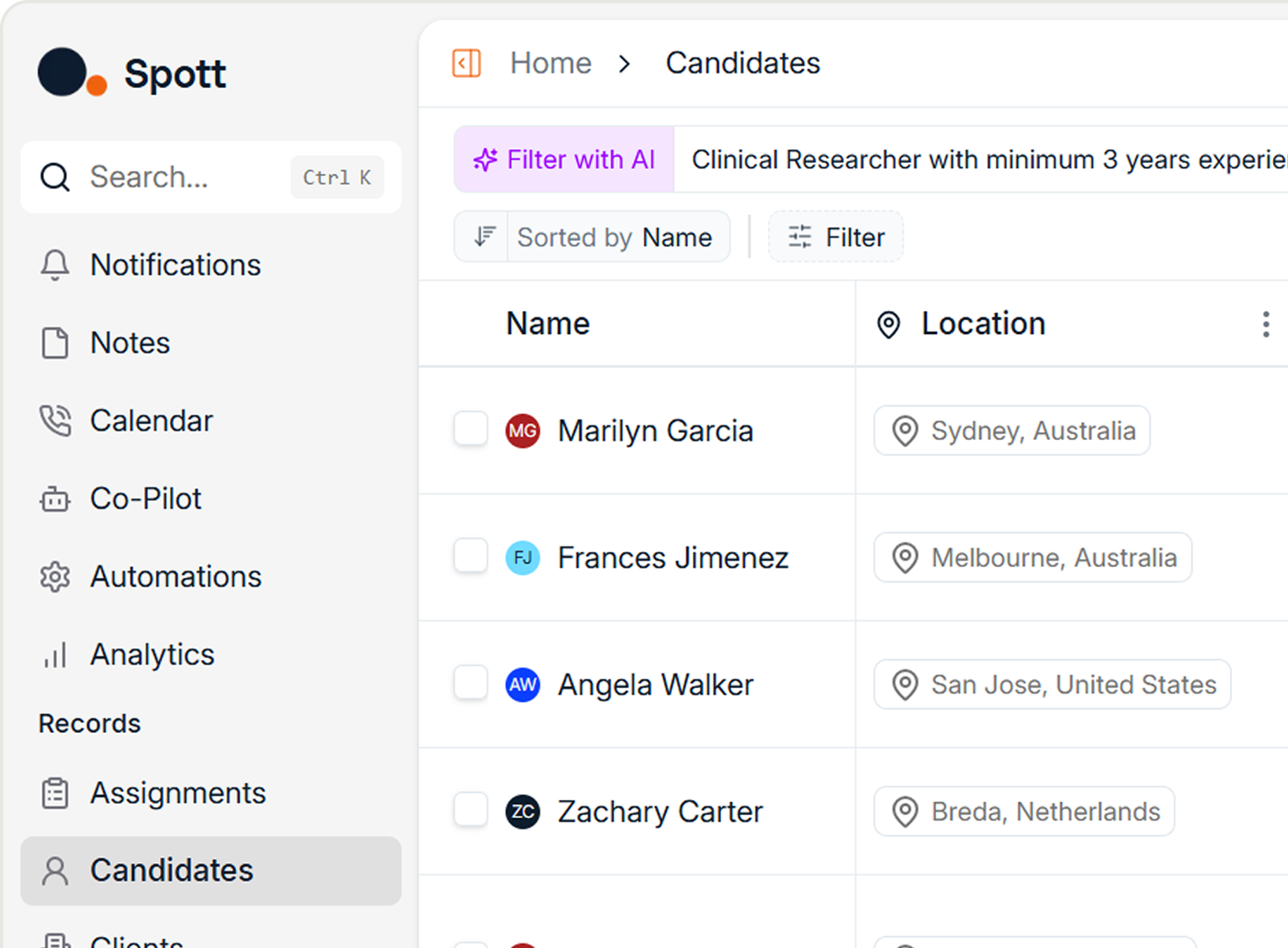
Spott's semantic search unlocked years of recruiter knowledge trapped in Bullhorn's free-text fields. A recruiter looking for a candidate with SAP experience could find that person in seconds, even if the detail was buried in a note from two years ago, even with typos.
During the demo, the recruitment team lead asked: "Can it also search within attached CVs?" Yes. Across notes, CVs, LinkedIn profiles, and all structured fields simultaneously.
Matching Consultants to Jobs and Knowing When They're Available
Unlike Bullhorn's close-the-job model, Spott lets United Consulting place a consultant without shutting down the vacancy. Multiple consultants can be placed from the same open position, each tracked individually with start dates, contract extensions, and expiration timelines.
For a consulting firm, bench visibility is everything. The question was framed clearly in the very first demo:
"We need to know today how many are on bench, and in three weeks with all expiring contracts, will that rise or fall?" — United Consulting
Spott's matching engine ranks candidates from the entire database against any open vacancy, weighing skills, experience, availability, and location. Combined with the placement tracker showing which contracts are expiring when, recruiters can now proactively match available consultants to upcoming opportunities instead of reacting after the fact.
Freelancers Who Are Also Clients
In United Consulting's world, the same person can be a placed consultant, a client contact, and a future candidate. Bullhorn forced a binary choice. Spott introduced candidate-contact duality: a single person record that can function as both, keeping the full history intact across roles.
Migration: Contract to Production in Under 4 Weeks
The operations team raised the concern everyone was thinking:
"We've done a migration to Bullhorn before. It didn't go well. We're still carrying the consequences. So the question is: how much work is on our side?" — United Consulting
Spott's process required three steps from United Consulting: request a data export from Bullhorn, validate a test migration, then approve the final cutover. Everything else (data mapping, field migration, workflow configuration) was handled by Spott.
"That's essentially three hours of meetings from your side. The migration is fully driven by our team. You sit in the backseat and check that everything is correct." — Spott
The timeline speaks for itself. The decision to move forward was made in December 2025. Bullhorn delivered the data export in early January. Spott's migration team mapped every field, ran the test migration, and presented it for validation. United Consulting confirmed the data looked correct on February 4. Four days later, the production environment was live. Two days after that, the first recruiter onboarding session was already underway.
From contract to a full team of recruiters working in a new system: under four weeks. No parallel run, no drawn-out transition. Bullhorn off, Spott on.
Onboarding: Enthusiasm From Week One
After the first week live, the recruitment team lead reported back:
"The recruiters are enthusiastic after their first week, which is really nice to hear!"
The team submitted structured feedback weekly. Spott shipped against their list in real time: rejection reason labels, 24-hour time formatting, interview date visibility on the pipeline, and candidate source customization were all addressed within the first two weeks.
By week four, the feedback list was getting shorter.
"We're already celebrating our first four weeks. The enthusiasm keeps growing among our users!" — Recruitment Team Lead, United Consulting
A second team is planned to join Spott in the next phase, expanding the platform across the broader organization.

Frequently Asked
Bullhorn was designed for fast agency placements with vacancies that close after one hire. United Consulting runs permanent open vacancies for consulting bench management, a fundamentally different model. Bullhorn couldn't accommodate this and was used as a glorified database alongside Excel spreadsheets for every meaningful metric.
For United Consulting, the switch ran from contract to production in a matter of weeks. The decision was made in December 2025, Bullhorn delivered the data export in early January, Spott mapped every field and ran a test migration, United Consulting validated on February 4, and the production environment was live four days later. Recruiter onboarding started two days after that. Every migration is different: expect a day to a few weeks, depending on database size and how fast feedback comes back during validation.
Spott introduced candidate-contact duality, a single person record that functions as both a candidate and a contact. This keeps the full relationship history intact across roles, unlike Bullhorn which forced a binary choice between candidate and client contact.
Spott's matching engine ranks candidates from the entire database against any open vacancy, weighing skills, experience, availability, and location. Combined with placement tracking that shows which contracts are expiring, recruiters can proactively match available consultants to upcoming opportunities instead of reacting after the fact.

Outp(l)ace everyone.
You can’t win tomorrow’s placements
with yesterday’s tools.