Why Alexander Lyons Solutions Moved from Vincere to Spott
Company: Alexander Lyons Solutions | Team: ~15 recruiters | Model: 360 recruitment | Previous ATS: Vincere
Key results
- 7+ bolt-on tools replaced by a single AI-native platform
- Zero team complaints after switching - a first for Alexander Lyons Solutions
- Database transformed from a neglected archive into the operational centre of the business
We were paying for software that made us slower
Alex Dick has run Alexander Lyons Solutions for close to 20 years. The firm runs a 360 model - consultants own both the client and candidate relationship - and has grown to around 15 people with more joining.
For most of that time, the ATS was a problem. First Bullhorn, then Vincere. Both started fine. Both degraded over time.
We became increasingly aware that there were software packages developing at a rate of knots and solutions leveraging AI in a way that more legacy software would struggle with.
Alex Dick, CEO of Alexander Lyons Solutions
The AI capabilities that did arrive came as bolt-ons rather than native functionality. Alex's take was blunt: "AI as a bolt-on will always be a bolt-on unless they set fire to it and start again."
The result was a team that stopped engaging with the system altogether. The database had become "almost like an Excel spreadsheet - a historical record of things rather than something people were actively using." For a recruitment agency, that is a serious problem. Your database is supposed to be your competitive edge - the asset that compounds over time. When your team stops using it, you are paying for software that adds friction instead of removing it.
Why they chose Spott
Alex first encountered Spott in early 2025 and watched the platform evolve over the following months.
I was amazed by the development it had had. The software was not even the same software in many ways. Of course, the logo was the same, but its functionality had come on in huge, huge, huge strides.
That rate of development became a deciding factor. Legacy platforms with market dominance have less incentive to evolve. A platform shipping features at pace signals a team that is building because they want to be the best - not because they have to.
We wanted to partner with a provider that has similar aspirations to ourselves. We want to grow. We want to evolve as a business. For us, we needed a package that was always trying to push the envelope forward.
What changed
The team did one training session and one follow-up. But the system did most of the heavy lifting on its own - "everything is kind of where you would expect to find it," as Alex puts it. Even the self-described technophobes picked it up without issues. For Alex, the signal that mattered most was what he was not hearing.
The team haven't complained once. In fact, they've said how easy it is to do things, how logical it is. And that is the sweet spot for somebody like myself - not having to flag constant complaints because it's not doing what we need it to.
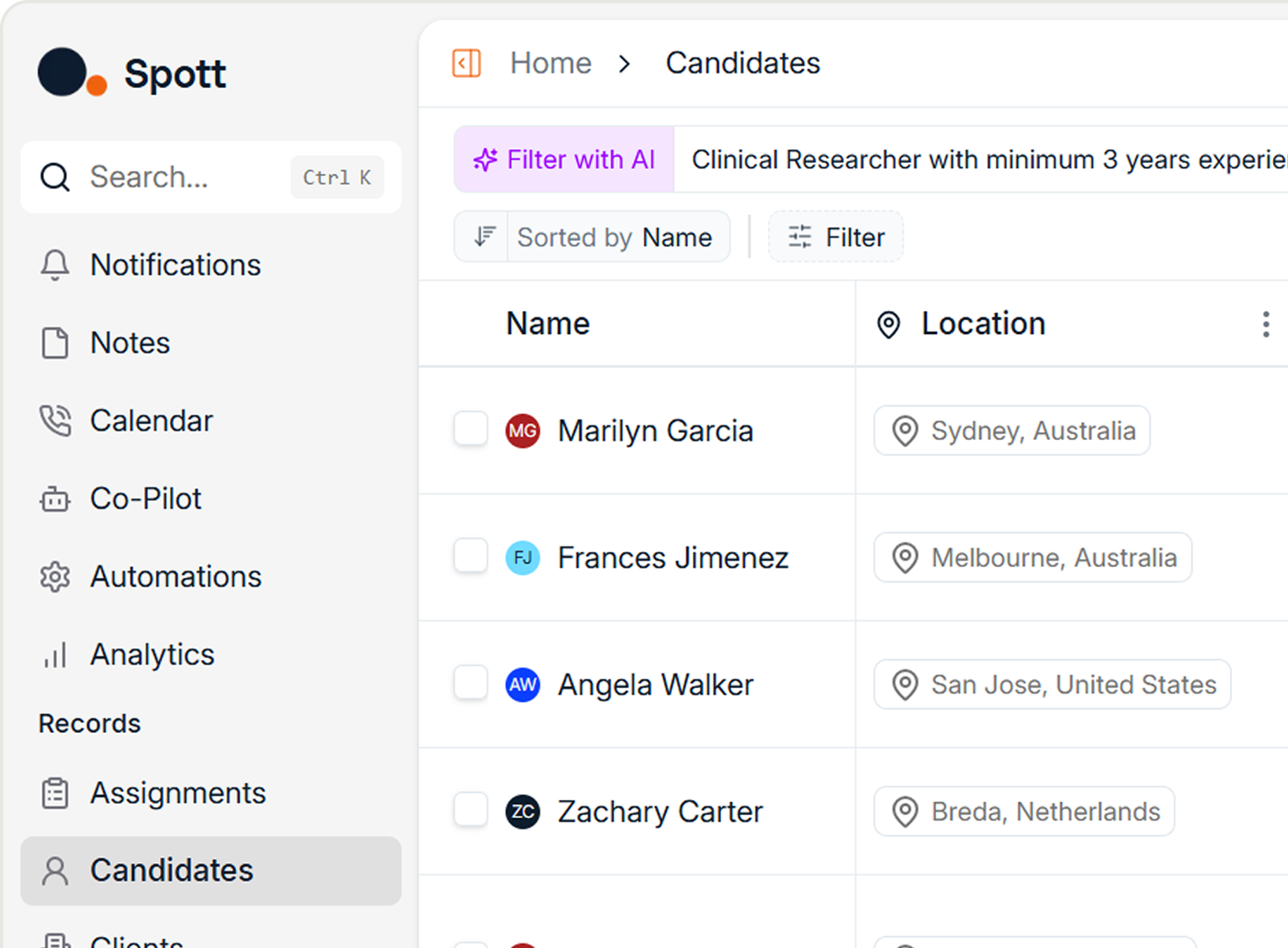
But the real shift was deeper than ease of use. The database went from something nobody touched to the operational centre of the business. Semantic matching means posting a job and finding suitable candidates takes seconds instead of complex Boolean strings. Data enrichment runs in the background, keeping profiles current without manual effort.
The biggest shift is one of it being a library of historical stuff to being where everything happens. And that, from an owner's perspective, is huge.
Speed followed. Actions that used to take 15 clicks now take one or two. The time from job order to candidate submission dropped dramatically. For 360 recruiters competing against other agencies on the same roles, that speed is the difference between winning and losing.
Historically, software packages were like driving a normal car, whereas this is like being in an F1 car by comparison. Everything happens quickly and efficiently and fast in a way that just makes sense.
And then there is the feedback loop - the thing Alex talks about most, including to the 5 to 10 people who message him about Spott every week on LinkedIn. When their MD wanted specific reporting functionality, it was built and delivered within hours - not weeks, not quarters.
There's a deep-seated foundation within Spott that they want it to be as good as it physically can be. Any feature suggestions, as long as there's a logical reason to do it, are embraced rather than resisted. That is rare in the recruitment software market.
The verdict
The move to Spott has been one of the best ones we've done. We can now actually grow this business with confidence, knowing that our tech stack is something we can rely on. Finally, we have an ATS CRM that we can rely on that will allow us to take our growth to the next level.
Alex Dick, CEO of Alexander Lyons Solutions
Your database should be your biggest asset, not a filing cabinet nobody opens. If that sounds familiar, book a demo and see what changes when your team actually wants to use the system.