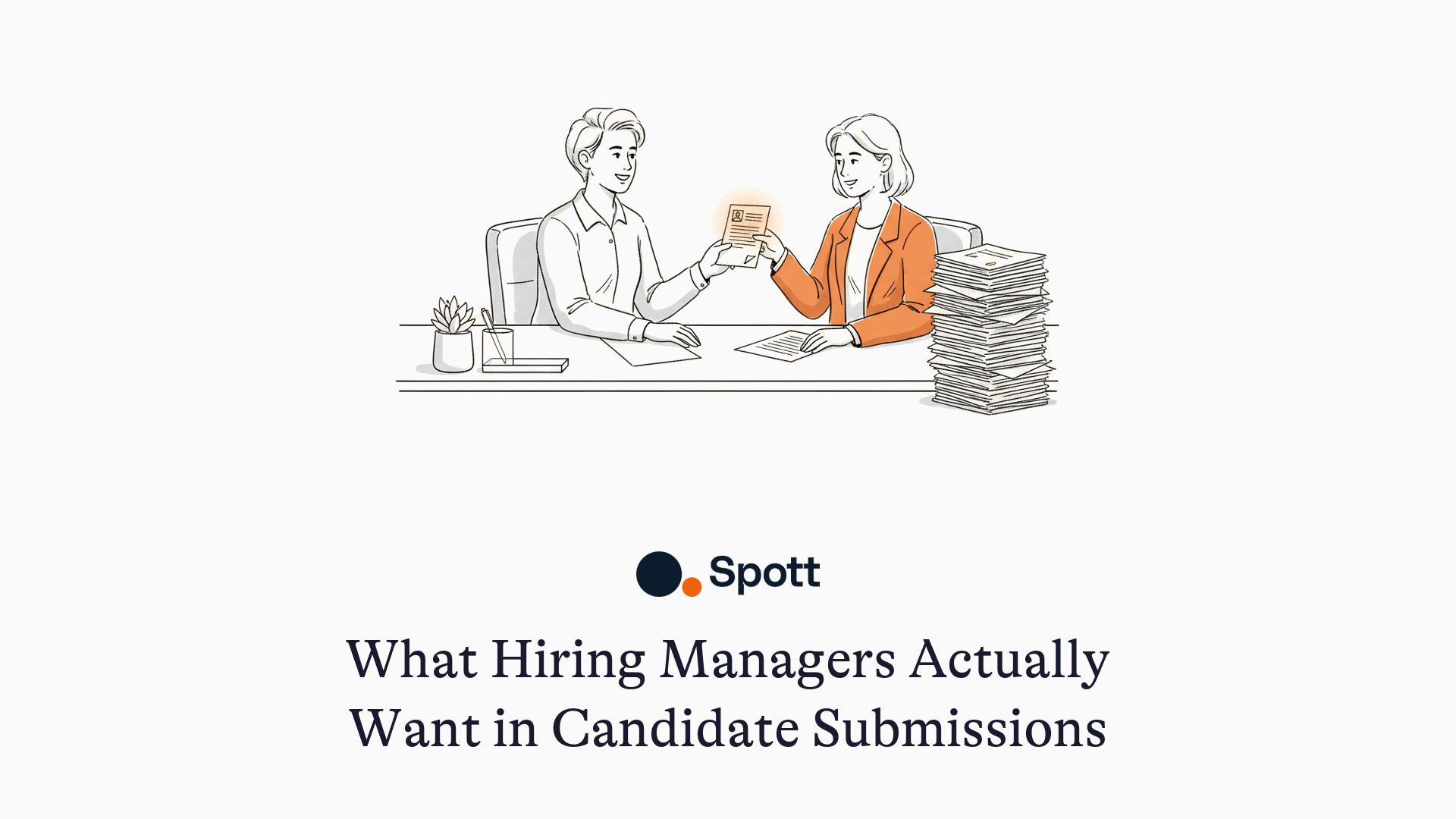
What Hiring Managers Actually Want in Candidate Submissions (It's Not a Longer CV)
TL;DR
Hiring managers want six things from a candidate submission: a one-paragraph answer to "why this person, for this role," evidence against their actual requirements (not the job spec boilerplate), the risks disclosed upfront, logistics they'd otherwise have to ask about (salary, notice, location), a consistent format they can compare across candidates, and speed. They do not want a five-page CV with no commentary, and they punish submissions that read like the recruiter never spoke to the candidate. The recruiter who answers the manager's questions before they're asked wins the interview slot, and usually the next role too.
Recruiters obsess over sourcing the right candidate and then lose the placement at the last step: a CV forwarded with two lines of email text, leaving the hiring manager to do the evaluation work themselves.
Here's the uncomfortable truth about that handoff: the hiring manager doesn't experience your sourcing, your screening calls, or your market knowledge. They experience the submission. To them, the submission is your agency.
So what do they actually want in it? After years of feedback from clients on both sides of these documents, it comes down to six things.
1. The "why," in one paragraph, before anything else
The first thing a hiring manager reads should answer the only question they have: why is this person worth 45 minutes of my week, for this specific role?
Not a career summary. Not "please find attached." A direct argument: "Sarah has run exactly this migration twice, most recently at a company with your stack and twice your scale, and she's looking to move for reasons your role happens to solve."
If you can't write that paragraph, you haven't finished screening. The paragraph is the product; the CV is the appendix.
2. Evidence against their requirements, not the job spec's
Job specs list ten requirements; hiring managers care about three of them. The recruiters who win know which three, because they asked during intake.
Structure the submission around those: "You said the non-negotiable was enterprise sales experience in regulated industries. Here are the two deals that prove it." Mapping evidence to stated priorities tells the manager you listened, and it spares them the skim-and-hunt across a CV that was written for a different audience anyway.
3. The risks, disclosed before they're discovered
Every candidate has a gap, a short tenure, a salary stretch, a notice period problem. The hiring manager will find it. The only question is whether they find it from you, with context, or by themselves, with suspicion.
"Two years at each of his last three companies; in each case the move tracked an acquisition, and his references confirm it" turns a red flag into a footnote. Omitting it turns a footnote into a credibility problem, for you, not just the candidate. Managers consistently rank honest risk disclosure as the thing that separates a trusted search partner from a CV-forwarding service.
4. The logistics they'd otherwise have to chase
Before any interview gets booked, someone has to know: current package and expectations, notice period, location and hybrid tolerance, other processes in flight, and visa status where relevant.
Put it in every submission, in the same place, every time. Each logistics question the manager has to email you is a day of delay, and in a contested search, days are how you lose candidates you already won.
5. A format they can compare side by side
Hiring managers rarely evaluate one candidate; they evaluate your shortlist against each other and against another agency's. Three CVs in three layouts with three different levels of detail make that comparison painful, and painful comparisons get postponed.
Consistent, branded submissions (same sections, same order, same depth for every candidate) let a manager line up five people in five minutes. This is also, bluntly, a brand asset: a polished shortlist in your agency's template is the most visible proof of professionalism most clients ever see from you. It's why reformatting CVs has been recruitment's most stubborn time sink, and why AI-generated candidate reports in your own template are one of the highest-leverage automations an agency can adopt.
6. Speed, because the shortlist that arrives first sets the bar
The first credible shortlist a hiring manager receives becomes the reference point that every later submission is judged against. Arrive first with three strong candidates and your agency frames the search; arrive third and you're being compared to someone else's framing.
Speed doesn't mean rushed. It means removing the friction between "we found them" and "the client met them": the formatting, the summary-writing, the logistics-chasing that turns a Tuesday shortlist into a Thursday email. (At Spott this entire step is generated from the data already in the system, calls, notes, and screening answers included. As one customer put it: "The speed...to share top candidates with clients is crazy. It makes the whole process feel effortless." — Savanna, McIlwain Solutions)
Anatomy of a submission that gets the interview booked
Put together, here's the structure that consistently performs, one page, before the CV:
- The pitch (3-4 sentences): why this person, for this role, now.
- Evidence vs your top 3 requirements (3 short bullets, each with a concrete example or number).
- What you should know (1-2 honest flags, each with context).
- Logistics line: package / expectation / notice / location / other processes.
- Recruiter's note (2 sentences): what you observed in the screening call that a CV can't show. Motivation, communication style, energy. This is the part only you can write, and the part managers quote back.
Then the CV, reformatted to your template.
If your team can't produce this in under 15 minutes per candidate, the fix isn't working later; it's tooling that drafts it from the context you've already captured.
The submission is where your agency's work becomes visible. Make the argument, show the evidence, disclose the risks, answer the logistics, keep the format, and arrive first.
Want to see candidate submissions generated in minutes, in your branding, from the calls and notes you've already made? Book a Spott demo. And for the other half of the client relationship, read how top agencies structure their BD process.