Why KennedyFitch Moved Executive Search from HubSpot to Spott
Company: KennedyFitch
Who: ~30 people, remote-first across Europe, HQ in Zürich
What: Executive search plus leadership consulting (transformation, coaching, organizational effectiveness)
Before Spott: HubSpot CRM + LinkedIn Recruiter + manual reporting
When Nils Richter, Managing Partner at KennedyFitch, started evaluating new tooling, the firm was not using a recruitment platform at all. Executive search ran on HubSpot, a generalist CRM, with LinkedIn Recruiter on top and a separate finance system on the side.
It worked, sort of. But a CRM is not an ATS.
"Spott brings everything together, with AI that actively supports business development, not just admin."
Nils Richter, Managing Partner, KennedyFitch
The problem: a CRM can't search like a search firm
KennedyFitch is a hybrid firm. Half the business is executive search for senior leadership roles; the other half is consulting on leadership transformation, career coaching, and organizational effectiveness. HubSpot could hold contacts for both, but for search work the gaps showed up everywhere:
- No CV parsing. Resumes sat in files no one could query.
- Search was the daily pain. Finding the right person in their own network meant remembering where information lived, not asking for it.
- Candidate reports were handcrafted. Partners assembled exclusive PDF reports of up to 30 pages per candidate, manually, for every presentation. At executive search fee levels, clients expect that quality. Producing it by hand does not scale.
Nils, who spent years investing in HR tech before running the evaluation himself, was specific about the goal: consolidate the stack instead of adding another tool to it.
Why Spott
A few things decided it:
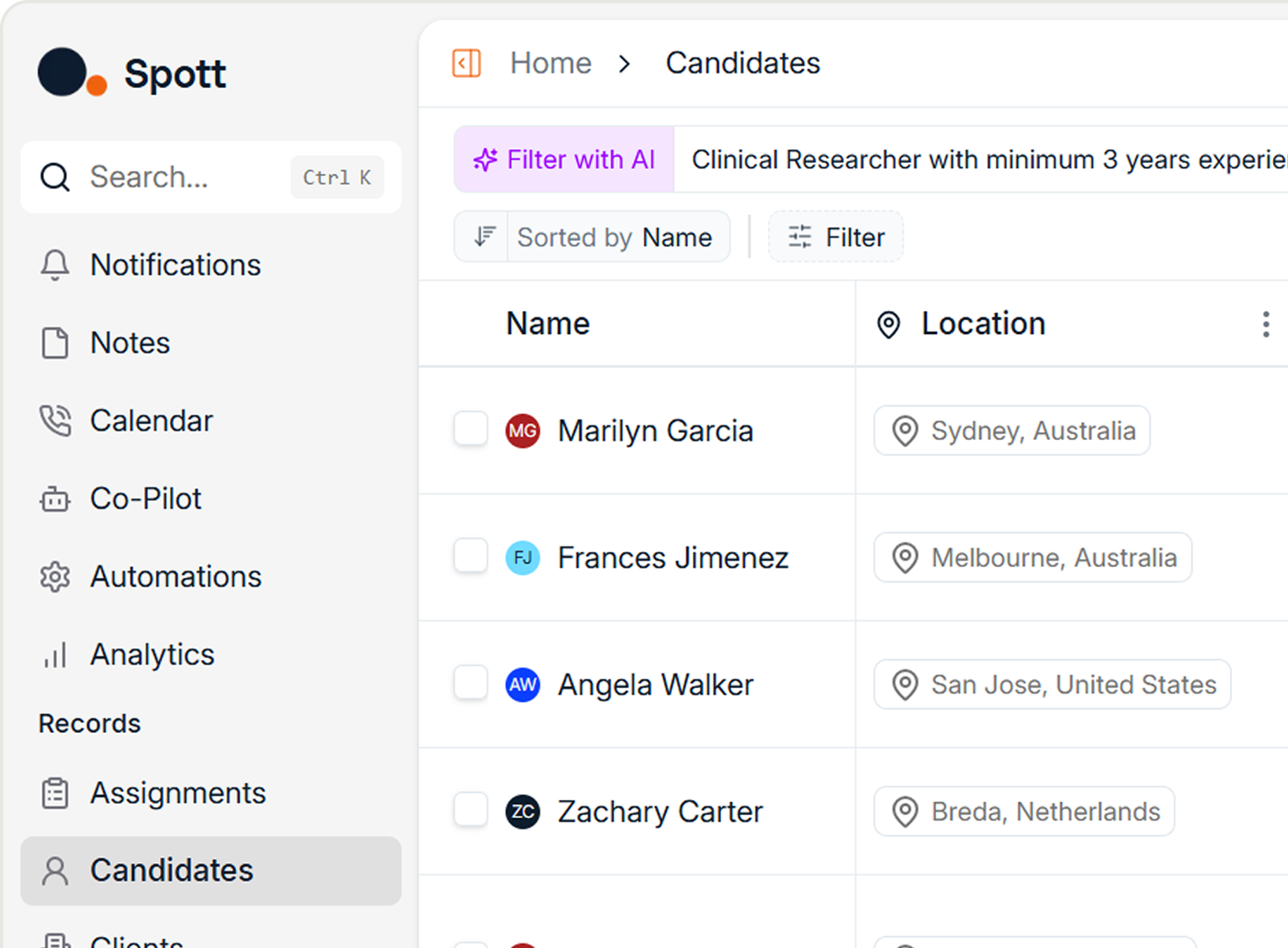
- AI matching that reads everything. Spott's matching searches across CVs, notes, references, and past conversations, not just job titles. For a firm whose real asset is a deeply mapped network of leaders, that is the difference between a database and a memory.
- Reports in minutes, not Fridays. Candidate reports draw on the vacancy, interview notes, intake conversations, and assessments already in the platform.
- One platform for two business models. Searches and consulting projects live side by side, with flexible fees (retainers, day rates, project amounts) per engagement.
- Compliance that holds up in DACH. GDPR consent management and ISO 27001 certification mattered for a firm working across Germany and Switzerland.
What changed
KennedyFitch rolled Spott out to the whole firm, 31 users across Europe. Meetings transcribe straight into the platform, email conversations log automatically, and partners run their business development pipelines in personal views they configured themselves, every working day.
That last part matters. The pitch for most ATS platforms is candidate admin. At KennedyFitch, partners use Spott as their daily BD cockpit: who to reconnect with, what was promised, what was said last time, all captured without anyone typing it in.
And when something needs adjusting, they talk to the team that builds the product. Questions raised by email get same-day answers; configuration requests get a quick call and a fix, not a ticket number.
KennedyFitch now refers prospective Spott customers as a reference. That is the verdict that counts.
Want your team's conversations working for you instead of sitting in files? Book a demo.

Frequently Asked
For the recruiting side of the business, yes. HubSpot is a generalist CRM: it has no CV parsing, no candidate matching, and no pipeline built for placements. Spott combines the ATS and CRM in one platform, so firms like KennedyFitch move both sides across. Some agencies keep HubSpot for marketing alongside Spott, connected through the API.
Yes. Agencies run a two-sided business (candidates and clients), so they need pipeline management and relationship management. The real question is whether to run them as two tools or one integrated platform; in 2026, integrated wins on context, cost, and compliance.
It depends on the size of your database and how quickly feedback flows. We've taken agencies off their old system in a single day; most migrations take a few weeks from the moment we receive your full data export. Nothing goes live until you've validated your data.


Outp(l)ace everyone.
You can’t win tomorrow’s placements
with yesterday’s tools.