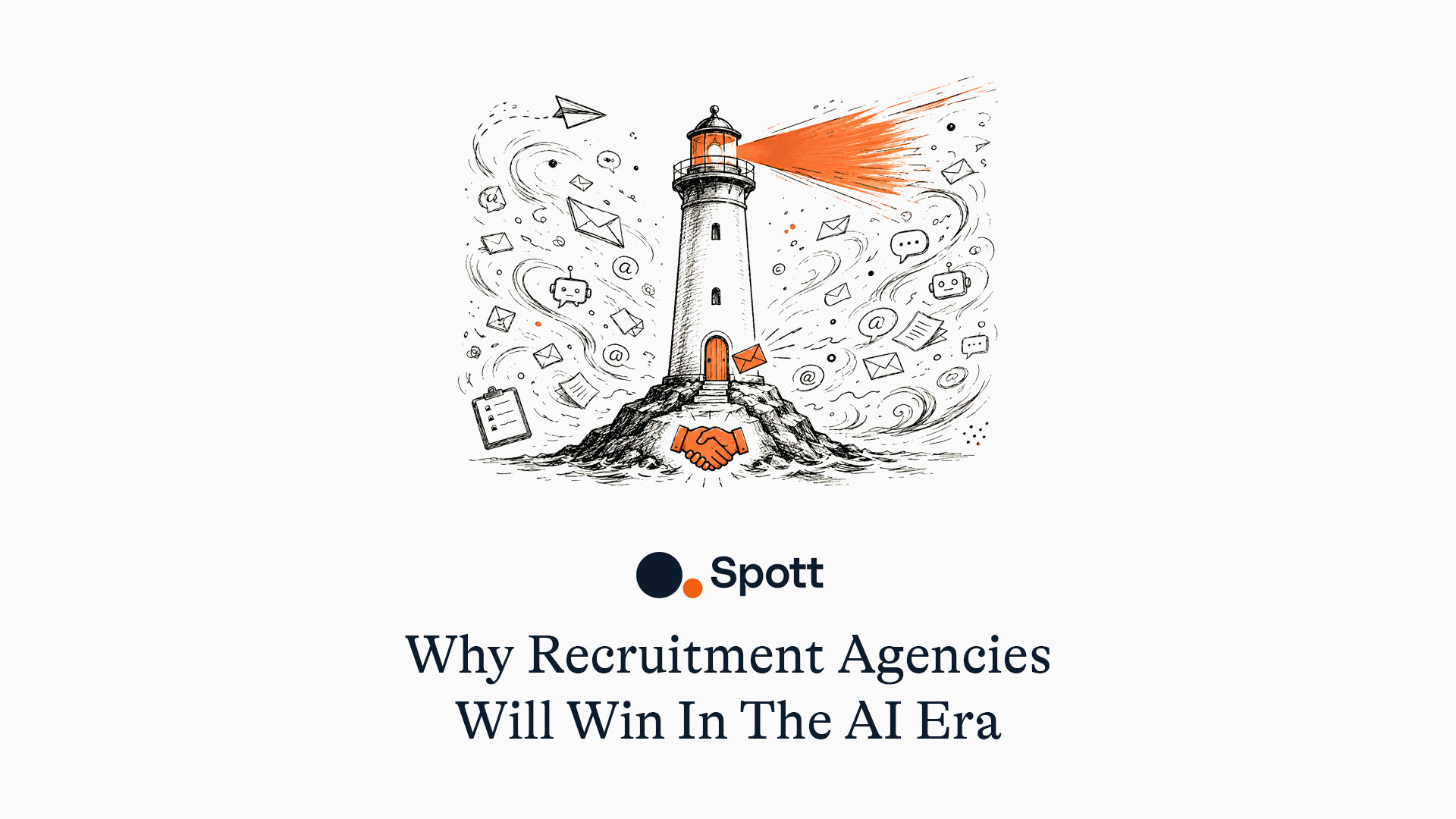
Why Recruitment Agencies Will Win in the AI Era (Not Lose)
Job boards were supposed to kill the recruitment agency. Then LinkedIn. Now it's AI.
Every wave of recruitment technology has come with the same prediction: this is the one that finally makes agencies obsolete. Companies will hire directly. Software will replace the middleman. The recruiter as a profession will fade away.
It's never happened. And looking at how AI is actually playing out across the recruitment market in 2026, it's not going to happen this time either.
The opposite is happening. AI is creating exactly the conditions where good recruitment agencies become more valuable than ever - and where the gap between the top firms and the rest gets wider, faster.
Here is why.
The new problem: AI has broken cold outreach
Until two years ago, you could spot an automated email at fifty paces. "Hi, [first_name]," the obvious template, the generic compliment about your LinkedIn post.
That signal is gone. AI-generated outreach in 2026 is genuinely good. It references your work history, picks up details from your last LinkedIn post, mentions a specific paper you were quoted in. The personalisation is real. The grammar is perfect. The hook is calibrated.
The problem is that everyone is doing it. Every sales rep, every recruiter, every founder, every fundraiser. Inboxes are flooded with messages that all look like the kind of message a thoughtful human would have written - except no human wrote them.
Hiring managers and senior executives have responded the way humans always do when signal becomes noise. They have stopped reading. They have stopped trusting. They route messages to spam aggressively. They ignore LinkedIn DMs by default.
One of our customers put it directly: "I get 20 sales emails a day. We catch 30 to 40 in spam automatically. It's been two months since I had a real cold call."
That last sentence is the punchline. Cold calls have become the rare, trusted channel.The medium that was supposed to die first is now the only one that reliably gets through.
The counterintuitive truth: trust is the new scarcity
If everyone has access to the same AI outreach tools, the value of those tools collapses to zero. Whatever advantage they create lasts about a quarter before it becomes table stakes.
What doesn't collapse is trust.
The more inboxes get flooded, the more candidates and clients default to the people they already know. The agency partner who placed them three years ago. The recruiter who has called twice a year for the last decade with relevant roles. The specialist who knows their market better than any AI ever will.
Manu Vanderveeren, co-founder of Spott, articulates this directly:
"As everyone starts spamming, the market needs connectors. Agencies that map their niche, know when people are available, and are a trusted brand that candidates actually respond to. The more people spam, the stronger the agencies that don't get."
This is the flywheel that legacy recruitment thinking misses. AI noise increases the value of agencies that don't spam. The harder it gets for everyone else to break through, the more valuable a maintained, trusted network becomes.
And maintained, trusted networks are exactly what good recruitment agencies have spent decades building. That asset doesn't depreciate. It appreciates.
Why companies can't replace agencies with internal teams
The standard counter-argument has always been: "Companies will just hire more internal recruiters and skip the agency fee."The math doesn't work. To replicate what a specialist agency does, an internal team would need to map every potential candidate in every relevant role across every relevant company - and maintain those relationships continuously, regardless of whether the company is hiring.
Manu again:
"We have 25+ people internally. There's no way I can map every software engineer, every sales rep, every role we hire for - let alone build relationships with them. That's impossible internally. Even with AI helping, you can't be in 50 niches at once."
Specialist agencies can be in 50 niches at once because that's the entire job. They have a partner who has spent 15 years on fintech CFOs in London. Another who lives and breathes Series B sales leadership in DACH. Another who has built every product team at every Series A startup in the Nordics.
That depth doesn't get cheaper as AI improves. It gets more valuable, because the alternative - using AI to source from cold lists - is exactly the channel candidates are tuning out.
AI doesn't replace recruiters - it multiplies them
Here's the part most agency owners aren't thinking about clearly enough.
The same AI that's flooding inboxes is also dramatically increasing what a single great recruiter can do. The boring work - data entry, candidate research, drafting outreach, formatting reports, scheduling - is collapsing to almost zero time. The valuable work - building relationships, reading rooms, closing deals, advising clients - still takes the same time it always did, because that work is human.
The result: a recruiter who used to do 5 to 10 placements per year can do 20+ on the same hours. The fee structure doesn't change. The market size doesn't shrink.
This is the placement volume opportunity. Manu's framing:
"Within 2-3 years, instead of 5 or 10 placements per year, the best recruiters will be doing 2 placements per month. The pie doesn't shrink. It just gets redistributed to the agencies that move with the technology."
Notice the framing. The pie doesn't shrink. It redistributes.
The winners and losers split
Here's where it gets uncomfortable for some agencies.
The market dynamic going into 2026 isn't "AI will kill agencies." It's "AI will widen the gap between the agencies that adopt it and the ones that don't."
Agencies that use AI to remove admin, accelerate sourcing, and free recruiters to spend more time on relationships will compound their advantage every quarter. They'll do more placements per recruiter, with better margin, and with happier candidates because the relationship still feels human.
Agencies that resist - sticking to manual processes, legacy ATS platforms, and "we've always done it this way" - will fall behind on volume, lose mandates to faster competitors, and eventually struggle to recruit talent into their own firms because the work feels dated.
The middle gets squeezed. The top compounds.
This isn't a prediction. It's already happening. The agencies hitting record placement years right now are the ones like Alexander Lyons Solutions that quietly invested in modern tooling 12-18 months ago The agencies struggling are still running on systems that were designed before ChatGPT existed.
Why efficiency gains don't shrink agency teams
One thing that confuses people about the AI productivity boom: surely if recruiters are more productive, agencies will hire fewer recruiters?
It almost never works that way in growing industries. Manu's take:
"What usually happens when something makes you more efficient is that the team expands, not shrinks. If I told you here's 50% more revenue, you wouldn't say great, let's downsize. You'd say great, let's scale."
Recruitment is a growth industry. Demand for hiring isn't shrinking. The market for placement work in 2026 is bigger than it was in 2024 and will be bigger still in 2028.
AI gives agencies leverage. The good ones use that leverage to grow - more recruiters, more verticals, more geographies. The pie keeps growing for them. The ones that don't use the leverage cede share.
Why the network is the moat
The deepest reason agencies will keep winning comes down to one thing: building a real network is the hardest thing in business, and AI doesn't change that.
Manu, on why LinkedIn became a monopoly:
"Building a network is the hardest thing there is. That's why LinkedIn has a monopoly. People don't log into a platform every day for something they need every two years."
The same is true at the niche level. Candidates don't log into a tech recruitment platform every day. They engage when a senior recruiter they trust reaches out with a relevant role. That trust is built over years and is essentially impossible to replicate with software.
Companies trying to replace agencies with AI tools quickly run into this. The tool can find the candidate. The tool can send the message. The tool can't make the candidate respond to a stranger when they ignore 19 other strangers that day.
The agency's network is the moat. AI sharpens what agencies do with that network. It doesn't replace the network itself.
What this means for your agency
If you run a recruitment agency in 2026, the strategic picture is clearer than it has been in a long time:
- Your network is the asset. Maintain it. Invest in it. The market will pay for it more, not less.
- Your niche is the moat. Pick a deep niche or a tight geographic focus and become the trusted brand for it. Generalists will lose to specialists faster than ever.
- Your tech stack is the leverage. Use AI to remove the admin and the busywork. Free your recruiters to spend their time where the value is - in conversations, relationships, and judgment calls.
- Your brand is the differentiator. When AI floods every other channel, the agencies with strong personal brands and visible expertise become the ones candidates actually respond to.
The agencies that get this right will take a bigger share of the placement market than they ever have. The ones that don't will keep doing what they've always done, until they don't.
The recruiter-first AI stack
The piece most agency owners have to get right is the tech stack. AI tools alone don't make a recruiter productive. AI tools embedded in the systems where recruiters actually work do.
That's why an outside perspective from Martin Shaw (Shaw Talent, executive search firm in Australia) is worth quoting:
"My prediction is that within about 12 months, if your ATS or your CRM doesn't connect directly into Claude or ChatGPT, you'll become pretty much obsolete. What you want is something that's great in the background and has all the back ends set up properly. The tool is the backend. The relationship is the product."
That's the right framing. Recruiters don't win because they have AI. They win because they have a great network and the AI fades into the background, doing the boring work that used to consume their day.
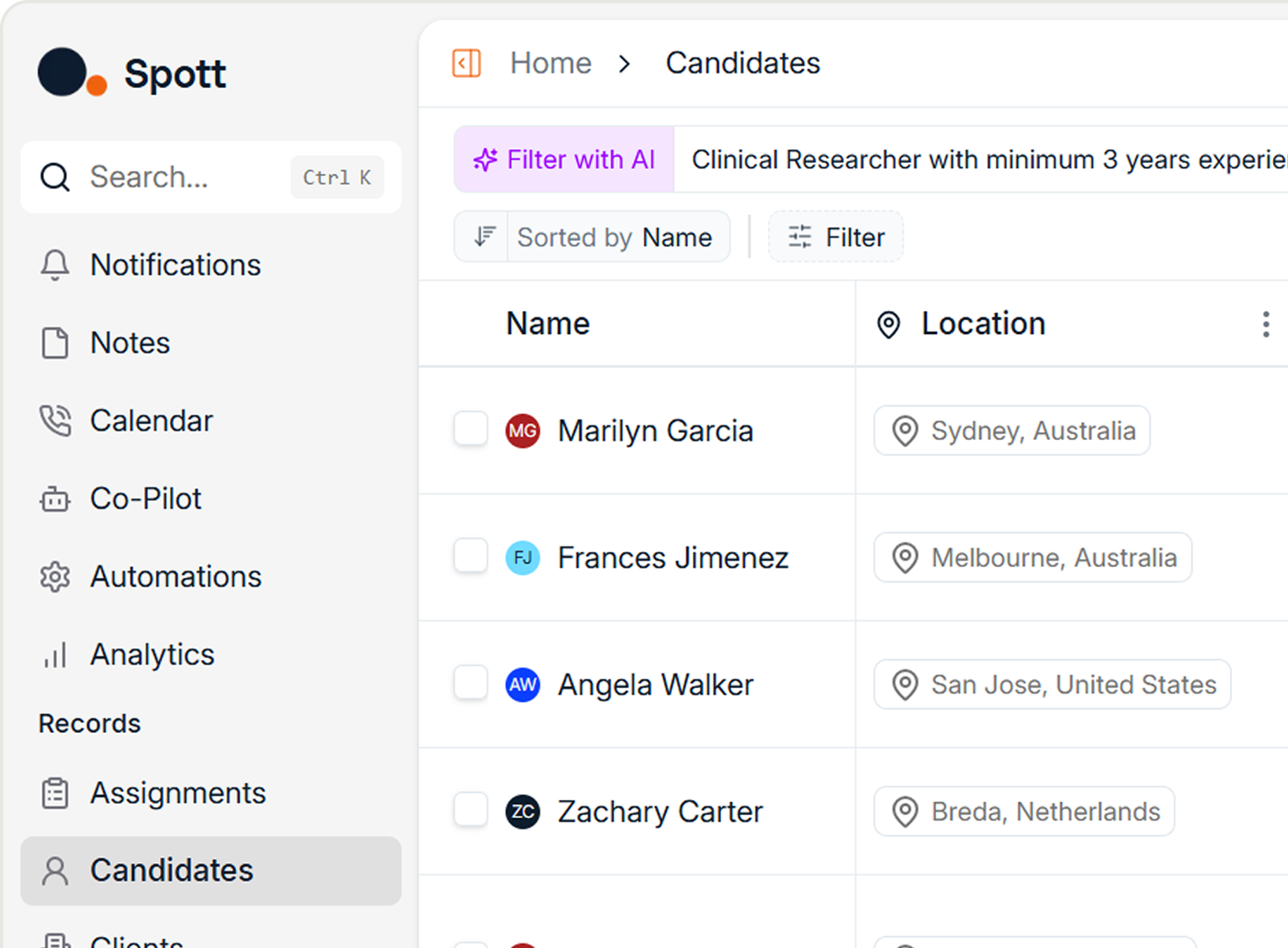
Spott was built around exactly this idea. AI-native architecture, contextual matching, auto-notes from calls, branded candidate reports, an open MCP server for Claude and ChatGPT - all designed to give recruiters their time back so they can spend it on the work that compounds: relationships, judgment, and trust.
The bottom line
AI was never going to kill the recruitment agency. It was always going to redistribute placements toward the agencies that move with the technology and away from the ones that don't.
The flood of AI noise is the best thing that's happened to trusted, niche-driven recruitment in a long time. It makes scarce what agencies have always sold: trust, relationships, and a network that picks up the phone when you call.
If you run an agency that takes care of those three things, the next decade will probably be the best in your firm's history.
If you'd like to see what an AI-native ATS built for this future looks like, book a demo.

Frequently Asked
No. The opposite is happening. As AI floods inboxes with automated outreach, trust and personal relationships have become the scarce resource in recruitment. Candidates and clients increasingly default to people they already know - the agency partner who placed them three years ago, the recruiter who has called twice a year for the last decade. AI noise increases the value of trusted, niche-driven agencies. The agencies that lose share won't lose to AI - they'll lose to other agencies that adopt AI faster.
Three reasons. First, AI has broken cold outreach - inboxes are flooded with automated messages and senior candidates have stopped responding to strangers. Trusted relationships are now the only reliable way to reach top talent. Second, no internal team can map an entire talent market the way a specialist agency can - that depth gets more valuable, not less, as AI improves. Third, AI multiplies what a single great recruiter can do, meaning the best agencies will take a bigger share of placements rather than fewer.
The right approach is to use AI to remove admin and busywork - data entry, candidate research, drafting first-draft outreach, formatting reports, scheduling - and free recruiters to spend more time on the work that compounds: relationships, judgment, closing, and advising clients. AI should fade into the background. The relationship stays the product. Agencies that try to replace the relationship with AI lose. Agencies that use AI to deepen the relationship win.
Agencies that combine four things will take a disproportionate share of the placement market: a deep niche or tight geographic focus, a trusted personal brand, strong long-term candidate relationships, and a modern AI-native tech stack that frees recruiters from admin work. Generalists with no niche, weak personal brands, and legacy ATS platforms will struggle. The middle gets squeezed; the top compounds.
No. The math doesn't work. To replicate what a specialist agency does, an internal team would need to map every potential candidate in every relevant role across every relevant company - and maintain those relationships continuously, regardless of whether the company is currently hiring. Even with AI helping, no internal team can be in 50 niches at once. Specialist agencies can, because that's the entire job. As cold outreach gets harder, this depth becomes more valuable, not less.
Faster than most agency owners realise. The agencies hitting record placement years right now invested in modern tooling 12-18 months ago. Recruiters at AI-native firms are doing 2-3x the placement volume of recruiters at legacy firms on the same hours, because admin work has collapsed to near-zero. The compounding effect means a year of delayed adoption can take 2-3 years to recover. In markets where talent expects modern tools, agencies on legacy systems also struggle to recruit recruiters into their own firm.
Five things, working together: a contextual / semantic matching engine that finds candidates by full context rather than keyword filters; auto-notes and call summarisation that capture every conversation without manual data entry; data enrichment that keeps candidate profiles fresh and contactable; branded candidate presentation tools that turn shortlist work into client-ready output in minutes; and an open AI layer (e.g. an MCP server) so external assistants like Claude and ChatGPT can work directly on the data. The point is integration. AI features bolted onto a legacy ATS deliver a fraction of the productivity gain of an AI-native architecture.
No. AI has made cold outreach less effective, not more. The personalisation is real but everyone has access to the same tools, so the signal-to-noise ratio has collapsed. Senior candidates and hiring managers respond to people they know and trust. The recruiters winning in 2026 are using AI to free up time for relationship-building, brand-building, and warm referrals. Not to send more cold emails. Cold outreach still has a place at scale, but the differentiator is now reputation and network, not message quality.



Outp(l)ace everyone.
You can’t win tomorrow’s placements
with yesterday’s tools.