How Macmillan Davies replaced Vincere and went live with Spott in under 4 weeks
Why they left Vincere
Macmillan Davies has been placing HR professionals for over 45 years. After 15 years on Profile (acquired by Access Group), they migrated to Vincere two years ago and watched the platform stand still.
The core problem was that consultants stopped filling in structured data. Industry sectors, sub-functions, salary information: none of it got entered because the manual effort wasn't worth the payoff. And without structured data, Vincere's keyword-only search was useless. The database had 280,000 candidates in it, but finding the right one meant already knowing their name.
"One of the reasons we're leaving is that the data doesn't get entered."
This hit especially hard in HR recruitment, where the same role goes by wildly different names. A comp & benefits manager, a C&B manager, and a rewards manager are functionally the same person. Vincere's search didn't know that.
"One of the reasons why we chose Spott was to have the search capability that our other systems, Vincere, was just absolutely atrocious for searching."
Teh team evaluated five platforms before shortlisting two AI-native contenders. What tipped it was architecture: Spott stores every CV, note, call transcript, and WhatsApp conversation in a vector database built from day one.
Migration: cleaning up years of messy data
Spott's migration team handled the full process, from negotiating the data export with Vincere through to go-live. Signed in November 2025, data alignment started Christmas Eve, live in January 2026.
Deduplication from 280K to 180K candidates. Spott doesn't allow duplicate records. Phone numbers are normalized aggressively (a number starting with 0 and the same number with a country code are treated as identical), same for email addresses and LinkedIn URLs. 100,000 duplicates were de-duplicated, with an audit trail for every merge.
Consolidating scattered salary and currency fields. Years of data collection had scattered salary information across multiple tables and formats. Desired salary and current salary fields had ended up in different places: candidate records, job application data, custom fields. Spott’s mapping effort consolidated these into a unified set, giving the team around 50,000 searchable salary records from day one.
Migrating historical email correspondence. Vincere stored email history in .msg files across multiple user message tables. Multiple iterations of cross-referencing export files against actual Vincere records ensured years of email history made it across, properly matched to the right candidates.
All CVs were re-parsed during migration, overwriting Vincere's incomplete education and work experience data wherever Spott's parser produced a better result.
Broadbean: streamlining job distribution and inbound processing
Broadbean went live in January 2026 and simplified how the team handles the full job posting workflow.
Consultants create a job in Spott and post it to Broadbean in one click, distributing it to their own website and across job boards. No separate login, no duplicate data entry.
When candidates apply through any Broadbean-connected channel, their details flow directly into Spott. Candidates are automatically parsed, deduplicated against the existing database, and ranked against the job's AI matching criteria. Consultants open the inbound tab and see candidates already sorted by fit, strongest matches at the top. No more manually reviewing every application from scratch.
How matching works day-to-day
The onboarding session on February 9th walked the full team through the matching workflow.
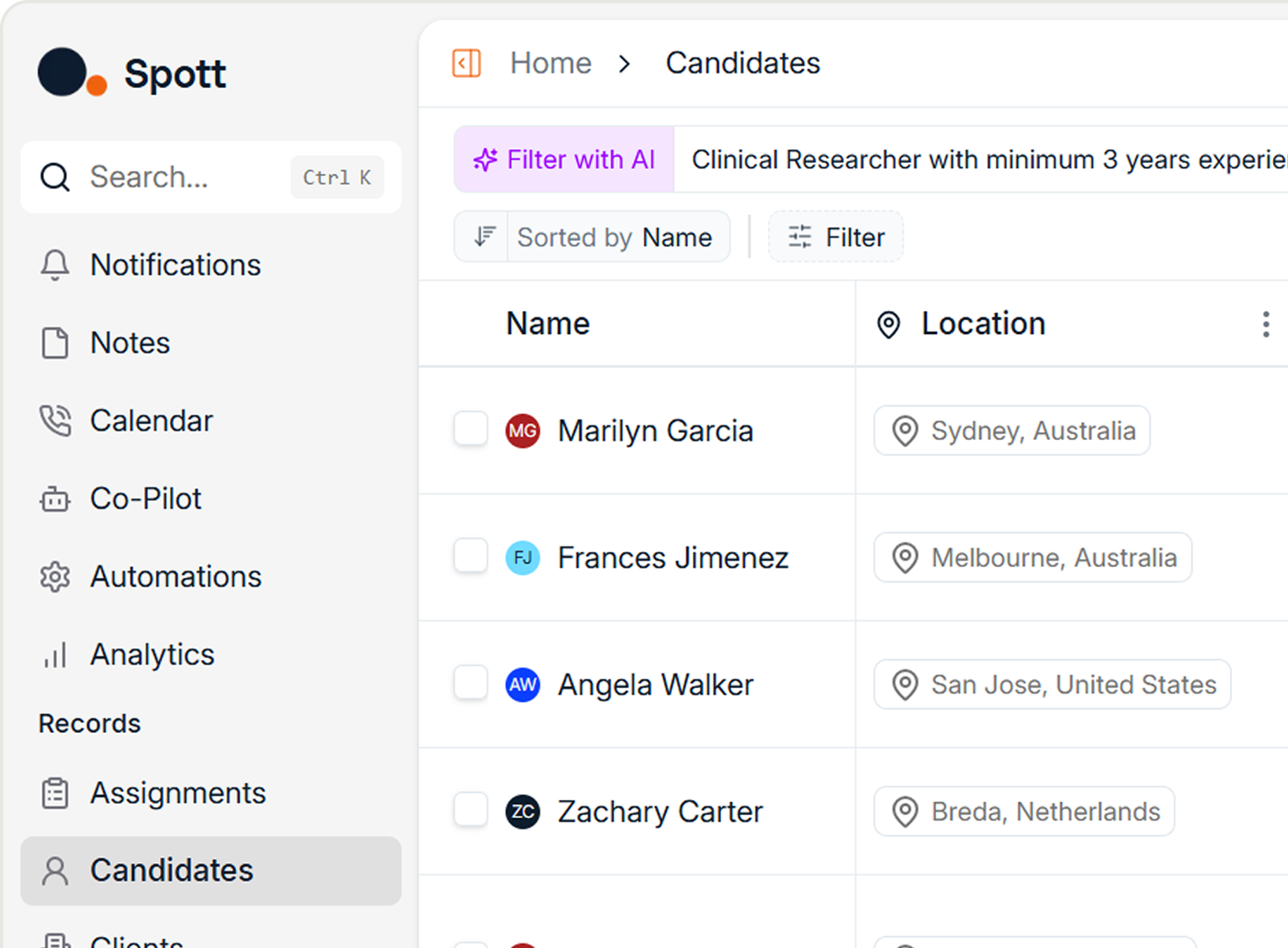
Hard filters first, then AI ranking. The 180,000-candidate pool is first narrowed using hard filters: GPS-based location radius, salary range (using those 50,000 migrated salary records), latest CV date, and custom attributes carried over from Vincere. This brings the pool down to 2,000 to 6,000 candidates. Then AI re-ranks that subset against up to five natural-language criteria, weighted by priority.
Salary filtering was a priority. HR roles with similar titles can have enormous salary ranges. By filtering on salary as a hard constraint before AI ranking, the team avoids wasting time on candidates outside budget. New salary data mentioned in calls or notes is surfaced as suggested field updates, keeping structured data fresh without manual entry.
"One of the biggest areas for us is being able to search for candidates and ensure things like salary. Within a similar role, there could be a big range of salaries."
Describe the ideal candidate, don't type keywords. Instead of "HR Director," consultants write descriptive criteria: "5 to 10 years of HR leadership experience, ideally with exposure to industrial relations and HRIS implementations such as Cascade." The AI searches across CVs, notes, and call transcripts, surfacing candidates who mentioned relevant experience in passing, not just in their CV headline.
What's next
AI columns for automatic tagging. The team has configured AI columns to tag HR functional expertise, industry sectors, and seniority levels across all 180,000 candidates, backfilled retroactively from CVs and notes. This replaces the manual Vincere fields that consultants never bothered filling in.
"I think the AI columns are going to be a better way of doing this. It should be able to look at the candidates and code them without us having to do it manually."
VoIP integration for automatic call logging. The team is exploring VoIP providers to connect phone calls directly into Spott. Calls would be automatically logged, transcribed, and summarized on candidate records. That content would flow back into the vector database and become searchable in matching. A salary expectation mentioned on a quick phone call would be just as findable as one written in a CV.