Three friends.
Disappointing ATS/CRMs.
A fresh start.
Spott was born when three management consultants realized they were all advising recruiting firms, and all frustrated by the same outdated tools. So they built the ATS they wished existed.
We kept seeing the same thing
Manu, Lander, and Samuel met eight years ago at KU Leuven. Business engineering students who hit it off through a student club, spent every holiday together, and eventually all ended up in management consulting in Brussels. Manu at McKinsey, Samuel at BCG and Lander at Bain.
Each of them rotated through projects at staffing and recruiting agencies. Europe, the UK, the Middle East. And each of them saw the same thing: recruiters spending half their day logging activities instead of making placements. ATS systems that stored data but never did anything with it. Billions of candidate records sitting in databases that couldn't understand a single one of them.
The funny part? None of them knew the others were working in recruiting too. They'd each arrived at the same conclusion independently: someone should fix this.
When they finally compared notes, the answer was obvious. They should.
One system, specifically, kept showing up. Bullhorn. It was in every agency Manu advised, on every project. It does what it has to do. But after years of watching recruiters work around its limitations (logging every call manually, copy-pasting between tabs, losing context the moment a conversation ended) he knew it wasn't good enough anymore. And he knew that no amount of AI bolted on top would fix a foundation that was never designed for it.
Bullhorn is the reason Spott exists.
No half measures
Their first instinct wasn't to build a new ATS from scratch. That would be insane. Three guys from Belgium, going up against a market dominated by entrenched players with thousands of employees.
So they tried the sensible path first: add AI on top of existing platforms. Bullhorn. Salesforce. Faster to market, lower risk.
It didn't work. The architecture of those systems made it impossible to do properly. You can bolt a chatbot onto a relational database. You can't make it truly understand context. The meaning behind a call. The intent behind a message. The fit between a candidate and a role that goes beyond keyword matching. That requires a fundamentally different foundation.
So they made the harder choice. Start from zero.
The three of them aren't "let's see how it goes" people. When they decide to do something, they go all in. That meant quitting McKinsey, BCG, and Bain. Building a prototype. And applying to Y Combinator, the startup accelerator behind Airbnb, Stripe, and Dropbox.
They got in.
YC made an initial investment of $500K, and suddenly it was real. Not "exciting" real. "Terrifying" real. The clock started immediately. Three months to build a product worth presenting to the world's top investors.
Three months that changed everything
Their YC partner was Tom Blomfield, founder of Monzo, who'd built two unicorn companies before he was 30. He flew them to San Francisco, challenged their assumptions from day one, and still speaks with the team every week.
The team moved into a bungalow in Palo Alto, then an apartment in the Mission District. Four or five people sleeping in the same house. Manu on calls with European clients at 4 a.m. Engineers working until midnight. Six days a week, fourteen hours a day.
They'd applied to YC with a candidate report writer, a tool that drafted candidate presentations from interview transcripts and CVs. Within weeks, they realized that to do this properly, they needed to build something much bigger: a full ATS, rebuilt from scratch around AI.
So they pivoted. Mid-program. With the demo day clock ticking.
The atmosphere in San Francisco pushed them forward. A city where you can't grab a Friday beer without someone talking about technology. They sat next to AI founders from sales tech, marketing tech, and HR tech. They learned what worked in adjacent industries and applied it to a sector that was years behind. Any time OpenAI released a new model, someone in the cohort had heard about it 72 hours earlier and was already ready to implement it.
That cross-pollination mattered. The team absorbed playbooks from completely different industries and brought them into recruiting, a space that was still catching up.
By demo day, the product they presented looked nothing like what they'd applied with. The report writer had become one small feature inside a complete AI-native ATS.
.jpg)
60 investor meetings in one week
YC's demo day is exactly what it sounds like: present your company, your revenue, your vision, and convince investors to back you.
What followed was a week of back-to-back meetings. Thirty minutes each. Sixty-plus conversations. Explaining not just what Spott was, but where recruiting software was headed over the next decade.
The first lesson from fundraising: stop discounting yourself. Manu had been pitching at a conservative valuation. The Belgian instinct. Tom Blomfield told him to stop. "If you go in at that number, everyone will think your startup is ten times worse than the rest." The number changed. The conversations changed with it. Within days, investors who'd been polite were suddenly urgent.
US investors, the team learned, bet on people first. They want founders who are going all the way. The current state of the product is almost an afterthought. It's the team and the market that matter.
In March 2025, Spott raised $3.2M in seed funding, led by Base10 Partners, with Y Combinator, True Equity and Fortino Ventures participating.
Built in Belgium. Used worldwide.
YC's data says 85% of unicorns are built in San Francisco. The Spott founders came back to Belgium anyway.
Belgium isn't the easiest place to build a global company. Manu is the first to say it. The market is small, the startup culture is still developing, and the ambition that's normal in San Francisco can feel out of place in Brussels.
But Leuven has something San Francisco doesn't: KU Leuven, consistently ranked among Europe's top technical universities, and a deep bench of engineers who want to build things that last.
The engineering team works side by side in the same office. Every day. No remote, no hybrid. When something needs fixing, someone turns around and asks a question. When a customer needs a feature, it goes from conversation to ticket to production in days, not quarters. Across a codebase of over a million lines, that proximity is what makes weekly releases possible.
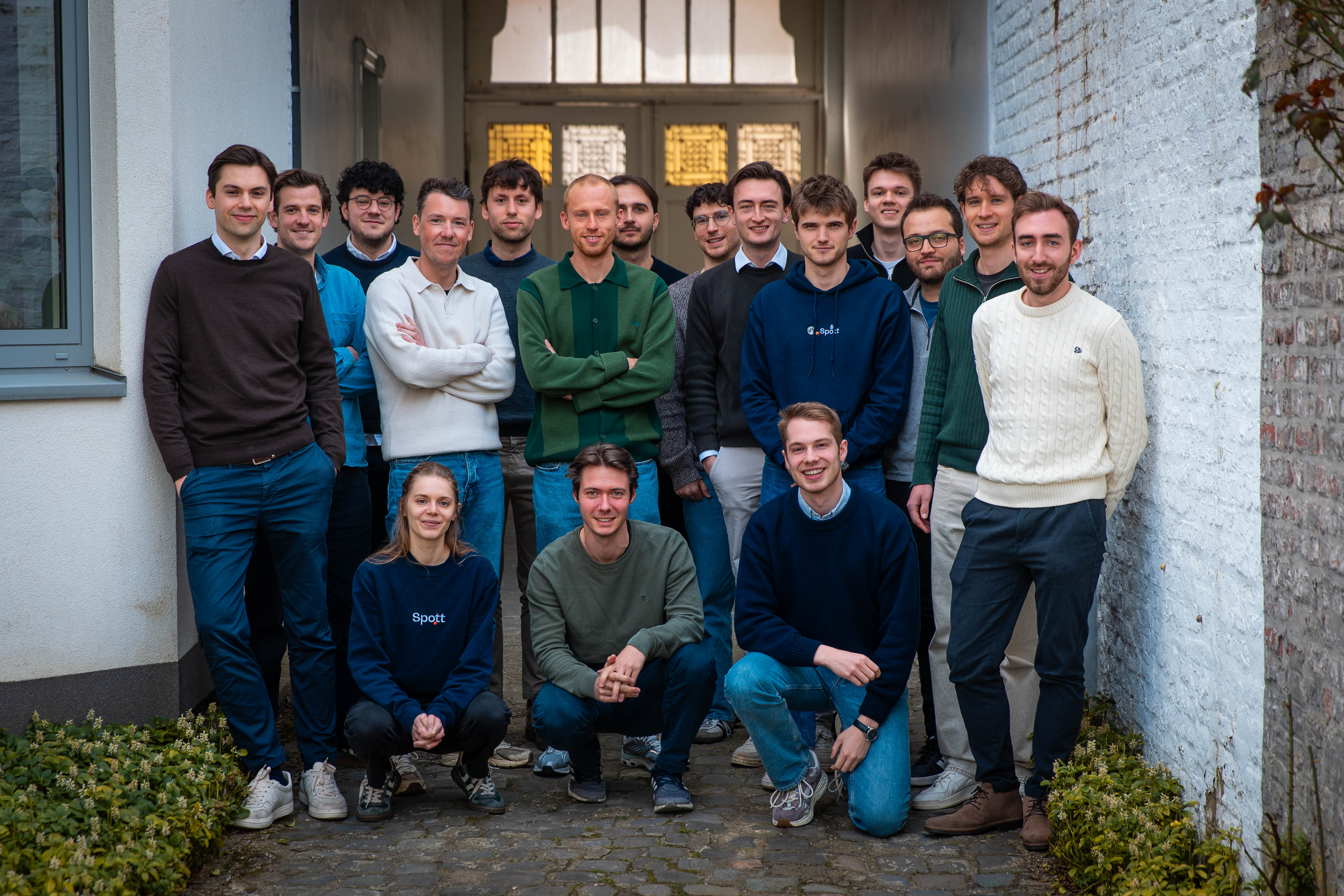
The team chose Leuven for the engineering. The plan was always to grow globally from there. Satellite offices in New York, London, wherever the customers are. The product doesn't care where it was built. The customers on every continent already prove that.
Our bet on the future
The recruiting industry has a stacking problem. Agencies run a legacy ATS that's been there for 15 years, then pile tools on top for outreach, CV formatting, matching, and marketing. Each tool works in isolation. Nothing talks to anything else.
We believe that's ending.
The specific decision we made was to build Spott on a vectorized database alongside the traditional relational one. That means the system understands the meaning of everything stored in it, not just the keywords. It's what makes matching work on personality and potential, not just job titles and skills. It's what lets you find the candidate who mentioned they were open to relocating in a conversation six months ago. No legacy system can do this. It requires building from scratch.
That's why we started from zero. Not out of arrogance. Out of necessity.
The end state we're building toward: a platform that handles 70-80% of the recruitment process autonomously. Not because we want to replace recruiters, but because the 70% that can be automated (matching, outreach, scheduling, note-taking, reporting) shouldn't take up a recruiter's day. The 30% that requires human judgment? The negotiation, the relationship, the read on whether someone will actually thrive in a role. That's where great recruiters make their money. We're building so they can spend their time there.
The recruiting firms that adopt this approach will make more placements per recruiter. The ones that don't will fall behind. We're here to make sure you're in the first group.
From €0 to €1M+ ARR. No cold calls. Zero churn.
In October 2025, Spott had around €100K in annual recurring revenue. Four months later, that number crossed €1 million.
Every single customer that joined is still here. Zero churn. Not because they're locked in, but because the product works.
The team grew from 3 to 21 and the first dedicated salespeople joined in 2026. 60% of revenue now comes from enterprise customers: agencies with 100+ recruiters switching from Salesforce, Bullhorn, and Loxo.
$21M to take it global
In September 2026, Spott raised a $21M Series A led by Balderton Capital. Base10 Partners, Y Combinator and Fortino Ventures, who backed us early, all came back in, bringing the total raised to $24.2M.
The round came about a year after launch. By then, 500+ agencies ran on Spott and the team had grown to 44. The money goes into building faster and reaching many more agencies, from offices in Leuven, New York and Sydney.
Spott is the ATS we wished existed when we were advising recruiting firms. Now it's yours.

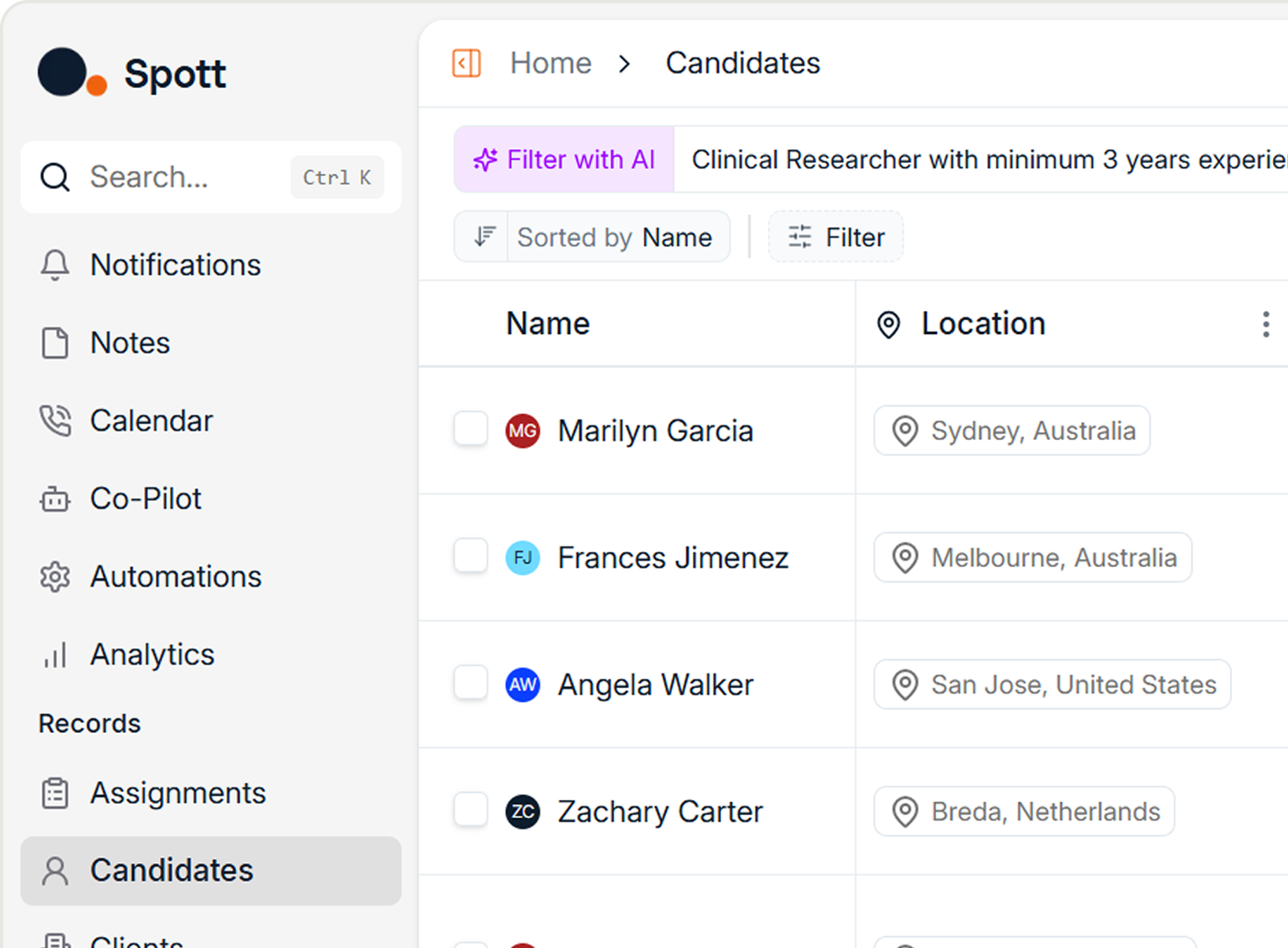
Outp(l)ace everyone.
You can’t win tomorrow’s placements
with yesterday’s tools.