Transforming Search: AI as a Competitive Advantage
AI can be a key advantage for modern search firms. It helps teams work faster, smarter, and with greater consistency. From finding and ranking candidates to managing data and workflows, AI can enhance every step of the recruitment process. This not only saves time but improves the quality of placements. In this post, we look at how AI gives search firms a powerful edge in a competitive market.
Speed: Accelerating the Recruitment Lifecycle
Time is a critical factor in recruitment, and AI is reshaping expectations around hiring timelines. Automated processes powered by intelligent algorithms can shorten hiring cycles, reducing the time to identify, evaluate, and onboard candidates.
Repetitive admin tasks that once consumed hours of human effort can now be automated. From initial candidate screening to preliminary interview scheduling, AI enables recruitment teams to focus on only the high-value interactions, that determine candidate fit and potential.
Moreover, this acceleration doesn't come at the cost of quality. AI can simultaneously process and evaluate multiple candidate profiles, ensuring that no potential good candidate goes unnoticed while reducing the time-to-hire metric that has long challenged recruitment firms. Often times, AI actually allows you to make a step change in your ATS data quality because of better consistency in tagging, automating updates and more.
Personalization at Scale: More than Traditional Matching
The one-size-fits-all approach to recruitment is becoming outdated. Modern AI technologies enable unprecedented levels of personalization in talent acquisition. Advanced AI tools can generate highly tailored candidate proposals that go beyond basic matching of skills and experience.
By analyzing complex datasets, AI can uncover nuanced connections between candidate profiles and organizational needs. This means identifying talent not just based on traditional metrics, but by understanding deeper potential, cultural alignment, and future growth trajectories.
The Ethical Landscape of AI Recruitment
While the potential of AI in recruitment is huge, it's crucial to approach these technologies with a commitment to fairness, transparency, and ethical considerations. The latest AI platforms are designed with built-in safeguards to minimize bias and ensure equitable evaluation of candidates.
This means creating algorithms that look beyond traditional demographic markers, focusing instead on skills, potential, and genuine fit. Ethical AI in recruitment is about augmenting human decision-making, not replacing the essential human elements of empathy, intuition, and complex judgment.
Enhanced Candidate Matching: Intelligence Beyond Keywords
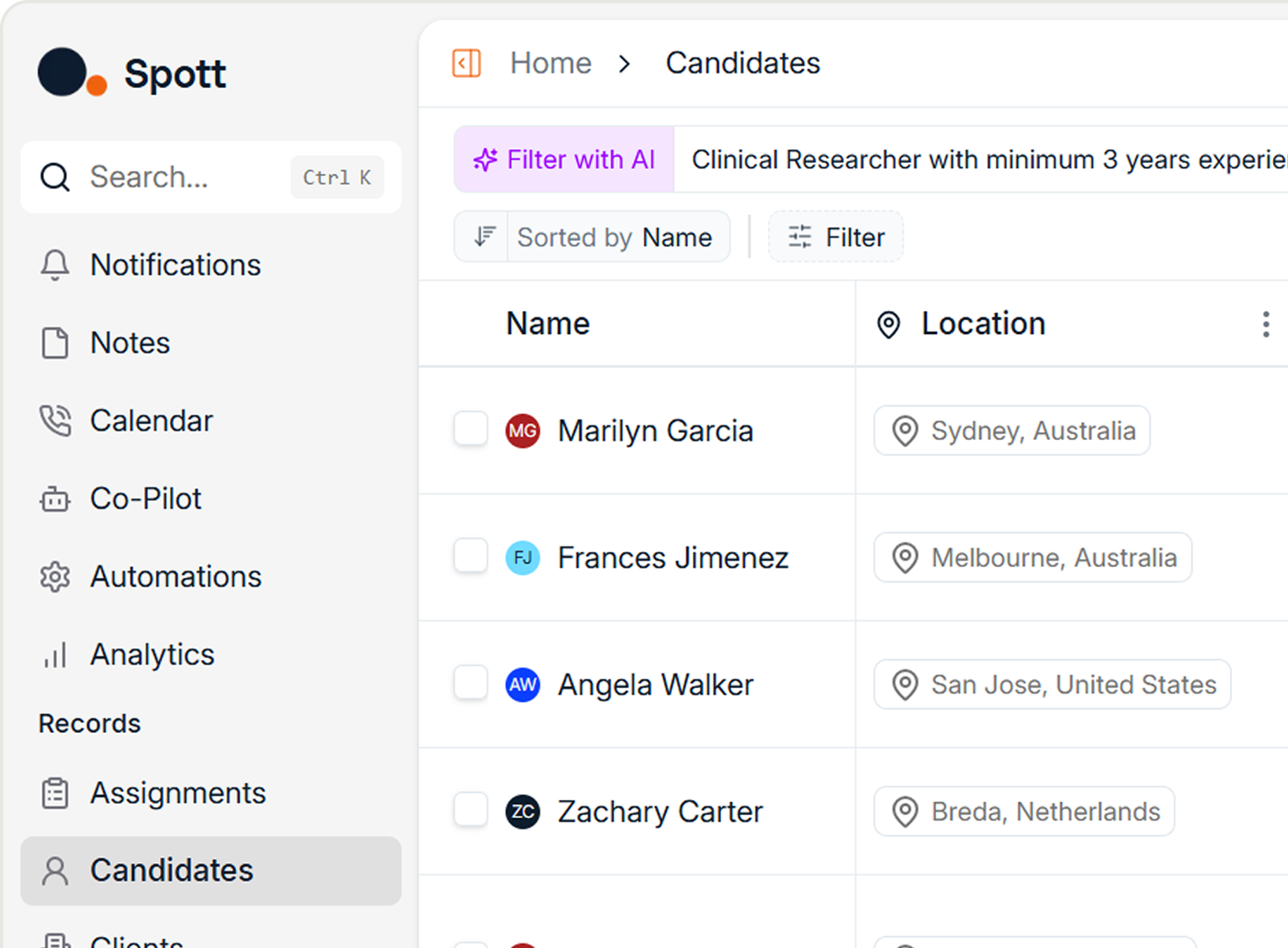
Traditional ATS systems relied on keyword matching, often missing the contextual elements that define candidate potential. AI-native platforms like Spott improve this by offering more advanced matching mechanisms.
These systems don’t just match text; they interpret context, assess soft skills, and explain candidate recommendations. This gives recruiters insights beyond surface-level qualifications, supporting more informed hiring decisions.
AI also goes beyond skill alignment by recognizing relationship networks, identifying transferable skills across industries, and predicting career trajectories that recruiters might miss.
Your Next Step in the AI-Powered Recruitment Revolution
The recruitment landscape is changing, and the organizations that adapt will lead. Spott represents the next generation of AI-native recruitment platforms, designed to transform how companies discover, evaluate, and engage with candidates and clients.
Ready to experience the future of recruitment? Our team is happy to demonstrate how Spott can revolutionize your talent acquisition strategy. Send us a message today and see firsthand how AI can become your most powerful recruitment ally.

Frequently Asked
AI creates competitive advantage across three dimensions: speed, personalization, and matching accuracy. Automated processes shorten hiring cycles by handling administrative tasks like candidate tagging and profile updates, freeing recruiters for high-value relationship building. AI-powered matching goes beyond keyword recognition to assess cultural alignment, growth potential, and transferable skills across industries. Firms using AI-native platforms gain compounding advantages as their data improves over time, making their candidate recommendations more precise with every placement.
AI-native platforms are architected from the ground up around AI, meaning every feature is designed to work with intelligent automation from day one. AI-powered tools, by contrast, bolt AI features onto existing legacy architectures, often resulting in disconnected capabilities and limited contextual understanding. The distinction matters because AI-native systems like Spott can interpret contextual elements across the entire recruitment workflow, from sourcing through placement, while retrofitted tools typically only automate isolated tasks like resume parsing or chatbot scheduling.
Advanced AI matching interprets contextual elements that define candidate potential rather than simply scanning for keyword hits. This includes assessing soft skills, recognizing professional network connections, identifying transferable skills across industries, and evaluating cultural alignment with the hiring organization. AI-native platforms generate tailored candidate proposals that consider growth trajectories and potential, not just past experience. The result is shortlists that surface non-obvious candidates who might be overlooked by traditional Boolean or keyword-based searches.
Ethical AI implementation requires built-in safeguards that minimize algorithmic bias and emphasize skills and fit over demographic markers. Responsible platforms provide explainable recommendations so recruiters understand why a candidate was surfaced, rather than relying on opaque scoring. AI should augment human judgment on complex decisions like cultural fit and negotiation rather than replace it entirely. Firms should choose AI-native platforms that prioritize transparency and allow recruiters to review, override, and refine AI suggestions as part of their standard workflow.


Outp(l)ace everyone.
You can’t win tomorrow’s placements
with yesterday’s tools.